


A new battle in an ongoing war between game console makers is expected to break out at a leading videogames conference that opens in Los Angeles tomorrow.
Typically a stage for new blockbuster titles, the Electronic Entertainment Expo (E3) this year will also be an arena where Sony, Microsoft and Nintendo duel with motion-sensing controls for rival PlayStation 3, Xbox 360 and Wii consoles.
“Motion controls are by far and away going to be the talk of the show,” said Scott Steinberg, head of videogame consulting firm TechSavvy Global.
Microsoft has planned a set of high-powered events to debut “Project Natal” technology that lets players control Xbox 360 consoles using natural gestures such as the wave of a hand.
Natal boasts facial recognition capabilities that enable consoles to distinguish between players.
“The big story of the year is going to be motion controls for Xbox 360,” Game Trailers editor-in-chief Shane Satterfield said.
“Nintendo sort of broke the mold for the videogame industry with Wii and everyone else has been trying to capture lightning in a bottle ever since,” he said.
At a game developers conference in San Francisco in March, Sony unveiled a hotly anticipated motion-sensing Move controller that it hopes will fuel new interest in its PlayStation 3 (PS3).
Movement wands that synch with eye cameras on the consoles will hit the market in time for the year-end holiday shopping season, as will Natal technology, which will be renamed before it heads for store shelves.
Sony, Microsoft and Nintendo are expected to reveal rich line-ups of videogames they hope will win players to their consoles and motion-control systems.
“It’s going to be a big battle between Sony and Microsoft,” Satterfield said. “On the heels of that, Nintendo has a big show planned. It is going to be tough to topple Nintendo.”
A shift to downloadable content will be among the trends on an E3 show floor renowned for action-packed trailers displayed on giant screens, demonstrations of coming titles and models dressed as popular game characters.
Videogame publishers use downloadable content to deliver gaming software as well as virtual items such as outfits or weapons to consoles via the Internet. Popular titles can be kept alive by selling new missions or sequels to original games bought on packaged disks at real-world stores.
Downloadable content has a dark side, tempting videogame makers to hold back on content in the original package so they can sell it to players later. Knowing that glitches can be fixed with patches available online can also result in premature releases of titles.
“[Downloadable content] has already been abused,” Satterfield said. “It’s a slippery slope for developers. Sadly, it looks like that is the direction it is going.”
Downloadable content also opens up opportunity for independent game makers to sell titles from Web sites and for games to be adapted in real time based on feedback from players, Steinberg said.
For example, Bethesda Softworks resurrected the main character of Fallout 3 who died at the end of the original title, but was brought back to continue the adventure.
E3 remains, at its heart, a showcase for top-shelf blockbuster videogames. Hot titles on the expo horizon include Rage and sequels to popular franchises including Halo, Call of Duty, Little Big Planet, Civilization, Fallout, Mafia, Mario, Fable and Portal.

CHIP RACE: Three years of overbroad export controls drove foreign competitors to pursue their own AI chips, and ‘cost US taxpayers billions of dollars,’ Nvidia said China has figured out the US strategy for allowing it to buy Nvidia Corp’s H200s and is rejecting the artificial intelligence (AI) chip in favor of domestically developed semiconductors, White House AI adviser David Sacks said, citing news reports. US President Donald Trump on Monday said that he would allow shipments of Nvidia’s H200 chips to China, part of an administration effort backed by Sacks to challenge Chinese tech champions such as Huawei Technologies Co (華為) by bringing US competition to their home market. On Friday, Sacks signaled that he was uncertain about whether that approach would work. “They’re rejecting our chips,” Sacks
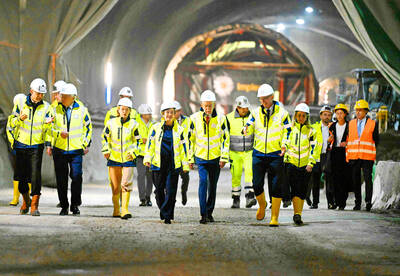
It is challenging to build infrastructure in much of Europe. Constrained budgets and polarized politics tend to undermine long-term projects, forcing officials to react to emergencies rather than plan for the future. Not in Austria. Today, the country is to officially open its Koralmbahn tunnel, the 5.9 billion euro (US$6.9 billion) centerpiece of a groundbreaking new railway that will eventually run from Poland’s Baltic coast to the Adriatic Sea, transforming travel within Austria and positioning the Alpine nation at the forefront of logistics in Europe. “It is Austria’s biggest socio-economic experiment in over a century,” said Eric Kirschner, an economist at Graz-based Joanneum

BUBBLE? Only a handful of companies are seeing rapid revenue growth and higher valuations, and it is not enough to call the AI trend a transformation, an analyst said Artificial intelligence (AI) is entering a more challenging phase next year as companies move beyond experimentation and begin demanding clear financial returns from a technology that has delivered big gains to only a small group of early adopters, PricewaterhouseCoopers (PwC) Taiwan said yesterday. Most organizations have been able to justify AI investments through cost recovery or modest efficiency gains, but few have achieved meaningful revenue growth or long-term competitive advantage, the consultancy said in its 2026 AI Business Predictions report. This growing performance gap is forcing executives to reconsider how AI is deployed across their organizations, it said. “Many companies
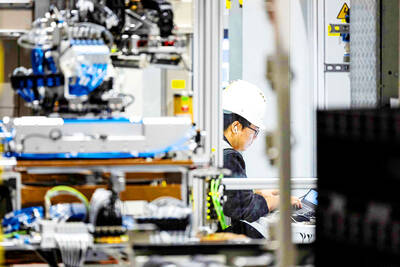
France is developing domestic production of electric vehicle (EV) batteries with an eye on industrial independence, but Asian experts are proving key in launching operations. In the Verkor factory outside the northern city of Dunkirk, which was inaugurated on Thursday, foreign specialists, notably from South Korea and Malaysia, are training the local staff. Verkor is the third battery gigafactory to open in northern France in a region that has become known as “Battery Valley.” At the Automotive Energy Supply Corp (AESC) factory near the city of Douai, where production has been under way for several months, Chinese engineers and technicians supervise French recruits. “They


 RSS
RSS