


MediaTek Inc (聯發科), the nation’s largest handset chipmaker, said yesterday fourth-quarter earnings more than tripled from a year ago amid recovering demand for consumer electronics.
Some analysts expressed disappointment, however, pointing to the sequential drop in quarterly earnings.
Last quarter, MediaTek earned NT$8.75 billion (US$273 million), a substantial rise from NT$2.88 billion a year ago. On a quarterly basis, however, earnings were down about 26 percent from a two-year high of NT$11.8 billion in the previous quarter because of slowing demand in China after the holiday shopping season in October.
Last quarter’s earnings were lower than the NT$9.3 billion and NT$9.4 billion estimated by Citigroup and Fubon Securities Investment Services Co (富邦投顧) respectively in the face of mounting pricing pressure.
Because of escalating competition, MediaTek’s gross margin is expected to fall further to between 56 percent and 57 percent this quarter, from 58.7 percent in the final quarter of last year, company president Hsieh Ching-jiang (謝清江) told investors yesterday.
“Pricing pressure for both new and old products is very heavy ... because of the large number of competitors,” Hsieh said.
MediaTek has to downwardly “adjust [its] average selling price to cope with market competition,” company financial executive Yu Mingto (喻銘鐸) said.
Fubon analyst Kenneth Lee (李克揚) said MediaTek’s first-quarter gross margin guidance was lower than his forecast of 58.1 percent for the first quarter.
Slower-than-expected expansion in demand for new chips — including those supporting China’s TDSCDMA and WCDMA 3G technologies — could be a major reason, Lee said.
Lee, however, remained positive on MediaTak, maintaining a “buy” rating on the stock with a target price of NT$700, implying a 39 percent upside over the next 12 months from the stock’s closing price of NT$505 yesterday.
“It would be foolhardy to sell the stock now,” Lee said, citing strong shipment forecasts for cellphone chips this year.
MediaTek said shipments of handset chips could grow 29 percent to 450 million units this year from 350 million last year, with new chips accounting for about 5 percent of the total.
MediaTek supplies handset chips mostly to Chinese mobile phone makers and some global brands such as Motorola Inc and LG Electronics.
The Hsinchu-based handset chipmaker expected revenues to hold steady or grow by 5 percent in the current quarter to NT$30.6 billion at the most, from last quarter’s NT$29.1 billion, with between 70 percent and 75 percent coming from mobile phone chips.
“Customers are placing orders aggressively ahead of the Lunar New Year [holiday shopping season]. In general, they are optimistic [about prospects],” Hsieh said.
For the full year, MediaTek nearly doubled its net income to NT$36.71 billion last year, from NT$19.19 billion in 2008.
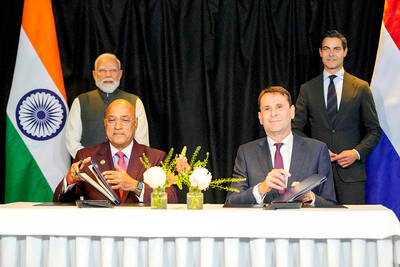
NEW MARKET: The partnership opens up India to the Dutch company, which already has a strong hold in the semiconductor market of South Korea, Taiwan and China ASML Holding NV entered into a partnership agreement with Tata Electronics Pvt Ltd aimed at ramping up India’s goal to develop domestic chip-manufacturing capabilities. The Dutch company’s technology would help power Tata Electronics’ planned 300 millimeter (mm) semiconductor foundry in Gujarat, according to a joint statement from the two companies on Saturday. The signing of a memorandum of understanding coincides with a visit by Indian Prime Minister Narendra Modi to the Netherlands, which is looking to deepen bilateral relations with New Delhi. ASML, whose top customers include Taiwan Semiconductor Manufacturing Co (台積電) and Samsung Electronics Co, makes lithography machines that can print
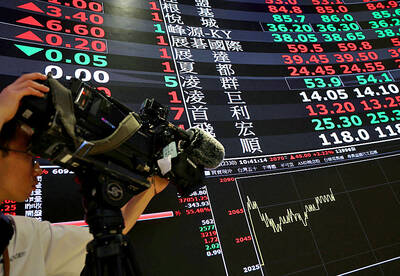
After several years flying high as Asia’s best Nvidia Corp proxy, Taiwan Semiconductor Manufacturing Co (TSMC, 台積電) is increasingly vying with other artificial intelligence (AI) stocks for investor attention. Stock traders are chasing a wider array of beneficiaries as mainstream usage of AI creates demand for hardware beyond the most-advanced chips TSMC makes for Nvidia. Subthemes from the deepening memory crunch to advances in robotics are also luring bids. At the same time, investment caps on single stocks are pushing funds to diversify, while retail investors long familiar with TSMC through its US depositary receipts are being offered a broader set of

TECH RELIANCE: Growth is increasingly reflecting an unequal K-shaped distribution, where technology sectors outperform and other industries struggle, an expert said Standard Chartered Bank has significantly raised its forecast for Taiwan’s economic growth to 9.5 percent this year, up from 7.6 percent previously, citing surging artificial intelligence (AI) demand driving exports, semiconductor production and investment. The upgrade reflects a sustained AI supercycle that continues to fuel demand for advanced chips and technology infrastructure, which form the backbone of Taiwan’s exports, the bank said in a report this week. “We raise our 2026 growth forecast to reflect a much stronger-than-expected first-quarter GDP figure,” Standard Chartered senior economist for greater China and Asia Tommy Wu (胡東安) said in the report. Driven largely by a 35.3 percent
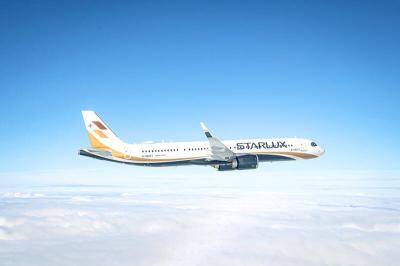
Two of Taiwan’s international carriers, Starlux Airlines Co (星宇航空) and EVA Airways Corp (長榮航空), have retained the five-star airline rating awarded by international airline review organization Skytrax. Starlux was awarded the distinction for a second consecutive year, while EVA Air received it for the 11th straight year, Skytrax said in statements released yesterday and on Thursday last week, respectively. The five-star rating is considered one of the airline industry's highest honors and is awarded following professional audits of airline product and frontline service standards, Skytrax said. The ratings are based on in-depth assessments using unified global quality standards rather than customer review scores


 RSS
RSS