


China Mobile Ltd (中國移動), the world’s biggest telecommunications operator by subscribers, and Taiwan’s HTC Corp (宏達電) signed a memorandum of understanding in Taoyuan yesterday to establish a long-term alliance in Time Division Synchronous Code Division Multiple Access (TD-SCDMA) research and development, associated product development and market research.
TD-SCDMA is the first patented third generation (3G) data-centric mobile technology developed by the People’s Republic of China (PRC) that is not dependent on Western technology.
China Mobile’s heavy TD-SCDMA promotion requires collaboration with many international cellphone makers to create mobile handsets catering to this new telcoms trend.
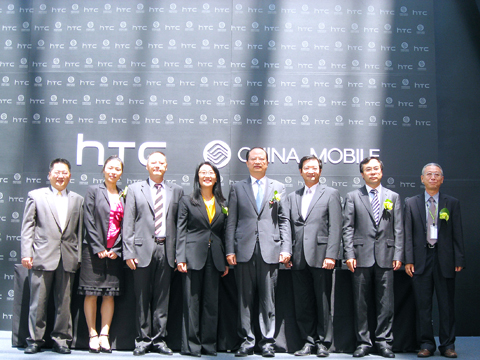
PHOTO: CNA
“As the world migrates from 2G to 3G technology, we aim to introduce more than 200 TD-SCDMA products for Chinese customers as opposed to the current 50 models out on the market. Also, countries such as Japan and [South] Korea have expressed interest to learn and adopt our mobile innovations,” China Mobile chairman and chief executive officer Wang Jianzhou (王建宙) said at the signing ceremony yesterday.
China Mobile’s other existing mobile vendor partners include Samsung Electronics Co, LG Electronics Inc, Lenovo Group Ltd(聯想), Huawei Technologies Co’s (華為科技) and ZTE Telecommunication Equipment Co (中興通訊), Wang told reporters. The company is also in talks with Nokia Corp.
The PRC operator intends to invest more than 47 million yuan (US$6.88 million) in its strategic alliance with HTC, and aside from its focus on TD-SCDMA, the two will also study the next Western mobile telecommunications technology, Long Term Evolution (LTE), to spread its bets on the future worldwide standard.
At the same event yesterday, HTC chairwoman Cher Wang (王雪紅) said she was enthusiastic about the TD-SCDMA technology and told media that “since 2008, HTC has already launched one TD-SCDMA phone in China, which met with much success.”
“We promise to offer China Mobile our best design and best quality TD-SCDMA mobile handsets. In fact, chairman Wang has already been to our creativity lab and seen the next cellphone to be launched later this year as well as two others scheduled for next year,” Cher Wang said.
“Our LTE technology development with China Mobile will primarily emphasize research, rather than commercialization. But our TD-SCDMA products will definitely incorporate the China Mobile user interface and its wide variety of widgets,” HTC chief executive officer Peter Chou (周永明) said.
So far, China Mobile has sold more than 1 million 3G phones. Chairman Wang said that in order for TD-SCDMA phones to become mainstream in China, they would have to become more affordable, settling in the 1,000 yuan price range, as it gains new subscribers, and existing customers retire their old cellphones to embrace newer technology.


Taiwan’s foreign exchange reserves fell below the US$600 billion mark at the end of last month, with the central bank reporting a total of US$596.89 billion — a decline of US$8.6 billion from February — ending a three-month streak of increases. The central bank attributed the drop to a combination of factors such as outflows by foreign institutional investors, currency fluctuations and its own market interventions. “The large-scale outflows disrupted the balance of supply and demand in the foreign exchange market, prompting the central bank to intervene repeatedly by selling US dollars to stabilize the local currency,” Department of Foreign

Intel Corp is joining Elon Musk’s long-shot effort to develop semiconductors for Tesla Inc, Space Exploration Technologies Corp and xAI, marking a surprising twist in the chipmaker’s comeback bid. Intel would help the Terafab project “refactor” the technology in a chip factory, the company said on Tuesday in a post on X, Musk’s social media platform. That is a stage in the development process that typically helps make chips more powerful or reliable. The chipmaker’s shares jumped 4.2 percent to US$52.91 in New York trading on Tuesday. The Terafab project is a grand plan by Musk to eventually manufacture his own chips for
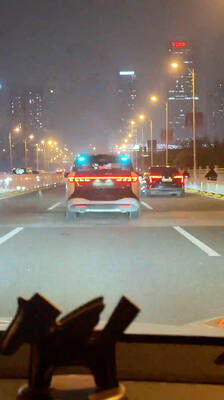
Some robotaxi passengers were left stranded in the middle of fast-moving traffic in a major Chinese city after their driverless vehicles stopped running, according to police and media reports on Wednesday. A preliminary investigation indicates more than 100 robotaxis came to a halt because of a “system malfunction,” police in the city of Wuhan said in a statement, without elaborating. No injuries were reported. One passenger told Chinese media that their robotaxi stopped after turning a corner. An instruction on a screen read: “Driving system malfunction. Staff are expected to arrive in 5 minutes.” After no one showed up, the passenger pushed

Taiwan Power Co (Taipower, 台電) yesterday said it plans to resume operations at two coal-fired power generators for three months to boost security of electricity supply as liquefied natural gas (LNG) supply risks are running high due to the Middle East conflict. The two coal-fired power generators are at Mailiao Power Plant in Yunlin County’s Mailiao Township (麥寮). The plant, operated by Formosa Plastics Group (台塑集團), supplied electricity to Taipower’s power grid until the end of last year. Taipower’s decision came about one month after Minister of Economic Affairs Kung Ming-hsin (龔明鑫) on March 10 said that the nation had no imminent


 RSS
RSS