


Taipei Times (TT): What is the current trend for Scotch whisky in Asia and worldwide?
Allen: While some regions were growing, other regions were declining, so the general environment was flat for many years in Scotch whisky. Over the last two or three years, what is being defined by the Scotch Whisky Association (SWA) as a renaissance in Scotch whisky is happening. So Scotch whisky is back in growth, and that is great news for the industry and for Diageo.
It really does show the results of a continuous investment by the industry and by the big brands in the future of this category. And it’s growing for a variety of reasons. First of all, in some of the more mature regions like North America and Europe, business performances have improved.
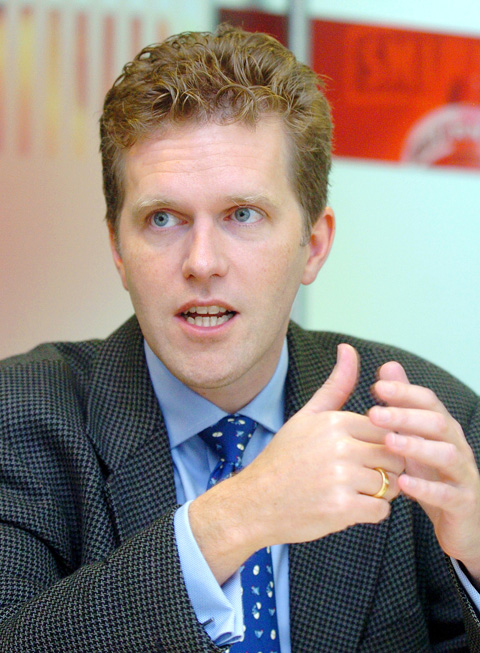
PHOTO: LIAO CHEN-HUI, TAIPEI TIMES
So Europe is back to flat from having declined and North America is back to growth. And those are very mature and valuable markets, where a lot of Scotch whisky brands and Diageo brands are present in the market.
TT: Are these two the biggest markets for Diageo?
Allen: North America is the biggest market. And then what’s happened in Asia and Latin America is that growth in some of the markets within those regions has accelerated. So we’ve seen amazing growth in China, Russia, Brazil and Mexico, and India is one of the untouched opportunities for this industry.
Obviously, at the same time, we are seeing different consumer trends. I think now there is a return in terms of a trend towards products that offer genuine authenticity and quality. So consumers are prepared to pay premium prices for products as long as they are reassured that they are high quality.
The other trend that is really helping at the moment is the fact that consumers want to believe these products are being made by real people from real places. So a lot of brands and products out there in old categories are quite faceless — the perception is that they are being produced by big corporations and factories. But the beauty of Scotch whisky is you can trace the origins right back to individual distilleries and communities.
So it’s a combination of consumer trends, macroeconomic trends, and general states of market development in Scotch that is fueling this growth.
You may have read in newspaper reports that we are building a brand new distillery up in Scotland, called Roseisle distillery. It will be the largest single malt distillery ever built in Scotland. It will open in March, April of next year and it will secure the future for Diageo in Scotch whisky for many years to come.
That level of commitment in terms of investing in a new distillery, I think it’s a clear sign that Diageo believes long-term in this category.
TT: How does this new distillery differ from the previous ones?
Allen: It’s a lot bigger. In terms of output, our largest single malt distillery today produces about 6 million liters of alcohol a year. Roseisle distillery will produce about 10 million liters of alcohol. It’s almost twice the size of our largest distillery at the moment. The other difference about Roseisle is that in the past, these distilleries have grown up in communities and buildings where people have to fit things in. The Roseisle design is in one long line, from the input of raw materials to the output of whisky at the other end. It’s more efficient.
TT: How is Diageo’s sales performance in Taiwan this year? Has it been affected by slowing domestic consumer spending?
Allen: Taiwan is not immune to the macroeconomic climate that is happening all over the world, of course. The market is down and it is down for the total industry. Diageo’s share within that market is holding up because we have leading brands, like Johnnie Walker and some of the best malt whisky brands in the world. So we are performing well within a declining market.
What we are seeing here is a reflection of what we see to varying degrees in other parts of the world. So some consumption is switching from bars and restaurants into the home. But what is staying the same largely is people’s desire and appetite for premium brands. What we are finding is that people are not abandoning our brands, because they are still very affordable within the overall context of the economy. But what we are seeing is that people may be choosing to drink these brands with their friends at home, rather than going out. So their consumption is still there, it’s just changing location.
TT: What are the regions or countries where Diageo’s sales have been most impacted by the global economic slowdown?
Allen: I’d say at the moment in Europe, we have a business that is very mature. We have consumers that are less loyal to our brands than consumers in Asia.
What we are finding in Diageo, if we think beyond Scotch, we are seeing consumers switching categories. If a consumer feels he or she can no longer afford to drink a premium Scotch whisky, what we may find is they will switch to a premium tequila or vodka. What we find is that people trade across rather than trading down, because people don’t want to feel that they are drinking a cheaper Scotch whisky if they’ve been drinking Johnnie Walker Black Label for many years.
TT: What about the North American market?
Allen: The Scotch whisky category in North America, as a result of all the trends I mentioned earlier, that market has been coming back. I think we are going to see some switching between categories in North America, but our North American business is very robust.
Overall, our business is in good shape. If we were to dive into individual categories, we’d see that within whisky, the top end of whisky is doing very well because these luxury consumers are people who will always have disposable income.
In the mid segment, where people may have recently started drinking Johnnie Walker Black Label and suddenly they are feeling the pinch in the current economic downturn. They are the ones who are most likely to trade across into a different category. So again, if we may have some declines in Scotch whisky, we will see increases in vodka or Baileys. So the net effect for Diageo is that North America is still our No. 1 and most valuable market. And it’s the market where we are investing heavily.
TT: Is Asia more resilient to the crisis than others?
Allen: I think we’ll see, but there are certain consumer dynamics in Asia as there are in Latin America that can give us confidence. A lot of the growth in Asia has been driven by the economic success, the emerging middle classes and higher disposable incomes.
And typically what we see in those environments is that people want to demonstrate their growing social standing and success. What better way to demonstrate success than going out to a restaurant or bar, buying a bottle of Singleton or Johnnie Walker, having it on the table, because it serves as a beacon, if you like. Other people in the bar will look at people at that table enjoying a high quality bottle of Scotch and that says a lot about you.
And that consumer dynamic is more prevalent in emerging markets than in mature markets, where people now are expressing their status in different ways. So that gives me more confidence that Asia will be more resilient.
TT: Will Diageo cut its marketing spending, reduce staff or pay to help save costs?
Allen: I can’t comment on individual aspects of that. I think what we’ll see in the brand agenda is we’ll see more focus spent against activities and plans that we know work. For example, the Johnnie Walker brand, which is our lead whisky brand, we’ll see a lot more focus on the growth of Johnnie Walker Blue Label, that’s our premier brand within the Johnnie Walker lineup.
We know what motivates consumers around the world. We spent a lot of money to understand consumers. And we’re doing that continuously, and that won’t stop.
Even in these recession environments, we have to keep our fingers on the pulse of our consumers. We have to know what they’re thinking, what their motivations are, and we’ll deploy our activities in a more focused manner in these periods against the things that we know work, which will maintain our market share, which will prepare us when things get better.
TT: Does Diageo see the turmoil as an opportunity to expand?
Allen: Scotch whisky is a long-term business. We’re forecasting way into the future. The past is a good indicator of what may happen in the future, so is the global economy and individual market GDP growth. But we don’t know, we can only speculate. So we are taking decisions right now about how the Scotch whisky industry may look like in 20 to 25 years.
The conclusion we’ve come to is that in order to supply that opportunity we see, we need to build new capacity. I remember reading the reports in the newspapers when we made this announcement about Roseisle, there was a lot of speculations about whether this is the right thing to do.
We believe we got it right. But what we can’t do is arrive in 20 and 25 years, and sit back and say, we wish we had some more whisky. There is a saying in English: You have to speculate to accumulate. We are speculating based on some good evidence in our belief that we will need certain amounts of Scotch whisky in 20 to 25 years and beyond.
To ensure we can supply that demand that we anticipate, we have to put a new capacity. Interestingly, since Diageo announced its building this new distillery, most of the other industry players have done things or announced things about how they are also increasing their capacity.
So the outlook is positive, the outlook is being driven by what we are seeing in these big emerging markets and some fairly robust assumptions about growth rates.
And this industry doesn’t have to grow by much to get bigger. The current Scotch whisky industry’s business may be 80 million cases a year, Diageo has just under 40 [percent] to 42 percent of that globally. That’s a big business. You only have to grow a couple of points a year off that base and you have a big business on your hands.
(Warning: Excessive consumption of alcohol can damage your health.)

CHIP RACE: Three years of overbroad export controls drove foreign competitors to pursue their own AI chips, and ‘cost US taxpayers billions of dollars,’ Nvidia said China has figured out the US strategy for allowing it to buy Nvidia Corp’s H200s and is rejecting the artificial intelligence (AI) chip in favor of domestically developed semiconductors, White House AI adviser David Sacks said, citing news reports. US President Donald Trump on Monday said that he would allow shipments of Nvidia’s H200 chips to China, part of an administration effort backed by Sacks to challenge Chinese tech champions such as Huawei Technologies Co (華為) by bringing US competition to their home market. On Friday, Sacks signaled that he was uncertain about whether that approach would work. “They’re rejecting our chips,” Sacks

NATIONAL SECURITY: Intel’s testing of ACM tools despite US government control ‘highlights egregious gaps in US technology protection policies,’ a former official said Chipmaker Intel Corp has tested chipmaking tools this year from a toolmaker with deep roots in China and two overseas units that were targeted by US sanctions, according to two sources with direct knowledge of the matter. Intel, which fended off calls for its CEO’s resignation from US President Donald Trump in August over his alleged ties to China, got the tools from ACM Research Inc, a Fremont, California-based producer of chipmaking equipment. Two of ACM’s units, based in Shanghai and South Korea, were among a number of firms barred last year from receiving US technology over claims they have

It is challenging to build infrastructure in much of Europe. Constrained budgets and polarized politics tend to undermine long-term projects, forcing officials to react to emergencies rather than plan for the future. Not in Austria. Today, the country is to officially open its Koralmbahn tunnel, the 5.9 billion euro (US$6.9 billion) centerpiece of a groundbreaking new railway that will eventually run from Poland’s Baltic coast to the Adriatic Sea, transforming travel within Austria and positioning the Alpine nation at the forefront of logistics in Europe. “It is Austria’s biggest socio-economic experiment in over a century,” said Eric Kirschner, an economist at Graz-based Joanneum

OPTION: Uber said it could provide higher pay for batch trips, if incentives for batching is not removed entirely, as the latter would force it to pass on the costs to consumers Uber Technologies Inc yesterday warned that proposed restrictions on batching orders and minimum wages could prompt a NT$20 delivery fee increase in Taiwan, as lower efficiency would drive up costs. Uber CEO Dara Khosrowshahi made the remarks yesterday during his visit to Taiwan. He is on a multileg trip to the region, which includes stops in South Korea and Japan. His visit coincided the release last month of the Ministry of Labor’s draft bill on the delivery sector, which aims to safeguard delivery workers’ rights and improve their welfare. The ministry set the minimum pay for local food delivery drivers at


 RSS
RSS