


The profitability of publicly traded companies in Taiwan plunged by 26.23 percent year-on-year in the first three quarters of this year, led by shipping and semiconductor firms hurt by higher crude oil prices and a slowing global economy, the Securities and Futures Bureau (SFB) said in a statement released on Thursday.
The SFB statistics included listed companies on the Taiwan Stock Exchange (TWSE) and those that trade on the over-the-counter GRETAI Securities Market.
Based on the bureau’s data, aggregate sales of TWSE-listed firms from January to September increased by NT$982.9 billion (US$29.95 billion), or 9.78 percent, from a year earlier. However, cumulative pre-tax profit declined by NT$241.5 billion, or 20.73 percent, during the same period, the bureau said.
Add in GRETAI-traded companies, whose before-tax income dropped by NT$85.5 billion, and the profitability of all publicly traded companies fell by NT$327 billion, or 26.23 percent, from a year earlier, the bureau’s data showed.
As of Sept. 30, the benchmark TAIEX had dropped 32.8 percent from Jan. 1, the TWSE’s data showed.
The figures also showed that among the top 20 companies who led the decline in profitability, the majority were from the semiconductor and shipping sectors.
But in terms of the scale of the decline, the shipping and finance/insurance sectors posted the largest annual falls at 82.72 percent and 80.64 percent respectively. There was also a noticeable profitability decline in the auto sector, which registered a fall of 60.03 percent, the bureau said.
Aside from higher crude costs and a gloomy economic climate, profitability was affected by a new measure requiring companies to book employee stock bonuses as an expense and to book impairment losses on financial assets in the face of the global credit crisis, the bureau said.
Bonus expense and asset impairment losses totaled NT$106.19 billion in the first nine months of the year, accounting for 43.97 percent of the total decline of NT$241.5 billion in pre-tax income for listed companies.
ADDITIONAL REPORTING BY STAFF WRITER
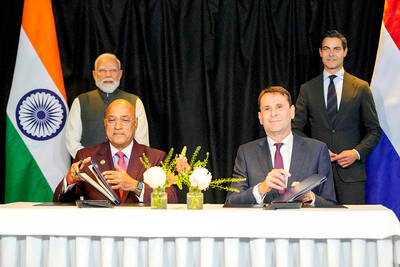
NEW MARKET: The partnership opens up India to the Dutch company, which already has a strong hold in the semiconductor market of South Korea, Taiwan and China ASML Holding NV entered into a partnership agreement with Tata Electronics Pvt Ltd aimed at ramping up India’s goal to develop domestic chip-manufacturing capabilities. The Dutch company’s technology would help power Tata Electronics’ planned 300 millimeter (mm) semiconductor foundry in Gujarat, according to a joint statement from the two companies on Saturday. The signing of a memorandum of understanding coincides with a visit by Indian Prime Minister Narendra Modi to the Netherlands, which is looking to deepen bilateral relations with New Delhi. ASML, whose top customers include Taiwan Semiconductor Manufacturing Co (台積電) and Samsung Electronics Co, makes lithography machines that can print

TECH RELIANCE: Growth is increasingly reflecting an unequal K-shaped distribution, where technology sectors outperform and other industries struggle, an expert said Standard Chartered Bank has significantly raised its forecast for Taiwan’s economic growth to 9.5 percent this year, up from 7.6 percent previously, citing surging artificial intelligence (AI) demand driving exports, semiconductor production and investment. The upgrade reflects a sustained AI supercycle that continues to fuel demand for advanced chips and technology infrastructure, which form the backbone of Taiwan’s exports, the bank said in a report this week. “We raise our 2026 growth forecast to reflect a much stronger-than-expected first-quarter GDP figure,” Standard Chartered senior economist for greater China and Asia Tommy Wu (胡東安) said in the report. Driven largely by a 35.3 percent

Tokyo Electron's Taiwan unit today said in a written response that it respects the judicial process, takes the court ruling seriously and would not appeal in the Taiwan Semiconductor Manufacturing Co (TSMC, 台積電) trade secrets case. Last month, a court fined the Taiwan unit of Japan's Tokyo Electron NT$150 million (US$4.74 million) in a case involving trade secrets related to TSMC's sensitive chip technology.
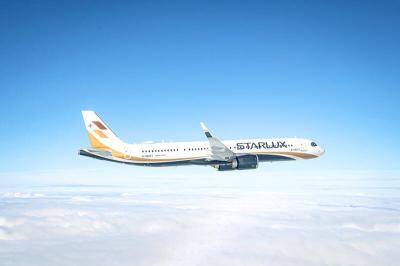
Two of Taiwan’s international carriers, Starlux Airlines Co (星宇航空) and EVA Airways Corp (長榮航空), have retained the five-star airline rating awarded by international airline review organization Skytrax. Starlux was awarded the distinction for a second consecutive year, while EVA Air received it for the 11th straight year, Skytrax said in statements released yesterday and on Thursday last week, respectively. The five-star rating is considered one of the airline industry's highest honors and is awarded following professional audits of airline product and frontline service standards, Skytrax said. The ratings are based on in-depth assessments using unified global quality standards rather than customer review scores


 RSS
RSS