


The Chinese-language China Times (中國時報) newspaper will reduce its number of pages and lay off part of its work force by the middle of next month in a bid to streamline its organization, a company official said yesterday.
“The media environment in Taiwan has become over-competitive over the past few years. In addition, the economic slowdown and our huge drop in advertising revenue have made it very difficult for the China Times to maintain our current operations,” China Times president Lin Sheng-fen (林聖芬) told reporters in front of the company’s headquarters in Taipei yesterday.
Despite an increase in the number of media outlets, the nation’s advertising revenue has dropped from NT$100 billion (US$3.3 billion) in 1990 to NT$50 billion in 2006, Lin said.
He attributed the difficult operational environment to the soaring price of paper stock, which has surged nearly 50 percent from US$600 per metric tonne last year to US$900.
A company employee who wished to remain anonymous told the Taipei Times earlier yesterday that the China Times planned to downsize from its current 52 pages to 40 pages by Sept. 1, and lay off half of its employees, which would amount to about 600 people, before the end of August.
Lin said he could not provide the actual figure for layoffs, but that the company would announce more concrete plans by the middle of next month.
“There is a very tough road ahead for traditional news media like newspapers,” Chou Sheng-yuan (周盛淵), publisher of the China Times, said in an e-mailed letter to employees yesterday.

SECOND-RATE: Models distilled from US products do not perform the same as the original and undo measures that ensure the systems are neutral, the US’ cable said The US Department of State has ordered a global push to bring attention to what it said are widespread efforts by Chinese companies, including artificial intelligence (AI) start-up DeepSeek (深度求索), to steal intellectual property from US AI labs, according to a diplomatic cable. The cable, dated Friday and sent to diplomatic and consular posts around the world, instructs diplomatic staff to speak to their foreign counterparts about “concerns over adversaries’ extraction and distillation of US AI models.” Distillation is the process of training smaller AI models using output from larger, more expensive ones to lower the costs of training a powerful new

Shares of Taiwan Semiconductor Manufacturing Co (TSMC, 台積電) have repeatedly hit new highs, but an equity analyst said the stock’s valuation remains within a reasonable range and any pullback would likely be technical. The contract chipmaker’s historical price-to-earnings (P/E) ratio has ranged between 20 and 30, Cathay Futures Consultant Co (國泰證期) analyst Tsai Ming-han (蔡明翰) told Central News Agency. With market consensus projecting that TSMC would post earnings per share of about NT$100 (US$3.17) this year, supported by strong global demand for artificial intelligence (AI) applications, and the stock currently trading at a P/E ratio of below 25, Tsai said the valuation
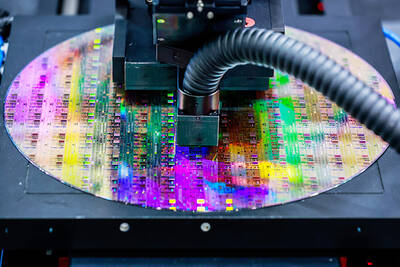
The artificial intelligence (AI) boom has triggered a seismic reshuffling of global equity markets, with Taiwan and South Korea muscling past European nations one by one. With its stock market now valued at nearly US$4.3 trillion, Taiwan surpassed the UK, Europe’s biggest market, earlier this month, data compiled by Bloomberg showed. South Korea is about US$140 billion away from doing the same. The tech-heavy Asian markets have shot past Germany and France in the past seven months. The shift is largely down to massive gains in shares of three companies that provide essential hardware for AI: Taiwan Semiconductor Manufacturing Co (TSMC, 台積電),

NEXT-GENERATION: The company announced plans to roll out platforms with 100 TOPS performance and expects AI-capable systems to become the standard Industrial computer maker Advantech Co (研華) is eyeing strong growth potential in edge artificial intelligence (AI), as the technology shifts from cloud-centric computing to edge deployment and real-world applications, Advantech embedded Internet of Things president Miller Chang (張家豪) said on Thursday last week. Amid rising demand for inference as the industry shifts from training, edge AI is emerging as a key field, given the need for low latency, real-time response and data privacy, Chang said in an exclusive interview with the Taipei Times. While consumer devices such as smartphones already feature some AI capabilities, large-scale inference demand would mainly come from applications


 RSS
RSS