


Asian stocks powered higher yesterday after a surprise increase in US retail sales and unexpectedly strong growth in Japan's economy eased some of the pessimism that has gripped the region.
The US dollar held around a one-month high against the yen, while Asian bonds slid as investors became less risk averse.
Platinum hit a record high as power supply problems afflict major producer South Africa, while oil prices climbed amid an intensifying legal row between Venezuela and ExxonMobil.
"Buoyant US economic data combined with a perception that markets have seen lows are prompting buying interest," said Hwang Geum-dan, an analyst at Samsung Securities.
The rise in US retail sales last month lifted hopes that Asia's top export market might yet skirt recession, and buoyed exporter shares such as LG Electronics that depend on US consumers to drive profits.
MSCI's measure of Asian stocks outside Japan rose 1.7 percent. The index had dropped more than 13 percent this year as of Wednesday as fears of a US recession and a financial sector reeling from a global credit crisis had soured many on Asian stocks.
Investors also welcomed data showing Japan's economy grew 0.9 percent in the last of quarter of last year, double the market forecast, with external demand and capital spending particularly strong.
"There's no question that these figures, which were much better than expected, seem to point to good growth in the present quarter as well," said Masayoshi Okamoto, head of dealing at Jujiya Securities.
The Nikkei benchmark stock average was up 3.1 percent, with exporters such as Sony Corp also lifted by a weakening Japanese yen.
Shares in exporters also helped South Korea's main index gain 2.6 percent, Singapore stocks rose 2.4 percent, while Australian shares gained 2.2 percent, spurred by gains in miners and banks.
Australia's jobless rate in January fell to the lowest in the history of the series, though that added to concerns that a tight labor market was fuelling inflation and underlining the need for yet another rise in interest rates.
Asian bonds dropped as investors became more comfortable shifting away from safe positions.
Japanese government bond futures fell nearly half a point on the back of the stronger-than-expected economic data, with March 10-year JGB futures down 0.18 point at 137.76.
Australian bonds also fell as the market priced in a greater chance of another rise in the 7 percent cash rate on the back of inflationary pressures.
The yen held steady against the dollar after the US currency jumped on Wednesday's retail sales data.
In early Asian trade, spot platinum hit US$1,995 an ounce, before slipping to US$1,980/US$1,990.
US crude oil futures edged up a few cents to US$93.36 a barrel. Venezuela and Exxon Mobile have been mired in a legal dispute over the South American country's takeover of a multibillion-dollar oil project.
Mizuho Financial Group Inc climbed for the first time in seven days after Japanese gross domestic product expanded at the quickest pace in three quarters. Samsung Electronics Co and Toyota Motor Corp led companies that rely on US revenue higher. Rio Tinto Group jumped after reporting higher profit.
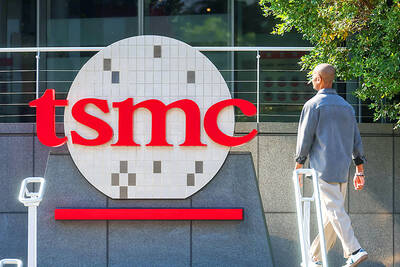
Shares of contract chipmaker Taiwan Semiconductor Manufacturing Co (TSMC, 台積電) came under pressure yesterday after a report that Apple Inc is looking to shift some orders from the Taiwanese company to Intel Corp. TSMC shares fell NT$55, or 2.4 percent, to close at NT$2,235 on the local main board, Taiwan Stock Exchange data showed. Despite the losses, TSMC is expected to continue to benefit from sound fundamentals, as it maintains a lead over its peers in high-end process development, analysts said. “The selling was a knee-jerk reaction to an Intel-Apple report over the weekend,” Mega International Investment Services Corp (兆豐國際投顧) analyst Alex Huang
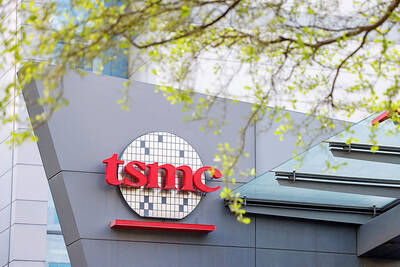
Taiwan Semiconductor Manufacturing Co (TSMC, 台積電) is expected to remain Apple Inc’s primary chip manufacturing partner despite reports that Apple could shift some orders to Intel Corp, industry experts said yesterday. The comments came after The Wall Street Journal reported on Friday that Apple and Intel had reached a preliminary agreement following more than a year of negotiations for Intel to manufacture some chips for Apple devices. Taiwan Institute of Economic Research (台灣經濟研究院) economist Arisa Liu (劉佩真) said TSMC’s advanced packaging technologies, including integrated fan-out and chip-on-wafer-on-substrate, remain critical to the performance of Apple’s A-series and M-series chips. She said Intel and Samsung
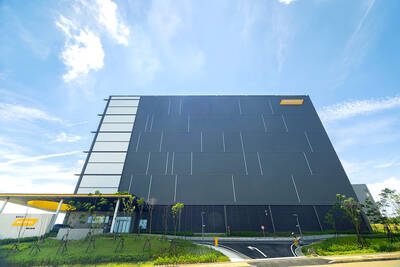
POWER BUILDUP: Powered by Nvidia’s B200 Blackwell chips, the data center would support MediaTek’s computing power demand and business growth, the company said Smartphone chip designer MediaTek Inc (聯發科) yesterday launched a new artificial intelligence (AI) data center with a maximum capacity of 45 megawatts to meet its rising demand for computing power required to develop new advanced chips for AI applications. The company has completed the first-phase computing power buildup at the data center in Miaoli County’s Tongluo Township (銅鑼), providing 15 megawatts of capacity to support its research and development (R&D) capabilities, despite an industrywide shortage of key components, MediaTek said. Supply constraints have plagued a wide range of key components, including memory chips, solid-state drives, power supply units and central
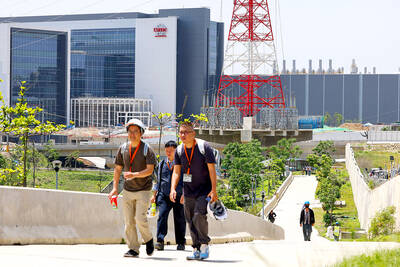
IMAGE SENSORS: The Japanese company would be the controlling shareholder of the venture, with development and production lines to be set up in Kumamoto Taiwan Semiconductor Manufacturing Co (TSMC, 台積電) yesterday said it has signed a non-binding memorandum of understanding (MOU) with Sony Semiconductor Solutions Corp to create a joint venture to develop and produce next-generation images sensors. The partnership seeks to explore and address emerging opportunities in physical artificial intelligence (AI) applications, such as automotive and robotics, paving the way for innovations and expanded technological advancements, TSMC said in a statement. Sony would be the majority and controlling shareholder of the joint venture, the statement said, adding that the company would set up development and production lines in its newly constructed fab in Kumamoto Prefecture’s


 RSS
RSS