


National Science Council (NSC) Chairman Chen Chien-jen (
A recent report by the Industrial Technology Research Institute (
PRODUCTION
Chen said gallium arsenide and indium arsenide are used in the manufacturing of some semiconductor devices, such as microwave integrated circuits as well as in optoelectronics.
Factories in the park, however, may not be the only source of the arsenic, Chen said.
He said that the burning of waste as well as emissions from iron and steel refineries may also be contributing to the high concentrations of airborne arsenic compounds.
Wind direction should also be taken into account, Chen said, and whether the high arsenic readings are constant, "chronic" or short-term should also be considered.
EXTREMELY HIGH
Kao Cheng-chung, professor at National Chiao Tung University, said that the reading of 120 nanograms per cubic meter was extremely high -- and rarely seen elsewhere in the world.
Kao quoted US Federal Environmental Protection Agency statistics showing that people who are repeatedly exposed to arsenic have elevated risks of cancer, especially lung cancer.
Ling Yung-chien (凌永健), a professor at National Tsinghua University, said it was imperative that the NSC and the Environmental Protection Administration conduct a comprehensive monitoring survey of the park's environment and a large-scale examination of nearby residents for arsenic exposure to determine the extent of the problem.

Shiina Ito has had fewer Chinese customers at her Tokyo jewelry shop since Beijing issued a travel warning in the wake of a diplomatic spat, but she said she was not concerned. A souring of Tokyo-Beijing relations this month, following remarks by Japanese Prime Minister Sanae Takaichi about Taiwan, has fueled concerns about the impact on the ritzy boutiques, noodle joints and hotels where holidaymakers spend their cash. However, businesses in Tokyo largely shrugged off any anxiety. “Since there are fewer Chinese customers, it’s become a bit easier for Japanese shoppers to visit, so our sales haven’t really dropped,” Ito
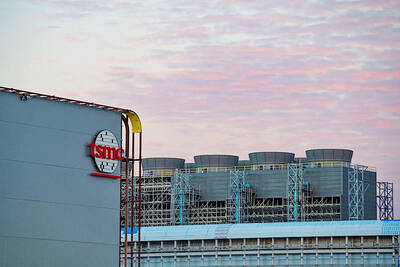
The number of Taiwanese working in the US rose to a record high of 137,000 last year, driven largely by Taiwan Semiconductor Manufacturing Co’s (TSMC, 台積電) rapid overseas expansion, according to government data released yesterday. A total of 666,000 Taiwanese nationals were employed abroad last year, an increase of 45,000 from 2023 and the highest level since the COVID-19 pandemic, data from the Directorate-General of Budget, Accounting and Statistics (DGBAS) showed. Overseas employment had steadily increased between 2009 and 2019, peaking at 739,000, before plunging to 319,000 in 2021 amid US-China trade tensions, global supply chain shifts, reshoring by Taiwanese companies and
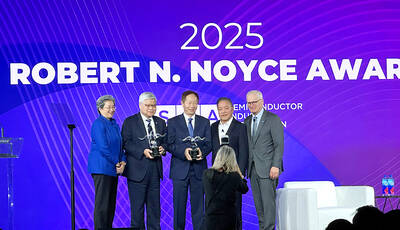
Taiwan Semiconductor Manufacturing Co (TSMC) Chairman C.C. Wei (魏哲家) and the company’s former chairman, Mark Liu (劉德音), both received the Robert N. Noyce Award -- the semiconductor industry’s highest honor -- in San Jose, California, on Thursday (local time). Speaking at the award event, Liu, who retired last year, expressed gratitude to his wife, his dissertation advisor at the University of California, Berkeley, his supervisors at AT&T Bell Laboratories -- where he worked on optical fiber communication systems before joining TSMC, TSMC partners, and industry colleagues. Liu said that working alongside TSMC
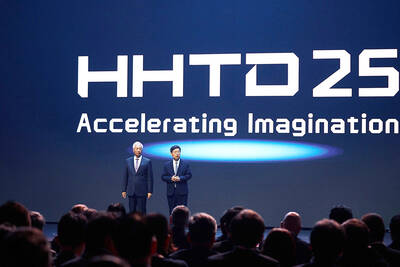
TECHNOLOGY DAY: The Taiwanese firm is also setting up a joint venture with Alphabet Inc on robots and plans to establish a firm in Japan to produce Model A EVs Manufacturing giant Hon Hai Precision Industry Co (鴻海精密) yesterday announced a collaboration with ChatGPT developer OpenAI to build next-generation artificial intelligence (AI) infrastructure and strengthen its local supply chain in the US to accelerate the deployment of advanced AI systems. Building such an infrastructure in the US is crucial for strengthening local supply chains and supporting the US in maintaining its leading position in the AI domain, Hon Hai said in a statement. Through the collaboration, OpenAI would share its insights into emerging hardware needs in the AI industry with Hon Hai to support the company’s design and development work, as well


 RSS
RSS