


Japanese semiconductor maker Elpida Memory Inc plans mass production of 65-nanometer DRAMs by March next year, becoming the first in the business to do so, a report said yesterday.
The 65nm DRAMs have narrower circuit widths and smaller surface areas than conventional 70nm versions, helping to boost productivity and lower costs by 30 percent, the Nikkei newspaper reported, without citing sources.
Once mass production starts at its Hiroshima plant in western Japan, Elpida will introduce the technology at Taiwan-based Rexchip Electronics Corp (瑞晶), a joint venture between Elpida and Powerchip Semiconductor Corp (力晶半導體), the Nikkei said.
Capital spending is likely to be kept down because only some equipment will require upgrades to be compatible with the state-of-the-art technology, it added.
Many DRAM manufacturers in South Korea, Taiwan and elsewhere have logged operating losses owing to falling DRAM prices and are now putting off planned capital investments.
However, Elpida, the world's fourth-largest DRAM producer with roughly a 10 percent market share, stayed profitable thanks to rising sales of chips for mobile telephones.
On Aug. 2, Powerchip Semiconductor, Taiwan's biggest maker of computer memory chips, signed a NT$59 billion (US$1.8 billion) syndicated loan to finance new equipment and the establishment of a new 12-inch wafer fabrication plant.
Powerchip will use NT$20 billion of the money to buy new equipment, which will upgrade the chipmaker's manufacturing technology from 90nm to the new 70nm technology in its 12-inch factory, the company said in a filing to the Taiwan Stock Exchange.
The other NT$39 billion would be offered to Rexchip Electronics to build four 12-inch fabs in Taichung, the statement said.
Additional reporting by Jessie Ho
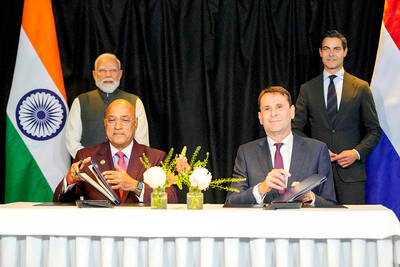
NEW MARKET: The partnership opens up India to the Dutch company, which already has a strong hold in the semiconductor market of South Korea, Taiwan and China ASML Holding NV entered into a partnership agreement with Tata Electronics Pvt Ltd aimed at ramping up India’s goal to develop domestic chip-manufacturing capabilities. The Dutch company’s technology would help power Tata Electronics’ planned 300 millimeter (mm) semiconductor foundry in Gujarat, according to a joint statement from the two companies on Saturday. The signing of a memorandum of understanding coincides with a visit by Indian Prime Minister Narendra Modi to the Netherlands, which is looking to deepen bilateral relations with New Delhi. ASML, whose top customers include Taiwan Semiconductor Manufacturing Co (台積電) and Samsung Electronics Co, makes lithography machines that can print
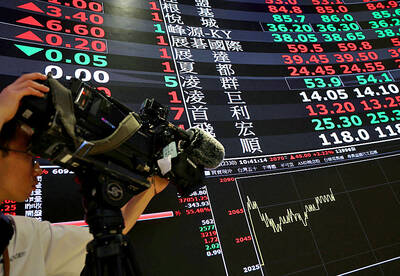
After several years flying high as Asia’s best Nvidia Corp proxy, Taiwan Semiconductor Manufacturing Co (TSMC, 台積電) is increasingly vying with other artificial intelligence (AI) stocks for investor attention. Stock traders are chasing a wider array of beneficiaries as mainstream usage of AI creates demand for hardware beyond the most-advanced chips TSMC makes for Nvidia. Subthemes from the deepening memory crunch to advances in robotics are also luring bids. At the same time, investment caps on single stocks are pushing funds to diversify, while retail investors long familiar with TSMC through its US depositary receipts are being offered a broader set of

TECH RELIANCE: Growth is increasingly reflecting an unequal K-shaped distribution, where technology sectors outperform and other industries struggle, an expert said Standard Chartered Bank has significantly raised its forecast for Taiwan’s economic growth to 9.5 percent this year, up from 7.6 percent previously, citing surging artificial intelligence (AI) demand driving exports, semiconductor production and investment. The upgrade reflects a sustained AI supercycle that continues to fuel demand for advanced chips and technology infrastructure, which form the backbone of Taiwan’s exports, the bank said in a report this week. “We raise our 2026 growth forecast to reflect a much stronger-than-expected first-quarter GDP figure,” Standard Chartered senior economist for greater China and Asia Tommy Wu (胡東安) said in the report. Driven largely by a 35.3 percent
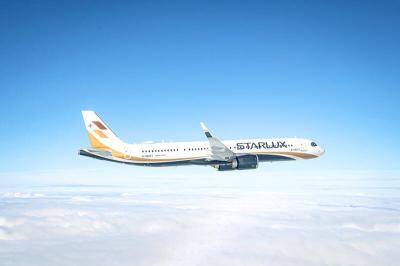
Two of Taiwan’s international carriers, Starlux Airlines Co (星宇航空) and EVA Airways Corp (長榮航空), have retained the five-star airline rating awarded by international airline review organization Skytrax. Starlux was awarded the distinction for a second consecutive year, while EVA Air received it for the 11th straight year, Skytrax said in statements released yesterday and on Thursday last week, respectively. The five-star rating is considered one of the airline industry's highest honors and is awarded following professional audits of airline product and frontline service standards, Skytrax said. The ratings are based on in-depth assessments using unified global quality standards rather than customer review scores


 RSS
RSS