


E-ton inks deal
E-ton Solar Tech Co (益通光能), the nation's second-largest solar cell maker, has signed a letter of intent to sell at least 4 megawatts of solar cells to Romag Holdings Plc, the company said in a filing to the Taiwan Stock Exchange yesterday.
Romag Holdings is a UK manufacturer of specialist transparent composites, and sells into the security, renewable energy, architectural and specialist transportation markets.
The letter states that E-ton would supply the solar cells to Romag Holdings from Oct. 1 this year to Sept. 30 next year. But the company did not reveal the dollar value of the sale.
Handsets turn into EasyCards
The Ministry of Economic Affairs yesterday passed a project to integrate Mass Rapid Transit cards into mobile phone handsets. The plan was first proposed by the nation's largest phone company Chunghwa Telecom Co (中華電信) and Taipei Smart Card Corp (台北智慧卡票證公司), the official distributor of the Taipei MRT's EasyCards.
The project aims to develop Combi-SIM cards, which allow consumers to make payments with their cellphones by swiping their handset in the MRT, buses and parking lots, and places that accept EasyCards, the ministry said in a statement.
The Combi-SIM cards can be used in GSM, GPRS and new third-generation telecommunication net-works, the statement said.
Cabinet to freeze loan scheme
The Cabinet has decided to freeze the housing loan scheme after the remaining funds of the current pool are used up, the nation's central bank said yesterday.
The project will retire once the unused NT$13 billion (US$395.1 million) of the government loans -- worth NT$300 billion and introduced in May last year -- are consumed, the central bank said in a statement.
The Cabinet's decision came even though the General Chamber of Commerce (商業總會) voiced its opposition last week.
The association's chairman Gary Wang (王令麟) called on the government to continue its preferential scheme to bolster the property market, that has underpined the nation's economy for several years now.
The government started to subsidize home buyers in 1998 by providing loans charging lower interest rates through selective lenders to stimulate the nation's lackluster real estate sector.
The authority then extended the offer several times, bringing the total balance of the preferential loans to NT$1.8 trillion.
Consortium wins bid
A team comprised of four leading transportation companies has won a bid to build and operate a logistics center in the Central Taiwan Science Park (中部科學園區) in Taichung County, officials said yesterday.
The Central Taiwan Science Park Logistics Co was formed by Chien Shing Harbor Service Co (建新), T Join Transportation Co (大榮汽車貨運), Taiwan Express Group (台灣航空貨運) and Da Tsun Transportation (大村交通事業).
The company will invest NT$1 billion (US$30.4 million) to build a logistics center covering an area of 66,000m2 in the park and have the right to operate the center for 20 years, according Yang Wen-ko (楊文科), director of the science park.
Beginning on Oct. 2, the company will expand its services to cover customs declaration, ware-housing and transportation, and expects sales to reach NT$500 million in the coming year, he said.
NT dollar loses ground
The New Taiwan dollar lost ground against its US counterpart yesterday, declining NT$0.003 to close at NT$32.909 on the Taipei foreign exchange market. Turnover was US$694 million.

The Fair Trade Commission’s (FTC) ongoing review of Grab Holdings Ltd’s US$600 million acquisition of Foodpanda Taiwan’s operations, announced on March 23, has taken on fresh urgency as industry experts warn that the transaction could embed significant Chinese cybersecurity vulnerabilities into Taiwan’s digital infrastructure through Grab’s deep ties to autonomous-driving firm WeRide (文遠知行). Less than 16 months after the FTC blocked Uber Eats’ direct attempt to acquire Foodpanda Taiwan — citing potential combined market shares of 80 to 90 percent — the emergence of Grab as the buyer has prompted questions about whether the same competitive harm is simply being rerouted
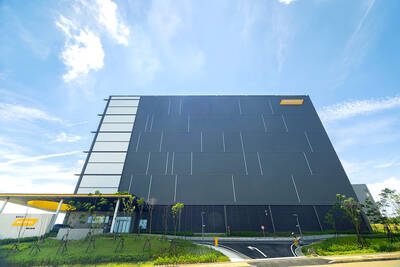
POWER BUILDUP: Powered by Nvidia’s B200 Blackwell chips, the data center would support MediaTek’s computing power demand and business growth, the company said Smartphone chip designer MediaTek Inc (聯發科) yesterday launched a new artificial intelligence (AI) data center with a maximum capacity of 45 megawatts to meet its rising demand for computing power required to develop new advanced chips for AI applications. The company has completed the first-phase computing power buildup at the data center in Miaoli County’s Tongluo Township (銅鑼), providing 15 megawatts of capacity to support its research and development (R&D) capabilities, despite an industrywide shortage of key components, MediaTek said. Supply constraints have plagued a wide range of key components, including memory chips, solid-state drives, power supply units and central
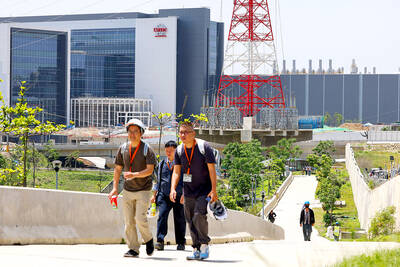
IMAGE SENSORS: The Japanese company would be the controlling shareholder of the venture, with development and production lines to be set up in Kumamoto Taiwan Semiconductor Manufacturing Co (TSMC, 台積電) yesterday said it has signed a non-binding memorandum of understanding (MOU) with Sony Semiconductor Solutions Corp to create a joint venture to develop and produce next-generation images sensors. The partnership seeks to explore and address emerging opportunities in physical artificial intelligence (AI) applications, such as automotive and robotics, paving the way for innovations and expanded technological advancements, TSMC said in a statement. Sony would be the majority and controlling shareholder of the joint venture, the statement said, adding that the company would set up development and production lines in its newly constructed fab in Kumamoto Prefecture’s

The nation’s foreign exchange reserves climbed back above US$600 billion at the end of last month, as investment gains, currency valuation effects and renewed foreign inflows offset volatility seen earlier in the month, the central bank said yesterday. Reserves stood at US$602.49 billion, up US$5.6 billion from the previous month, the central bank said. The rebound reflected returns on reserve assets, fluctuations in major currencies against the US dollar and the central bank’s market operations aimed at maintaining orderly trading conditions, Department of Foreign Exchange Director-General Eugene Tsai (蔡炯民) said. Financial markets were volatile early last month, with foreign investors recording net purchases


 RSS
RSS