


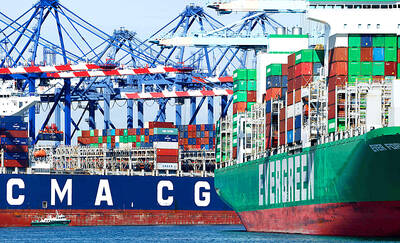
Evergreen Marine Corp (
The 11-member Westbound Transpacific Stabilization Agreement is seeking to raise its rates by US$50 for a standard 40-foot container and US$40 for standard 20-foot boxes beginning Oct. 1, the group said in an e-mailed statement yesterday.
The shipping lines may make "further rate adjustments" as they try to recover costs from customers, the statement said.
Hapag-Lloyd, Japan's Nippon Yusen K.K. and other shipping
lines have reported smaller profits this year because record oil prices are increasing costs and an oversupply of vessels is causing freight rates to weaken.
"The rate increase is needed for these commodities to help recover rising costs," the group said in the statement.
"Shipments are heavy and at times require special chassis equipment, routing and stowage aboard the ship. Equipment often requires special cleaning and maintenance in Asia," it said.
In Singapore, the price of 380 Centistoke Bunker Fuel used by ships rose to a record US$365 per tonne on May 3, 27 percent more than the price of US$287.50 at the end of last year. Costs have also increased for shipping lines to move cargo on land because truckers and railways are charging more to reflect higher fuel prices.
China Shipping Group (
Other members include Kawasaki Kisen Kaisha Ltd, Nippon Yusen,
Orient Overseas Container Line Inc and Yang Ming Marine Corp (
Shares of Hanjin Shipping, South Korea's largest shipping line, rose 1.4 percent to 21,300 won in Seoul. Shares of Nippon Yusen, Japan's biggest, gained 0.3 percent to ?726 in Tokyo.
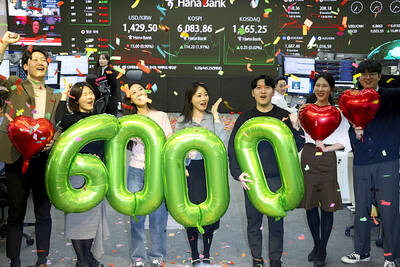
South Korea’s equity benchmark yesterday crossed a new milestone just a month after surpassing the once-unthinkable 5,000 mark as surging global memory demand powers the country’s biggest chipmakers. The KOSPI advanced as much as 2.6 percent to a record 6,123, with Samsung Electronics Co and SK Hynix Inc each gaining more than 2 percent. With the benchmark now up 45 percent this year, South Korea’s stock market capitalization has also moved past France’s, following last month’s overtaking of Germany’s. Long overlooked by foreign funds, despite being undervalued, South Korean stocks have now emerged as clear winners in the global market. The so-called “artificial intelligence
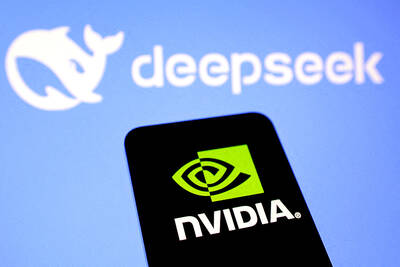
Chinese artificial intelligence (AI) start-up DeepSeek’s (深度求索) latest AI model, set to be released as soon as next week, was trained on Nvidia Corp’s most advanced AI chip, the Blackwell, a senior official of US President Donald Trump’s administration said on Monday, in what could represent a violation of US export controls. The US believes DeepSeek will remove the technical indicators that might reveal its use of American AI chips, the official said, adding that the Blackwells are likely clustered at its data center in Inner Mongolia, an autonomous region of China. The person declined to say how the US government received
FORTUNES REVERSED: The new 15 percent levies left countries with a 10 percent tariff worse off and stripped away the advantage of those with a 15 percent rate In a swift reversal of fortunes, countries that had been hardest hit by US President Donald Trump’s tariffs have emerged as the biggest winners from the US Supreme Court’s decision to strike down his emergency levies. China, India and Brazil are among those now seeing lower tariff rates for shipments to the US after the court ruled Trump’s use of the International Emergency Economic Powers Act to impose duties was illegal. While Trump subsequently announced plans for a 15 percent global rate, Bloomberg Economics said that would mean an average effective tariff rate of about 12 percent — the lowest since
Standard Chartered Bank Taiwan’s newly appointed chief executive officer, Anthony Yu (游天立), yesterday unveiled an ambitious growth strategy for the bank’s wealth management division, reflecting a bullish outlook on Taiwan’s high-net-worth market. Yu, the first local executive to lead Standard Chartered Bank’s Taiwan operations, emphasized rising client demand and detailed plans to expand the bank’s digital capabilities, as well as its physical presence across the country. Standard Chartered Taiwan saw a remarkable surge in new wealth management clients last month, with the number of clients holding assets equivalent to US$1 million more than doubling compared with the same month last year, he


 RSS
RSS