


Nearly 70 percent of local small and medium-sized businesses (SMBs) prefer to "lease" IT solutions as a means to save investment costs, a report said yesterday.
"Leasing will enable enterprises to start enjoying the benefits of IT solutions soonest, but pay their investment over a long period of time," said Bell Chiang (
According to Chiang, the results showed that when smaller firms are offered the option of leasing, most of them will deploy IT solutions in the areas of enterprise resource planning, customer relationship management and supply chain management.
The survey carried out by IBM, which polled 370 SMBs in Taiwan during the third quarter, also revealed that when choosing IT solutions, 33.2 percent of firms said price is the first priority, while 29.6 percent will go with a vendor which they have worked with before.
Meanwhile, 52.6 percent of all SMBs have set up IT departments within their own organizations, with the manufacturing sector being the most proactive in this regard, with a saturation rate of 63.5 percent.
By comparison, only 29.2 percent of retail and wholesale companies, which account for half of the nation's SMBs, have IT departments, according to the survey.
This means that Taiwan's SMBs still have a way to go in terms of utilizing IT solutions to facilitate operations, thus presenting untapped potential to solution providers such as IBM, Chiang said.
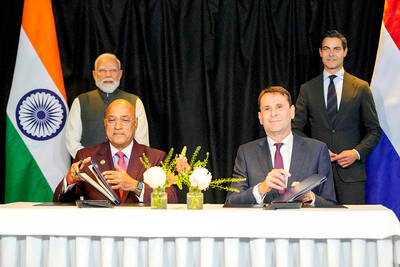
NEW MARKET: The partnership opens up India to the Dutch company, which already has a strong hold in the semiconductor market of South Korea, Taiwan and China ASML Holding NV entered into a partnership agreement with Tata Electronics Pvt Ltd aimed at ramping up India’s goal to develop domestic chip-manufacturing capabilities. The Dutch company’s technology would help power Tata Electronics’ planned 300 millimeter (mm) semiconductor foundry in Gujarat, according to a joint statement from the two companies on Saturday. The signing of a memorandum of understanding coincides with a visit by Indian Prime Minister Narendra Modi to the Netherlands, which is looking to deepen bilateral relations with New Delhi. ASML, whose top customers include Taiwan Semiconductor Manufacturing Co (台積電) and Samsung Electronics Co, makes lithography machines that can print

TECH RELIANCE: Growth is increasingly reflecting an unequal K-shaped distribution, where technology sectors outperform and other industries struggle, an expert said Standard Chartered Bank has significantly raised its forecast for Taiwan’s economic growth to 9.5 percent this year, up from 7.6 percent previously, citing surging artificial intelligence (AI) demand driving exports, semiconductor production and investment. The upgrade reflects a sustained AI supercycle that continues to fuel demand for advanced chips and technology infrastructure, which form the backbone of Taiwan’s exports, the bank said in a report this week. “We raise our 2026 growth forecast to reflect a much stronger-than-expected first-quarter GDP figure,” Standard Chartered senior economist for greater China and Asia Tommy Wu (胡東安) said in the report. Driven largely by a 35.3 percent

Tokyo Electron's Taiwan unit today said in a written response that it respects the judicial process, takes the court ruling seriously and would not appeal in the Taiwan Semiconductor Manufacturing Co (TSMC, 台積電) trade secrets case. Last month, a court fined the Taiwan unit of Japan's Tokyo Electron NT$150 million (US$4.74 million) in a case involving trade secrets related to TSMC's sensitive chip technology.
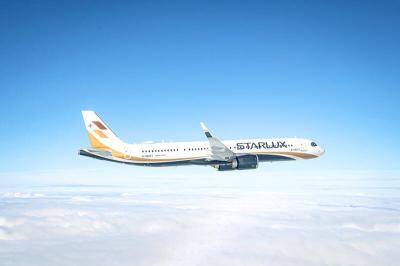
Two of Taiwan’s international carriers, Starlux Airlines Co (星宇航空) and EVA Airways Corp (長榮航空), have retained the five-star airline rating awarded by international airline review organization Skytrax. Starlux was awarded the distinction for a second consecutive year, while EVA Air received it for the 11th straight year, Skytrax said in statements released yesterday and on Thursday last week, respectively. The five-star rating is considered one of the airline industry's highest honors and is awarded following professional audits of airline product and frontline service standards, Skytrax said. The ratings are based on in-depth assessments using unified global quality standards rather than customer review scores


 RSS
RSS