


Computer giant International Business Machines Corp and Applied Materials Inc said they will form a five-year, US$300 million partnership to develop new microchip technologies.
The initiative will bring about 80 researchers to Albany Nanotech, a State University of New York affiliated center for nanotechnology research and development funded by the state and private sector.
Santa Clara, California-based Applied Materials, the world's largest supplier of equipment used to make and test microchips, and IBM will work to develop chips that can be used in biotechnology and medicine, said State University at Albany President Kermit Hall.
Potential applications include blood testing, DNA sequencing and drug development and delivery. The technology may also be used in telecommunications, artificial intelligence software and sensors for environmental, energy and defense applications, officials said.
Nanotechnology is the science of working at the atomic and molecular levels -- at scales, for example, that are about 1/100,000th the diameter of a human hair.
The state, in an effort to transform an area dependent on government bureaucracy and rust-belt industry into another Silicon Valley, has invested hundreds of millions already in the Albany Nanotech campus.
The project is the second such collaborative effort at Albany Nanotech.
In July, Armonk-based IBM, New York state and three of the world's largest computer chip makers agreed to spend US$600 million over the next five years on a research, education and economic development project here focused on creating the next generation of computer microchips.
Sematech, a consortium of nine of the world's largest computer chip makers, is also building a US$400 million research center here, and Tokyo Electron Ltd, the world's second-largest maker of semiconductor manufacturing equipment, built a US$300 million facility next door.
"We're creating this high-end facility where private corporations can send researchers to undertake work that they would not otherwise be able to do," Hall said.
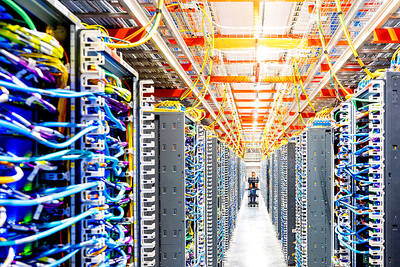
AI SPLURGE: The four major US tech companies have lost more than US$950 billion in value since releasing earnings and outlooks, while equipment makers were gaining Four of the biggest US technology companies together have forecast capital expenditures that would reach about US$650 billion this year — a flood of cash earmarked for new data centers and all the gear within them. The spending planned by Alphabet Inc, Amazon.com Inc, Meta Platforms Inc and Microsoft Corp, all in pursuit of dominance in the still-nascent market for artificial intelligence (AI) tools, is a boom without a parallel this century. Each of the companies’ estimates for this year is expected either near or surpass their budgets for the past three years combined. They would set a high-watermark for capital spending
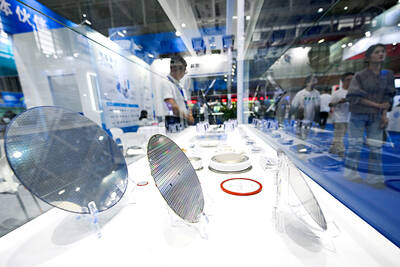
China’s top chipmaker has warned that breakaway spending on artificial intelligence (AI) chips is bringing forward years of future demand, raising the risk that some data centers could sit idle. “Companies would love to build 10 years’ worth of data center capacity within one or two years,” Semiconductor Manufacturing International Corp (SMIC, 中芯) cochief executive officer Zhao Haijun (趙海軍) said yesterday on a call with analysts. “As for what exactly these data centers will do, that hasn’t been fully thought through.” Moody’s Ratings projects that AI-related infrastructure investment would exceed US$3 trillion over the next five years, as developers pour eye-watering sums

Bank of America Corp nearly doubled its forecast for the nation’s economic growth this year, adding to a slew of upgrades even after a rip-roaring last year propelled by demand for artificial intelligence (AI). The firm lifted its projection to 8 percent from 4.5 percent on “relentless global demand” for the hardware that Taiwanese companies make, according to a note dated yesterday by analysts including Xiaoqing Pi (皮曉青). Taiwan’s GDP expanded 8.63 percent last year, the fastest pace since 2010. The increase “reflects our sustained optimism over Taiwan’s technology driven expansion and is reinforced by several recent developments,” including a more stable currency,
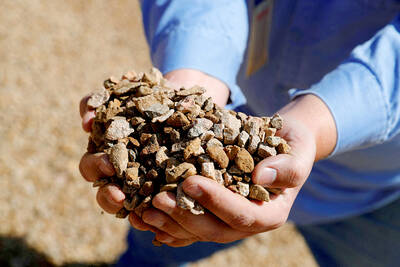
COLLABORATION: Taiwan and the US could jointly find solutions to weaknesses in supply chain resilience for critical materials, focusing on mining and initial refinement Taiwan is likely to purchase rare earths from the US in the future, and is also in talks with Australia and Canada to strengthen global rare earth supply chain security, Minister of Economic Affairs Kung Ming-hsin (龔明鑫) said yesterday. Taiwan and the US last month concluded the sixth Economic Prosperity Partnership Dialogue, during which both sides signed a joint statement endorsing the principles of the Pax Silica Declaration, pledging to deepen cooperation in areas including critical minerals. At the time, Kung said the two sides would establish working groups to advance cooperation in areas including artificial intelligence, digital infrastructure, critical materials and


 RSS
RSS