


China is beefing up efforts to extend its economic and political tentacles to Latin America and is set to start talks on a free trade agreement (FTA) with Chile during the weekend's leadership summit.
The two nations announced on Thursday night that they will formally start negotiations on a free trade pact. The talks were precipitated by Chinese President Hu Jintao's (
According to statistics released by Beijing, bilateral trade between China and Latin America grew by 50.4 percent to US$26.8 billion last year from 2002. China's exports increased 40 percent last year, while its imports from Latin America soared by 79.1 percent.
Trade between China and Brazil has increased 800 percent over the past 10 years, and last year China became Brazil's third-largest trading partner, behind the US and Argentina. Beijing hopes to double its annual trade with Brazil to US$20 billion within three years.
China has become Argentina's fourth largest trading partner, with two-way trade reaching US$3.176 billion last year, up 122 percent from the year before, according to figures released by Beijing.
Chile in 1970 became the first South American nation to establish full diplomatic relations with China. Two-way trade between Chile and China reached US$3.529 billion last year, up 37.6 percent from the previous year.
In the wake of China's ambitious move to tap into Latin American economies, Taiwan hopes to engage in more FTA talks and thus secure firmer relations with its diplomatic allies in the region.
Central America is of significant diplomatic importance to Taiwan. Of the 33 countries in Latin America, 14 have diplomatic relations with Taiwan.
Taiwan signed its first FTA with Panama last August and expects to sign a second one with Guatemala, although the timetable for negotiations was disrupted when the Guatemalan government was reshuffled at the end of last year.
Negotiations with Paraguay to sign an FTA are on the horizon after Paraguay and Taiwan signed a joint communique in Taipei in May, promising to hold a bilateral economic cooperation conference in the Paraguayan capital of Asuncion to further boost trade and economic exchanges.
Wu Rong-i (
While China is trying to gain broader economic control of the Latin American market, the US will continue to dominate the region, Wu said.
"The Chinese market looks big, but its GDP contributes only 3 percent of the world's total, while the US accounts for 20 percent. I don't see China becoming the dominant economic power in the region in the foreseeable future, because it has a lot of domestic problems to worry about and the communist regime might collapse one day if it doesn't handle its own problems well," Wu said.
Instead of battling with the political aspect, Taiwan might want to switch its focus to purely economic matters, Choong Yong Ahn (安忠榮), chairman of the APEC Economic Committee, told the Taipei Times on Thursday.
"I can see the political barrier created by China. If Taiwan seeks to excel in trade-oriented economies, it's very important to separate business from politics," he said.
"I think it's possible to move in this direction and it's equally important that Taiwan continues to expand its economic strengths. I also believe that it's very possible for Taiwan to sign more FTAs with other countries if the negotiations are based purely on the economic and commercial aspects," he said.
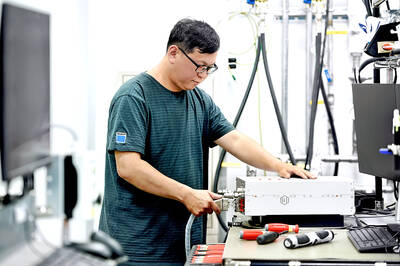
SEMICONDUCTORS: The German laser and plasma generator company will expand its local services as its specialized offerings support Taiwan’s semiconductor industries Trumpf SE + Co KG, a global leader in supplying laser technology and plasma generators used in chip production, is expanding its investments in Taiwan in an effort to deeply integrate into the global semiconductor supply chain in the pursuit of growth. The company, headquartered in Ditzingen, Germany, has invested significantly in a newly inaugurated regional technical center for plasma generators in Taoyuan, its latest expansion in Taiwan after being engaged in various industries for more than 25 years. The center, the first of its kind Trumpf built outside Germany, aims to serve customers from Taiwan, Japan, Southeast Asia and South Korea,

Gasoline and diesel prices at domestic fuel stations are to fall NT$0.2 per liter this week, down for a second consecutive week, CPC Corp, Taiwan (台灣中油) and Formosa Petrochemical Corp (台塑石化) announced yesterday. Effective today, gasoline prices at CPC and Formosa stations are to drop to NT$26.4, NT$27.9 and NT$29.9 per liter for 92, 95 and 98-octane unleaded gasoline respectively, the companies said in separate statements. The price of premium diesel is to fall to NT$24.8 per liter at CPC stations and NT$24.6 at Formosa pumps, they said. The price adjustments came even as international crude oil prices rose last week, as traders
Taiwan Semiconductor Manufacturing Co (TSMC, 台積電), which supplies advanced chips to Nvidia Corp and Apple Inc, yesterday reported NT$1.046 trillion (US$33.1 billion) in revenue for last quarter, driven by constantly strong demand for artificial intelligence (AI) chips, falling in the upper end of its forecast. Based on TSMC’s financial guidance, revenue would expand about 22 percent sequentially to the range from US$32.2 billion to US$33.4 billion during the final quarter of 2024, it told investors in October last year. Last year in total, revenue jumped 31.61 percent to NT$3.81 trillion, compared with NT$2.89 trillion generated in the year before, according to

SIZE MATTERS: TSMC started phasing out 8-inch wafer production last year, while Samsung is more aggressively retiring 8-inch capacity, TrendForce said Chipmakers are expected to raise prices of 8-inch wafers by up to 20 percent this year on concern over supply constraints as major contract chipmakers Taiwan Semiconductor Manufacturing Co (TSMC, 台積電) and Samsung Electronics Co gradually retire less advanced wafer capacity, TrendForce Corp (集邦科技) said yesterday. It is the first significant across-the-board price hike since a global semiconductor correction in 2023, the Taipei-based market researcher said in a report. Global 8-inch wafer capacity slid 0.3 percent year-on-year last year, although 8-inch wafer prices still hovered at relatively stable levels throughout the year, TrendForce said. The downward trend is expected to continue this year,


 RSS
RSS