


China is planning to reorganize its coal industry and form eight to 10 large coal mining firms capable of mass output to address the country's serious energy shortage, state media said yesterday.
The plan was announced over the weekend as officials revealed China's coal output -- while expected to increase by 14 percent from last year to 1.6 billion tonnes this year -- cannot meet rising demand due to rapid economic growth.
Under the plan unveiled Saturday the companies will be capable of each producing more than 50 million tonnes of coal annually, the Xinhua news agency reported.
Four or five of the firms will be expected to each turn out 100 million tonnes a year, according to the plan revealed by the Chinese Society of the Coal Industry, formerly the Ministry of the Coal Industry, at a conference on coal sector reform.
The firms will be created through mergers and are expected to control 60 percent of the domestic coal market, Xinhua said.
The Society is also planning to build large coal mining centers and big and medium-sized mines equipped with advanced equipment.
Lack of large coal firms made it hard to relieve serious coal shortages earlier this year, the government found.
Only four companies in China are capable of producing 30 million tonnes of coal or more annually, accounting for only 14 percent of the domestic market demand.
Major coal producers in the US, on the other hand, can control up to 40 percent of the American coal market.
China -- the world's largest producer and consumer of coal -- boasts 28,000 mines, but these are relatively small and ill-equipped, with a production capacity of approximately 50,000 tonnes each.
Coal remains in short supply.
Power plants, for example, are expected to consume 826 million tonnes of coal this year, a rise of more than 13 percent from last year, according to Xinhua.
The situation is so serious that seven major power producers, including China Huaneng Enterprise Group, recently sent a petition to the government asking it to intervene.
Coal shortages forced generators to be shut down, disrupting electricity production at the plants, Xinhua said.
The problem is attributed to rapidly rising demand, shipment costs and coal prices, but experts cited the remarkable growth of the Chinese economy as the main factor, Xinhua said.
This year, China's economic growth rate is expected to hit 8.5 percent, increasing faster than any other major economy in the world.
Experts argued the pace of reform of China's energy system was lagging behind national economic growth.
Despite the fact that China is modernizing rapidly, at least 70 percent of its energy needs is still met with coal.
That ratio will remain unchanged for a long period to come, Xinhua quoted industry sources saying.
However, Shenhua Group, the country's leading coal producer, is expecting to turn out a record 100 million tonnes of coal this year.

HSBC Holdings PLC is deepening its commitment to Taiwan as the economy emerges as one of the bank’s fastest-growing markets globally, driven by an artificial intelligence (AI) investment boom, expanding cross-border trade, and rising wealth creation. “The advantage that Taiwan has is a growth story linked to the semiconductor and broader AI industries, strong underlying corporate performance, and wealth creation,” said Surendra Rosha, HSBC’s co-chief executive for Asia and the Middle East, in an exclusive interview with the Taipei Times on June 2, during this year’s HSBC Taiwan Conference. That combination has helped HSBC cement its position as the most profitable international
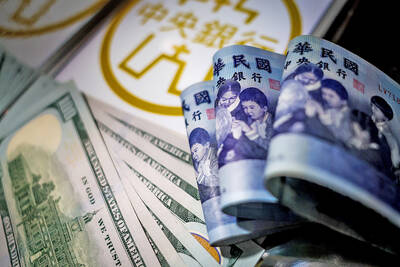
The New Taiwan dollar yesterday fell sharply against the US dollar to close at its lowest level since May 22 amid a massive outflow of funds from the country because of investors panicking over global equity markets. The NT dollar ended at NT$31.580 against the US dollar, slightly lower than its close of NT$31.568 on May 22, after moving between NT$31.5 and NT$31.648 on combined turnover of US$3.062 billion on the Taipei Foreign Exchange and the Cosmos Foreign Exchange. The NT dollar received a significant hit in the morning session, slumping as much as NT$0.173 at a time when other Asian currencies
Taiwan Semiconductor Manufacturing Co (TSMC, 台積電) is now ranked ninth among the world’s 100 most valuable companies after its market capitalization more than doubled over the past year, PricewaterhouseCoopers (PwC) Taiwan said in a report last month. TSMC’s market capitalization surged 101 percent year-on-year to US$1.427 trillion as of March 31, the accounting and consulting firm’s 2026 Global Top 100 Companies by Market Capitalization report said. The gain catapulted the world’s largest contract chipmaker from 12th place to ninth in the rankings, and it was the fastest-growing among the global top 10, it said. TSMC was the only Taiwanese company among the top
Taiwan Semiconductor Manufacturing Co (TSMC, 台積電) yesterday reported record revenue of NT$416.975 billion (US$13.17 billion) for last month, putting the world’s largest contract chipmaker on track to set a record for quarterly revenue. Last month’s figure surpassed March’s record NT$415.19 billion and represented increases of 1.5 percent from April and 30.1 percent from a year earlier. For the first five months of the year, TSMC generated NT$1.96 trillion in revenue, up 30 percent year-on-year, it said in a statement. TSMC has forecast second-quarter revenue of between US$39 billion and US$40.2 billion, representing sequential growth of about 10 percent and year-on-year growth of about


 RSS
RSS