


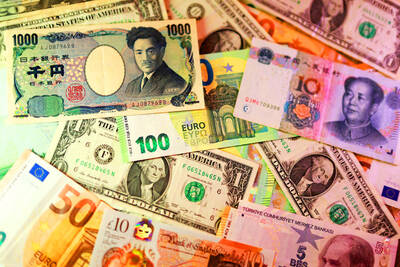
Taipei Times: Despite stepped-up international pressures and US tax-hike threats to force China into changing its currency policy, Beijing appears to be standing firm, not allowing the yuan to float. What is HSBC's view on this issue?
Tony Yang (楊錦裕): We should look at China's increasing trade surplus and US dollar reserves from two perspectives: foreign direct investments (FDIs) and surging foreign imports. As a result of globalization, multinationals are flowing in to take advantage of China's low labor costs in the format of FDIs, which contribute to nearly 55 percent of China's trade surplus here. Its increasing foreign reserves are, therefore, a result of a trade surplus brought by FDIs and a current account surplus, which has nothing to do with [the weakening of the] US greenback.

PHOTO: COURTESY OF TONY YANG
According to a world labor organization, the annual cost of Chi-nese labor averages at US$1,200 per head, which accounts for 2.2 percent of US labor costs, or 2.3 percent of Japan's labor cost. Cheap and well-educated labor is one of China's economic advantages, which other Asian countries can't compete with. Even if the Chinese yuan is to be appreciated, those job opportunities couldn't possibly return to the US as it wishes.
TT: Given China's cost advantages, the US-led economist camp still insists that Chinese-made products are not genuinely competitive. Do you agree with what they say -- that an under-valued yuan disadvantages US exporters?
Yang: No, I don't think so. US exporters are not directly competing with Chinese exporters. Most US businesses have outsourced to Asia to [rationalize their cost structures], be it to China or other Asian countries, which makes the US trade deficit inevitable. Besides, for the first half of this year, China imported 10 percent more than it exported, which we believed was expected to offset its trade surplus.
TT: What do you think China is doing to alleviate the pressure on its currency?
Yang: China has been doing a lot to decrease foreign reserves. First, it is considering formulating the qualified domestic institutional investors (QDII) mechanism to allow locals to invest in foreign markets. Second, there is unconfirmed news that China may officially adjust the refund of the averaged 15 percent export taxes, which is sure to add costs for exporters and helps retain the Chi-nese yuan. China also relaxed foreign currency controls, allowing locals to possess more US dollars before making foreign trips.
We believe China has prioritized a maintenance of its currency stability because it can't afford to have an unstable currency to impact its future economic growth amid potential crises of increasing unemployment and the collapse of the banking sector as a result of high non-performing loans and state-owned enterprise (SOE) reforms.
Therefore, we don't think that the yuan is likely to appreciate by the end of next year. But in the long run, the yuan is expected to conform to the market-based rate and be pegged to a basket of trade-weighted currencies instead of the US dollar.
TT: How has the yuan issue impacted Asian currencies especially after the Japanese yen, South Korean won and New Taiwan dollar reacted on the G7's call and slightly strength-ened weeks ago?
Yang: The G7 warned of a flexible policy in Asian currencies since most of them peg to the US dollar. We can't predict how the currency war will end but we certainly saw that each country adopted different monetary policies to resist international pressures. In the end, only market forces can decide.
But one thing is for sure -- we believe a stronger US dollar is not foreseeable since its trade deficits account for 5 percent of its GDP. Signs of a strong economic recovery in the US are not clear yet.
TT: After China fleshed out its Closer Economic Partnership Arrangement (CEPA) with Hong Kong, some Taiwanese banks have talked about using the free-trade pact to enter Chinese markets. Do you think that's feasible? Will the pact actually benefit Hong Kong as a springboard for the service sector to move into China?
Yang: Theoretically yes, although there are difficulties practically. In accordance with China's WTO commitments, foreign banks are originally required to have at least US$20 billion in assets before they can branch out into China. But the agreement lowers the asset-threshold to US$6 billion for foreign banks, which take up a 51 percent controlling stake in affiliated Hong Kong banks for a year, while further allowing them to manage yuan transactions after reaping profits for two consecutive years [Without the CEPA, it will take three years].
But the question is any Taiwan-ese banks or financial holding companies, which plan to open branches in China, require consent from both governments even if [they go] via Hong Kong since future cross-strait financial supervision is concerned in light of rules stipulated in the Basel Accord.
Therefore, even if China gives its go-ahead, Taiwan's Ministry of Finance can veto the application, which will be a practical hurdle. Other service-sector industries may not face such problems and may subsequently benefit from the agreement to move in its retailer and distribution units before waiting for China to open its markets in 2004.
TT: In other words, the banking sector's competition in China may be moved forward following the agreement. Based on your Chinese experience, how do you think China's bank-ing sector is performing? How competitive or vulnerable will it be after foreign players move in?
Yang: Most Chinese banks have a high bad loan ratio and low capital adequacy ratio (CAR) since they outloan many ill-performing SOEs. But it is just a matter of money deposited in the government's right or left pockets. To a certain extent, it won't hurt the banking sector's stability and people will continue to save their money in the banks since it's firmly believed that the government won't allow bank failure, be it small or big banks.
There's no way that the banking sector's poor performance in China will be resolved overnight. The Chinese government will continue to maintain a high GDP to create the public's wealth and generate tax income so as to be re-capitalized to gradually upturn the banking sector's health. China had previously set up a national asset management company with a governmental budget of 1.5 trillion yuan to buy bad loans.
In terms of competition, there are 160 foreign banks with over 200 branches nationwide, which only take up a relatively small 2 percent of market share here, compared to 100,000 branches by the four major Chinese commercial banks. All for-eign banks can only seek a competitive yet cooperative relationship with other strong Chinese rivals. Taiwan's government should soon allow local banks to come before it's too late or the competition heats up.
TT: China is boasting a 7 percent GDP growth rate this year, which some believe to be a fake number. But recently some economists also expressed views that China's GDP growth may actually hit 10 percent or 11 percent this year or next. What do you think?
Yang: I don't have the exact figure, but I am personally confident that China's economy is performing not too badly. Moreover, China is sure to have a strong underground economy.
Take my daughter for example. She is enrolled in the American school here [Shanghai] this year after having been on the waiting list last year. She's enrolled this year because there are three extra classes for nearly 100 more new applicants, which means that there were more than 100 foreign-investor families that moved into Shanghai recently. The tuition will cost me US$20,000 per year. Plus, the supply of local foreign-language schools is unable to meet the local demand.
How can you say China's economy is not doing well?
TT: One of your core businesses is to serve for Taiwanese businesspeople's financial needs. What difficulties do you think exist for them to raise enough capital in China or here in Taiwan?
Yang: To enjoy the favorable treatment of foreign investors, they have to bring in their own capital from elsewhere including Taiwan to start up businesses here. However, restrictions imposed by Taiwan's government on outflows of China-bound capital keep them from remitting enough capital. In terms of getting loans, local Chinese banks have a preference for Taiwanese businesses, which perform the best among all investors.
As a global bank, HSBC has branches worldwide to provide value-added financial services to Taiwanese businesses with international operations under its global platform.
TT: What do you think of the government's recent policy initiative to allow China-based Taiwanese businesses to list on the TAIEX?
Yang: I think the policy will do more good than harm to Taiwan's economy. It is sure to bring back many bluechip China-based Tai-wanese businesses on the TAIEX to advantage local stock investors who can then indirectly profit from gains of Chinese concept industries bolstered by its economic boom. The TAIEX will also be boosted.
Really, it doesn't concern Tai-wanese businesses at all where they can raise capital since money knows no nationality. Taiwan is not the only destination they can go since there are plenty of other places including China, Hong Kong and the US where they can get money.
TT: Given the importance of Chinese markets, what investment plans does the HSBC have in the pipeline?
Yang: We have now seven to eight account officers and plan to recruit a few more to serve more Taiwanese businesses. We also have a long-term commitment to Chinese markets by seizing every good investment opportunity and do not rule out any possibility to acquire small rivals here after buying an 8-percent stake in the Bank of Shang-hai and a 10-percent stake in China Ping An Insurance Co (平安保險).
Also See Story:
China may postpone QFII program, despite support

Taiwan’s foreign exchange reserves fell below the US$600 billion mark at the end of last month, with the central bank reporting a total of US$596.89 billion — a decline of US$8.6 billion from February — ending a three-month streak of increases. The central bank attributed the drop to a combination of factors such as outflows by foreign institutional investors, currency fluctuations and its own market interventions. “The large-scale outflows disrupted the balance of supply and demand in the foreign exchange market, prompting the central bank to intervene repeatedly by selling US dollars to stabilize the local currency,” Department of Foreign

Intel Corp is joining Elon Musk’s long-shot effort to develop semiconductors for Tesla Inc, Space Exploration Technologies Corp and xAI, marking a surprising twist in the chipmaker’s comeback bid. Intel would help the Terafab project “refactor” the technology in a chip factory, the company said on Tuesday in a post on X, Musk’s social media platform. That is a stage in the development process that typically helps make chips more powerful or reliable. The chipmaker’s shares jumped 4.2 percent to US$52.91 in New York trading on Tuesday. The Terafab project is a grand plan by Musk to eventually manufacture his own chips for
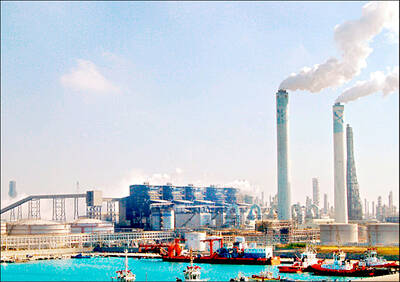
Taiwan Power Co (Taipower, 台電) yesterday said it plans to resume operations at two coal-fired power generators for three months to boost security of electricity supply as liquefied natural gas (LNG) supply risks are running high due to the Middle East conflict. The two coal-fired power generators are at Mailiao Power Plant in Yunlin County’s Mailiao Township (麥寮). The plant, operated by Formosa Plastics Group (台塑集團), supplied electricity to Taipower’s power grid until the end of last year. Taipower’s decision came about one month after Minister of Economic Affairs Kung Ming-hsin (龔明鑫) on March 10 said that the nation had no imminent

Some robotaxi passengers were left stranded in the middle of fast-moving traffic in a major Chinese city after their driverless vehicles stopped running, according to police and media reports on Wednesday. A preliminary investigation indicates more than 100 robotaxis came to a halt because of a “system malfunction,” police in the city of Wuhan said in a statement, without elaborating. No injuries were reported. One passenger told Chinese media that their robotaxi stopped after turning a corner. An instruction on a screen read: “Driving system malfunction. Staff are expected to arrive in 5 minutes.” After no one showed up, the passenger pushed


 RSS
RSS