


Intel will face its strongest challenge in more than a decade when its archrival, Advanced Micro Devices, formally unveils the Opteron 64b microprocessor next week.
Opteron represents a determined attempt by Advanced Micro to undermine Intel's blueprint for dividing the computing universe into two separate worlds: one represented by its desktop 32b Pentium processors; the other by its pricier, corporation-oriented Itanium 64b chips. In doing so, Advanced Micro is attempting to blur the line between the two computing categories, positioning its new processor as a simpler transition for software designers and computer users from the now-standard 32b chip architecture to 64b, which shatters the limit on computing memory from 4 billion bytes to what, for all practical purposes, is an unlimited ceiling.
But Advanced Micro, which competes directly against Intel in both microprocessors and in the market for flash memory chips, which are widely used in consumer products like cellphones, faces a big challenge in its attempt to chip away at Intel's powerful status in the industry. Indeed, many industry executives see the Opteron processor and the Athlon 64 -- its companion desktop version to be released this fall -- as a make-or-break test for AMD as it tries to carve out a secure, profitable position within Intel's shadow.
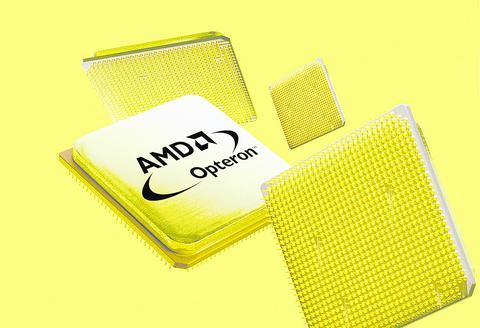
PHOTO: NY TIMES
Last week, AMD, while surpassing Wall Street expectations and claiming to have gained market share against Intel, reported a US$146 million loss for the quarter on revenue of US$715 million. AMD, based in Sunnyvale, California, has reported losses in four of the past five years and badly needs for Opteron to be a hit product.
The company is hoping that it can take advantage of the industry transition from 32b to 64b computing, which will initially be driven by the need for corporations to handle vast databases. But looking forward several years, an even bigger market beckons as desktop computers are expected to support far more powerful graphical applications.
During the past three decades Silicon Valley has gone from what now seem like simple 4b designs to the ability to turn out incredibly complex 64b processors. Each generation of chips has permitted computers to make use of larger blocks of data while also allowing them to double the amount of information that can be handled with each super-fast tick of the computer clock.
Until now Intel has thoroughly dominated the desktop computing world, while companies like IBM, Sun Microsystems and Hewlett Packard have sold more powerful and more expensive 64b computing systems to corporate computer users. Almost a decade ago Intel and Hewlett-Packard joined forces to design the 64b Itanium in an effort to blend the increasing computing potential of the more powerful processor with Intel's sophisticated manufacturing capabilities. Their first product was commercially introduced in 2001; it is now in its second generation.
Slow to convert
Itanium, however, has been slow to catch on, in part because the chip's performance has been disappointing and in part because software designers and corporate customers have been slow to convert software from other hardware platforms. Moreover, the computer cognoscenti have generally been more enthusiastic about the AMD chip design, which is expected to offer roughly equal performance at a lower price.
Even more threatening to Intel, the Opteron chip promises to seamlessly run existing software, potentially allowing AMD to get in the door with corporate users by promising a smoother transition to 64b technology. By contrast, Itanium users have faced a penalty in using current 32b software, which runs more slowly in a special emulation mode.
Intel is already under the gun, industry executives said, because Microsoft has committed to offering its operating system for the Opteron as well as Itanium. If Intel were forced to introduce a similarly compatible processor, which is reportedly in the works at the company's research labs as an insurance policy, it would be forced to either follow AMD's standard or persuade Microsoft to invest in yet a third 64b operating system.
Perhaps more significantly, AMD is pricing the new Opteron chips to compete against Intel's 32b Xeon processors, which are now widely used in the market for low-end corporate servers.
If the Opteron lives up to the earlier performance expectations and is widely adopted in corporate applications, it could badly undercut Hewlett-Packard as well as Intel, particularly because corporate spending on information technology has been cut by the recession.
"In many ways this is an excellent time to introduce the Opteron," Hector Ruiz, AMD's chief executive, said. "It will be possible to make a simpler transition because it will be possible to run the existing 32b software without modification."
Hewlett Packard and Intel executives respond that Opteron faces its own challenges in the marketplace. Bringing application software to new computer designs will be more complex than AMD suggests, they said.
"It is a hard, complex problem that we've been working on for a long time," said Shane V. Robison, chief strategy and technology officer for Hewlett-Packard. "The Opteron guys are going to have to go through the same thing."
Ready for what?
"Having the microprocessor is one thing," Robison added. "Having it ready for the enterprise -- all the software, management tools and other expertise you need -- is another."
He also asserted that HP and Intel will retain a performance edge because of Intel's manufacturing advantages in building chips with even smaller design features.
Apart from manufacturing, AMD's biggest challenge is to quickly establish support from industry leaders for its new design.
"It's important for AMD to build a sense of momentum for Opteron," said Jim Turley, publisher of Silicon-Insider, a computer industry newsletter in Pacific Grove, California. Dell, IBM and Sun Microsystems are all potential backers for the new AMD processors but none has publicly announced a commitment yet. Industry executives said it was likely that at least one of the computer makers would announce its support on Tuesday in New York, when the new processor is publicly unveiled.
The jockeying inside the industry has been brutal, according to a number of people who have been engaged in the struggle.

HORMUZ ISSUE: The US president said he expected crude prices to drop at the end of the war, which he called a ‘minor excursion’ that could continue ‘for a little while’ The United Arab Emirates (UAE) and Kuwait started reducing oil production, as the near-closure of the crucial Strait of Hormuz ripples through energy markets and affects global supply. Abu Dhabi National Oil Co (ADNOC) is “managing offshore production levels to address storage requirements,” the company said in a statement, without giving details. Kuwait Petroleum Corp said it was lowering production at its oil fields and refineries after “Iranian threats against safe passage of ships through the Strait of Hormuz.” The war in the Middle East has all but closed Hormuz, the narrow waterway linking the Persian Gulf to the open seas,

Taiwan has enough crude oil reserves for more than 100 days and sufficient natural gas reserves for more than 11 days, both above the regulatory safety requirement, Minister of Economic Affairs Kung Ming-hsin (龔明鑫) said yesterday, adding that the government would prioritize domestic price stability as conflicts in the Middle East continue. Overall, energy supply for this month is secure, and the government is continuing efforts to ensure sufficient supply for next month, Kung told reporters after meeting with representatives from business groups at the ministry in Taipei. The ministry has been holding daily cross-ministry meetings at the Executive Yuan to ensure
RATIONING: The proposal would give the Trump administration ample leverage to negotiate investments in the US as it decides how many chips to give each country US officials are debating a new regulatory framework for exporting artificial intelligence (AI) chips and are considering requiring foreign nations to invest in US AI data centers or security guarantees as a condition for granting exports of 200,000 chips or more, according to a document seen by Reuters. The rules are not yet final and could change. They would be the first attempt to regulate the flow of AI chips to US allies and partners since US President Donald Trump’s administration said it rescinded its predecessor’s so-called AI diffusion rules. Those rules sought to keep a significant amount of AI

A new worry has been rippling across the stock market lately: Entire businesses, not just their employees, might be thrown out of work. While most economists say fears of an artificial intelligence (AI) job apocalypse are overblown, seismic shifts have happened in the past after big tech breakthroughs. The IT revolution of the 1990s led to a surge in productivity that sped up the US economy for several years. It also rendered companies or even industries largely redundant — from travel agents and stockbrokers to classified advertising and newspapers, or video rental stores. Economists expect AI would deliver higher productivity,


 RSS
RSS