


Xstrata Plc, the Swiss metals company that sold shares in London seven years ago, is seeking a merger with Anglo American Plc to create a mining group that would rival BHP Billiton Ltd, the world’s largest.
Xstrata said on Sunday it proposed to London-based Anglo a “merger of equals” that would lead to “substantial” cost savings. The combined company would have sales of more than US$54 billion, based on last year’s figures, and produce commodities including copper, coal, iron ore and zinc.
Combining with Anglo would also be the largest deal yet for Xstrata chief executive officer Mick Davis, who has spent more than US$27 billion in six years to add copper production in Chile, nickel mines in Canada, coal in Australia and platinum in South Africa.
“Xstrata cannot go six months without doing a deal,” said John Meyer, head of natural resources at investment bank Fairfax IS Plc in London. “The credit crunch put the brakes on them a bit, but here they are back again. This would be Mick Davis’ biggest deal by far.”
Talks are “at a very preliminary stage, and there is no certainty that any transaction will be forthcoming,” Anglo said in a statement on Sunday.
Marc Ocskay, a spokesman for Glencore International AG, Xstrata’s largest shareholder, declined to comment.
Anglo closed at £16.23 (US$26.66) on the London Stock Exchange on Friday, giving it a market value of £21.4 billion. Xstrata, which is based in Zug, Switzerland, closed at £6.81, valuing it at £20.1 billion. While Anglo has gained 5 percent this year, the worst-performing stock in the 14-member FTSE 350 Mining Index, Xstrata has advanced 88 percent.
Founded by Ernest Oppenheimer in 1917 in Johannesburg, South Africa, Anglo grew to become South Africa’s biggest company during white rule as sanctions against apartheid limited its ability to expand outside the country. Anglo moved its headquarters to London in 1999.
“Anglo has high-quality, long-life assets, significant growth potential and a substantial opportunity to increase profit,” said Anwar Wagner, a fund manager in Cape Town at Old Mutual Investment Group, which holds Anglo shares. “We think Anglo is very attractive, and it’s cheap.”
Anglo mines copper, coal and zinc in countries including Brazil, Venezuela and Australia. It controls Anglo Platinum Ltd, the world’s biggest producer of the metal, and owns a 45 percent stake in De Beers, the largest diamond company.
The combined sales of Xstrata and Anglo would almost match those of London-based Rio Tinto Group, the world’s third-largest mining company. Melbourne-based BHP had sales of US$63.7 billion in the year to Dec. 31.
The merger may save as much as US$700 million a year by combining copper operations in Chile and coal mines in South Africa, Paul Cliff, an analyst at Nomura Securities Co Ltd in London, wrote in a report last month.
“A more aggressive approach to production discipline at Anglo Platinum could effectively rebalance the platinum market and help drive higher prices,” he wrote.
Iron ore and platinum are at the “top of Xstrata’s wish list,” he added.
Davis, 51, a South African, worked as an accountant before joining Eskom Holdings Ltd, Africa’s largest power supplier, in 1986 as executive director.
In 1994, Davis was hired as finance director of South African miner Gencor Ltd, which later became Billiton Plc. He joined Xstrata after Billiton agreed to be acquired by Australia’s BHP Ltd to create BHP Billiton.
Xstrata sold shares to investors in London in 2002. It paid A$5.1 billion (US$4.1 billion) for Australian copper and zinc producer MIM Holdings Ltd in 2003. Three years later, it bought Canadian nickel producer Falconbridge Ltd for US$18.1 billion.
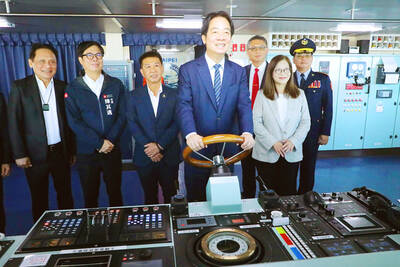
CALL FOR SUPPORT: President William Lai called on lawmakers across party lines to ensure the livelihood of Taiwanese and that national security is protected President William Lai (賴清德) yesterday called for bipartisan support for Taiwan’s investment in self-defense capabilities at the christening and launch of two coast guard vessels at CSBC Corp, Taiwan’s (台灣國際造船) shipyard in Kaohsiung. The Taipei (台北) is the fourth and final ship of the Chiayi-class offshore patrol vessels, and the Siraya (西拉雅) is the Coast Guard Administration’s (CGA) first-ever ocean patrol vessel, the government said. The Taipei is the fourth and final ship of the Chiayi-class offshore patrol vessels with a displacement of about 4,000 tonnes, Lai said. This ship class was ordered as a result of former president Tsai Ing-wen’s (蔡英文) 2018
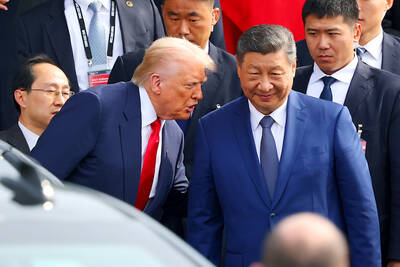
UKRAINE, NVIDIA: The US leader said the subject of Russia’s war had come up ‘very strongly,’ while Jenson Huang was hoping that the conversation was good Chinese President Xi Jinping (習近平) and US President Donald Trump had differing takes following their meeting in Busan, South Korea, yesterday. Xi said that the two sides should complete follow-up work as soon as possible to deliver tangible results that would provide “peace of mind” to China, the US and the rest of the world, while Trump hailed the “great success” of the talks. The two discussed trade, including a deal to reduce tariffs slapped on China for its role in the fentanyl trade, as well as cooperation in ending the war in Ukraine, among other issues, but they did not mention

HOTEL HIRING: An official said that hoteliers could begin hiring migrant workers next year, but must adhere to a rule requiring a NT$2,000 salary hike for Taiwanese The government is to allow the hospitality industry to recruit mid-level migrant workers for housekeeping and three other lines of work after the Executive Yuan yesterday approved a proposal by the Ministry of Labor. A shortage of workers at hotels and accommodation facilities was discussed at a meeting of the legislature’s Transportation Committee. A 2023 survey conducted by the Tourism Administration found that Taiwan’s lodging industry was short of about 6,600 housekeeping and cleaning workers, the agency said in a report to the committee. The shortage of workers in the industry is being studied, the report said. Hotel and Lodging Division Deputy Director Cheng
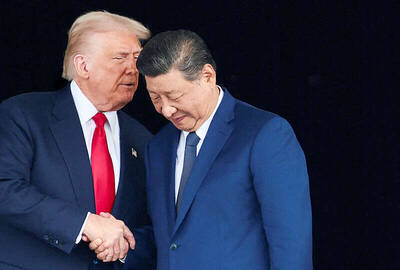
‘SECRETS’: While saying China would not attack during his presidency, Donald Trump declined to say how Washington would respond if Beijing were to take military action US President Donald Trump said that China would not take military action against Taiwan while he is president, as the Chinese leaders “know the consequences.” Trump made the statement during an interview on CBS’ 60 Minutes program that aired on Sunday, a few days after his meeting with Chinese President Xi Jinping (習近平) in South Korea. “He [Xi] has openly said, and his people have openly said at meetings, ‘we would never do anything while President Trump is president,’ because they know the consequences,” Trump said in the interview. However, he repeatedly declined to say exactly how Washington would respond in


 RSS
RSS