


LG Electronics Inc reported record quarterly profit as mobile-phone sales surged, challenging Motorola Inc as the world’s third-largest handset maker.
Second-quarter net income climbed 84 percent to 706.9 billion won (US$695 million), from 384.6 billion won a year earlier, Seoul-based LG said in a statement yesterday. Revenue increased 22.5 percent to 7.23 trillion won.
Mobile-phone shipments advanced 45 percent as LG’s Viewty, Voyager and Secret models helped meet demand for touch-screen handsets spurred by the success of Apple Inc’s iPhone. LG, which joins Nokia Oyj in posting phone earnings that beat estimates, forecast growth will slow as global economies weaken.
“LG’s earnings look good so far mainly because of the progress in its main business,” said Kim Young-tae, who helps manage about US$400 million at KTB Asset Management Co in Seoul.
Still, “slowing global growth will cool demand for mobile phones and other products,” Kim said.
LG Electronics rose 4.1 percent to close at 113,500 won on the Korea Exchange. That extended this year’s advance to 13.5 percent, the biggest gain among shares of the world’s four largest mobile-phone makers.
Net income missed the 826 billion won median estimate in a Bloomberg survey of 12 analysts after LG booked 170 billion won in currency-related losses and faced a higher tax rate. Profit was helped by contributions from subsidiary LG Display Co, whose earnings tripled last quarter.
Operating income, or sales minus the cost of goods sold and administrative expenses, quadrupled to 634.8 billion won, beating the 613 billion won median estimate in the Bloomberg survey.
Profit at the mobile-phone division, which accounted for 38 percent of revenue last year, doubled to 547.3 billion won, exceeding the median analyst estimate by about 5 percent. LG shipped a record 27.7 million phones during the quarter. Goldman, Sachs & Co estimates LG overtook Motorola in terms of shipments during the second quarter.
Nokia reported earnings and revenue last week that exceeded analysts’ estimates and forecast industry shipments this year may surpass its previous projection of about 10 percent growth.
Lehman Brothers Holdings Inc and JPMorgan Chase & Co have cut their price estimates on LG’s stock this month, citing concerns that a slowing global economy will undermine demand for mobile phones. LG’s profit probably peaked in the second-quarter, James Kim, an analyst at Lehman, wrote in a note last week.
LG said that profitability at its mobile-phone division will decline from the second quarter because of slower demand and rising competition, though margins will remain above 10 percent.
LG’s display division, which sells plasma screens and TVs, posted a 117 billion won loss, narrowing from 265 billion won a year earlier, after sales rose 23 percent.
Profit at the home-appliances division rose 20 percent to 207 billion won on higher sales from the Middle East and Asia, the company said.
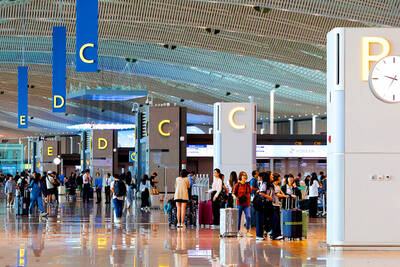
South Korea has adjusted its electronic arrival card system to no longer list Taiwan as a part of China, a move that the Ministry of Foreign Affairs said would help facilitate exchanges between the two sides. South Korea previously listed “Taiwan” as “Taiwan (China)” in the drop-down menus of its online arrival card system, where people had to fill out where they came from and their next destination. The ministry had requested South Korea make a revision and said it would change South Korea’s name on Taiwan’s online immigration system from “Republic of Korea” to “Korea (South),” should the issue not be

The Legislative Yuan’s Finance Committee yesterday approved proposed amendments to the Amusement Tax Act (娛樂稅法) that would abolish taxes on films, cultural activities and competitive sporting events, retaining the fee only for dance halls and golf courses. The proposed changes would set the maximum tax rate for dance halls and golf courses at 50 and 20 percent respectively, with local governments authorized to suspend the levies. Article 2 of the act says that “amusement tax shall be levied on tickets sold or fees charged by amusement places, facilities or activities” in six categories: “Cinema; professional singing, story-telling, dancing, circus, magic show, acrobatics

Tainan, Taipei and New Taipei City recorded the highest fines nationwide for illegal accommodations in the first quarter of this year, with fines issued in the three cities each exceeding NT$7 million (US$220,639), Tourism Administration data showed. Among them, Taipei had the highest number of illegal short-term rental units, with 410. There were 3,280 legally registered hotels nationwide in the first quarter, down by 14 properties, or 0.43 percent, from a year earlier, likely indicating operators exiting the market, the agency said. However, the number of unregistered properties rose to 1,174, including 314 illegal hotels and 860 illegal short-term rental

INFLATION UP? The IMF said CPI would increase to 1.5 percent this year, while the DGBAS projected it would rise to 1.68 percent, with GDP per capita of US$44,181 The IMF projected Taiwan’s real GDP would grow 5.2 percent this year, up from its 2.1 percent outlook in January, despite fears of global economic disruptions sparked by the US-Iran conflict. Taiwan’s consumer price index (CPI) is projected to increase to 1.5 percent, while unemployment would be 3.4 percent, roughly in line with estimates for Asia as a whole, the international body wrote in its Global Economic Outlook Report published in the US on Monday. The figures are comparatively better than the IMF outlook for the rest of the world, which pegged real GDP growth at 3.1 percent, down from 3.3 percent


 RSS
RSS