


Indian IT firms that thrived on the outsourcing boom in the West are themselves headed offshore from Malaysia to Mexico to escape the double sting of surging salaries and a rising rupee.
Tata Consultancy, Infosys, Wipro, Satyam and smaller companies are stepping up acquisitions and opening more facilities closer to US and European clients to cut costs -- the reason why work was farmed out to India in the first place.
Salaries of software professionals rose 18.7 percent this year, a survey showed Tuesday, while the rupee has gained almost 10 percent this year to near 10-year highs against the US dollar.
That's eroding the cost advantage once enjoyed by the US$50 billion information technology industry, which bills two-thirds of sales in US dollars but whose expenses are almost all incurred in rupees.
IT firms are "off-shoring" work to time zones and locations nearer their clients in a reversal of the trend that made Bangalore, India's Silicon Valley, the favorite back-office of the world's biggest firms.
Bangalore also gave the English language a new slang verb: being "bangalored" in the US meant a person had lost his job because it had been handed to an IT company in India that would do it for a fraction of the cost.
The term looks set to lose its pejorative punch as the same IT industry, which employs 1.63 million people at home, creates and sustains thousands of jobs abroad.
This week Wipro opened a facility in the Mexican city of Monterrey to service American and European clients and Satyam launched a software center in MSC Malaysia, a government-designated high-tech zone.
"In the past, we viewed off-shoring as India-centric, but we do not do it any more," said Satyam founder B. Ramalinga Raju, who on Monday opened the center to support business in the US, Southeast Asia and the Middle East.
"We look at off-shoring as delivering through high-quality workforce in lower-cost countries," he said.
Hyderabad-based Satyam has hired 300 mostly Malaysian IT engineers to work at the facility, whose workforce will rise to 2,000 in four years to cater to clients such as GlaxoSmithKline, one of its top 10 customers.
Malaysia was chosen because of its "competitive cost environment," said Raju, whose company is distributing work to locations where "it makes the most business sense."
Wipro will add to the 100 employees it hired in Mexico and invest in other lower-cost locations, said chairman Azim Premji, who last month paid US$600 million to buy US-based outsourcing firm Infocrossing to serve US clients.
Mumbai-based Tata Consultancy, India's top software maker, opened a center in the Mexican city of Guadalajara with 500 employees and said it will employ "thousands more" in the next five years.
Mexico shares a similar time zone with and is within five hours flying distance from anywhere in the US, enabling TCS to provide "nearshore services" to clients, the company said.
Infosys Technologies opened a 400-person facility in the Czech Republic to service European clients and purchased the service centers of Royal Philips in Poland and Thailand besides India. It's also weighing potential acquisitions.
At home, wage bills are rising as Indian firms compete with multinationals to hire and keep scarce software talent.
The IT industry's average annual salary rose 11 percent this year to 620,000 rupees (US$15,320), said a survey by the market-research firm IDC India for Dataquest magazine, a considerable amount in a country where the per capita income is less than US$900.
"Indian tech companies must find a way out of this ever increasing wage rise as rupee appreciation squeezes their margins further," the industry survey said.


RESILIENCE: Taiwan plays a key role in semiconductors, energy, information infrastructure and advanced manufacturing, AIT Director Raymond Greene said Taiwan’s continued investment in deterrence and resilience remains vital, especially in uncrewed systems and other emerging technologies, American Institute in Taiwan (AIT) Director Raymond Greene said yesterday. Greene made the remarks at the annual National Strategic Summit on Supply Chain Resilience held by the Research Institute for Democracy, Society and Emerging Technology (DSET), a government-backed think tank. As Taiwan last year became the US’ fourth-largest trading partner and supply chain security is becoming more important, cooperation in emerging technologies continues to deepen between the two countries, he said. The US is committed to accelerating innovation, building key infrastructure, strengthening cooperation

The National Chungshan Institute of Science and Technology yesterday showcased its locally developed variants of the Vision 60 robotic patrol dog, which it plans to deploy on the nation’s outlying territories in the South China Sea. The variants were produced under the Joint Lab project — created by the institute and domestic companies — and assembled with domestically produced motors, lenses and artificial intelligence (AI) systems alongside licensed tech from the US, Missile and Rocket Systems Research Division deputy director Jen Kuo-kang (任國光) told the media event at a military base in Taipei’s Dazhi (大直) area. Taiwan has built up its strengths

RIGHT DIRECTION: Taiwan’s efforts to prevent forced labor include a proposal to ‘fully prohibit’ employers from withholding workers’ documents, an official said Taiwan is to establish a mechanism to restrict imports of goods linked to forced labor, the Executive Yuan said yesterday, after the US proposed imposing additional tariffs on Taiwanese goods over labor concerns. “The Ministry of Labor and the Ministry of Economic Affairs are to establish an interministerial review procedure,” Executive Yuan spokesperson Michelle Lee (李慧芝) said at a news briefing in Taipei. “The government is to use the Foreign Trade Act [貿易法] as the legal basis to restrict imports of goods produced with forced labor” and bring its supply chain governance more in line with international standards on human rights, resilience
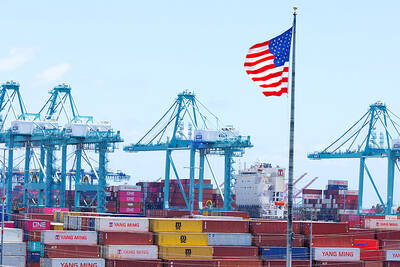
NOT IMMEDIATE: Taiwan has a chance to appeal the proposed 10 percent tariff before it starts, while other countries face a 12.5 percent tariff from the trade office Taiwan is among 60 economies determined by the US to have failed to impose or enforce a ban on the importation of goods produced with forced labor, according to a notice released on Tuesday by the Office of the US Trade Representative (USTR), which proposed imposing an additional 10 percent or more tariff on them. The USTR in a statement said that following an investigation, it had determined under Section 301 of the Trade Act of 1974 that the failure of the 60 economies to impose and effectively enforce a prohibition on the importation of goods produced with forced labor is


 RSS
RSS