


India's largest conglomerate is pinning its hopes on an Arabian Sea coast oil refinery, poised to become the world's largest, to catapult it and the country to industrial giant status.
"It is not just a refinery. We believe the refinery challenges the paradigm that China is forging ahead of India with its industry," Reliance Industries executive director Hital Meswani told reporters on a tour of the Jamnagar complex.
The sprawling facility in Gujarat state, which opened in December 1999, occupies 30km2 -- one-third the size of Manhattan -- and has helped move India from being a net importer of refined petroleum product to an exporter.
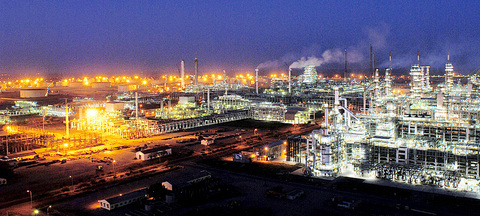
PHOTO: AFP
Reliance is set to invest a further US$6 billion in a bid to double output. Although Reliance gives few financial details for Jamnagar, analysts believe the facility will move into profit in 2009.
"It's a refinery for the world, based out of India," Meswani said of the complex, set for another expansion in 2008 -- and a move to the world's top spot from its current third place behind Venezuela and South Korea.
"We want to take India to the world and to transform Jamnagar as the refining hub for the world," he said. "India is often compared to China -- India for its services sector and China for its industrial sector. [But] we want to show what India can do on the manufacturing and industry sides."
In China, the industrial sector accounts for 46 percent of GDP, compared to 27 percent in India.
Reliance is a corporate behemoth that has straddled India's economy for decades with activities in petrochemicals, oil and gas, refining, power, insurance and telecommunications.
Situated in the Gulf of Kutch on the Arabian Sea, the refinery took just three years to build. The firm says its 5,000km of pipes, 1.7 million tonnes of concrete, 14,000km of cable and equivalent in steel of 16 Eiffel towers represent a record.
Work is entirely automated and overseen by engineers working out of underground control rooms, which are adorned with the portraits of the late Reliance founder Dhirubhai Ambani. None of the employees belong to a trade union.
It also has its own power station, a super tanker port, fire station, medical teams and security service, 170km of roads and a residential area of 2,500 homes -- making it virtually a self-sufficient "state within a state." A green belt is also hoped to lead to the production of 3,000 tonnes of mangoes a year.
"The volume, the energy consumption, the capital costs [and] the integration make the refinery unique in the world," the facility's sector chief D.M. Katre said.
The facility is producing 33 million tonnes of refined products -- gasoline, diesel, kerosene and liquefied petroleum gas -- plus petrochemicals each year.
Since opening, the complex has served 5,000 ships and "only Rotterdam is handling more refined products," said marine captain Sunil Pradham.
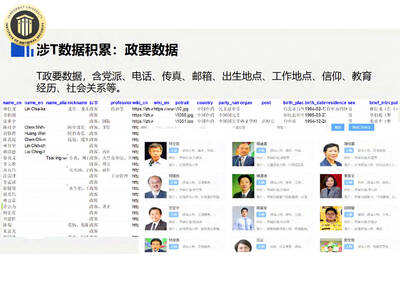
NETWORK-MAPPING PROJECT: The database contains 170 detailed files of Taiwanese politicians and about 23 million records of household registration data in Taiwan China has developed a network-mapping project targeting political figures and parties in Taiwan to monitor public opinion during elections and to craft tailored influence campaigns aimed at dividing Taiwanese society, according to documents leaked by Chinese technology firm GoLaxy (中科天璣). The documents, collected by Taipei-based Doublethink Lab, showed a database was specifically created to gather detailed information on Taiwanese political figures, including their political affiliations, job histories, birthplaces, residences, education, religion and a brief biography about them. Several notable Taiwanese politicians are in the database, including President William Lai (賴清德), former president Tsai Ing-wen (蔡英文), Minister of Foreign Affairs Lin Chia-lung (林佳龍),
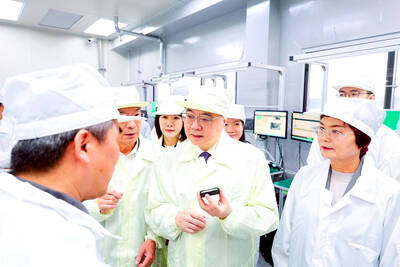
KEY INDUSTRY: The vice premier discussed a plan to create a non-red drone supply chain by next year, which has been allocated a budget of more than NT$7.2 billion The government has budgeted NT$44.2 billion (US$1.38 billion) to cultivate Taiwan’s uncrewed aerial vehicle (UAV) industry over the next five years, which would make the nation a major player in the industry’s democratic supply chain in the Asia-Pacific region, Premier Cho Jung-tai (卓榮泰) said yesterday. Cho made the remarks during a visit to the facilities of Cub Elecparts Inc (為升電裝). Democratic Progressive Party (DPP) Legislator Chen Su-yueh (陳素月) and Chinese Nationalist Party (KMT) Legislator Hsieh Yi-fong (謝依鳳) also participated in the trip. Cub Elecparts has transitioned from the automotive industry to the defense industry, which is the top priority among the nation’s
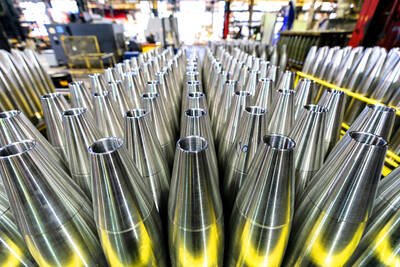
UPGRADED MISSILE: The Chungshan Institute of Science and Technology is reportedly to conduct a live-fire test of the Hsiung Feng III anti-ship missile on Thursday next week The US Army is planning to build new facilities to boost explosives production and strengthen its supply chain, a move aimed at addressing munitions shortages and supporting obligations to partners including Taiwan, Ukraine and Israel, Defense News reported. The army has issued a sources sought notice for a proposed Center of Excellence at the Blue Grass Army Depot in Kentucky, the report said. The facility would serve as a hub within the US industrial base for the production of key military explosives, including research department explosives (RDX) and high melting explosives (HMX), while also supporting research and development of next-generation materials. The proposed
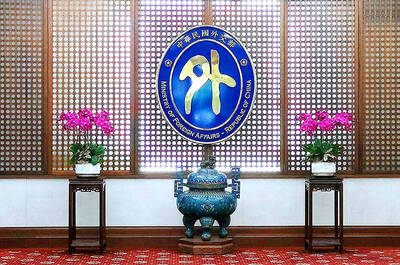
SOUTH KOREA DISPUTE: If Seoul continues to ignore its request, Taiwan would change South Korea’s designation on its arrival cards, the foreign ministry said If South Korea does not reply appropriately to a request to correct Taiwan’s name on its e-Arrival card system before March 31, the government would take corresponding measures to change how South Korea is labeled on the online Taiwan Arrival Card system, the Ministry of Foreign Affairs said yesterday. South Korea’s e-Arrival card system lists Taiwan as “China (Taiwan)” in the “point of departure” and “next destination” fields. Taipei has asked Seoul to change the wording. Since March 1, South Koreans who hold government-issued Alien Resident Certificates (ARC) have been identified as from “South Korea” rather than the “Republic of Korea,” the


 RSS
RSS