


For the first time, all the top picks in Consumer Reports' annual vehicle guide are made by Japanese automakers.
The Honda Civic is the magazine's top small sedan, while the Toyota Highlander Hybrid is the top mid-sized sport utility vehicle, according to results released on Wednesday. Vehicles from Nissan Motor Co and Subaru, a division of Fuji Heavy Industries Ltd, round out the top picks in 10 categories.
Asian brands also fared best in the magazine's survey of vehicle reliability. Toyota Motor Corp's Lexus brand was first, while Honda was second and the Toyota brand was third. Ford Motor Co's Mercury brand was the only domestic nameplate to crack the top 10.
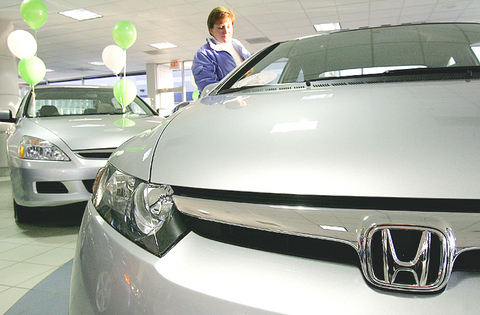
PHOTO: AP
Consumer Reports' rankings are important to automakers, even though companies can't use the ratings in their advertising. Consumer Reports spokeswoman Lauren Hackett said the April auto issue is consistently the magazine's most popular, selling more than 300,000 copies at newsstands. That's twice as many copies as its second-most popular issue, the November electronics issue.
Consumer Reports began its top-picks list in 1997. It is based on road and track tests, evaluations of comfort, convenience and fuel economy, crash protection ratings from the government and insurance industry and readers' reliability rankings. The magazine said it recently tested more than 200 vehicles to come up with its top picks.
Honda on top
Honda Motor Co had the most winners, snagging top picks in five of the 10 categories. In addition to the redesigned Civic, the Honda Accord was the top family sedan between US$20,000 and US$30,000, and the Acura TL was the top upscale sedan between US$30,000 and US$40,000.
The Honda Odyssey was the top minivan and the Honda Ridgeline, which is Honda's first entry in the pickup market, was the top pickup.
Toyota and Subaru each had two winners, including the Subaru Forester for small SUV and the Toyota Prius for "green car." Nissan had one, the M35 luxury sedan, which the magazine called "an excellent balance of performance, comfort and handling."
Consumer Reports said that Japanese and Korean brands had 12 problems per 100 vehicles, while US automakers had 18 problems and European makers had 21 problems. Asian and US automakers have been improving their scores but appeared to stall last year, the magazine said. European automakers' ratings haven't changed substantially in the last four years, the magazine said.
Less honorable mention
After Lexus, Honda and Toyota, the brands rounding out the top 10 for reliability were Mitsubishi, Subaru, Acura, Scion, Mercury, Mazda and Suzuki.
The 10 lowest-rated brands were Audi, Infiniti, Saturn, Lincoln, Jaguar, Mercedes-Benz, Volkswagen, Land Rover, Hummer and Porsche.

POLITICAL AGENDA: Beijing’s cross-strait Mid-Autumn Festival events are part of a ‘cultural united front’ aimed at promoting unification with Taiwan, academics said Local authorities in China have been inviting Taiwanese to participate in cross-strait Mid-Autumn Festival celebrations centered around ideals of “family and nation,” a move Taiwanese academics said politicizes the holiday to promote the idea of “one family” across the Taiwan Strait. Sources said that China’s Fujian Provincial Government is organizing about 20 cross-strait-themed events in cities including Quanzhou, Nanping, Sanming and Zhangzhou. In Zhangzhou, a festival scheduled for Wednesday is to showcase Minnan-language songs and budaixi (布袋戲) glove puppetry to highlight cultural similarities between Taiwan and the region. Elsewhere, Jiangsu Province is hosting more than 10 similar celebrations in Taizhou, Changzhou, Suzhou,
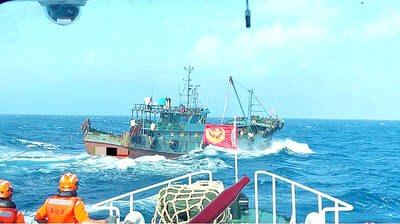
COGNITIVE WARFARE: Chinese fishing boats transmitting fake identification signals are meant to test Taiwan’s responses to different kinds of perceived incursions, a report said Chinese vessels are transmitting fake signals in Taiwan’s waters as a form of cognitive warfare, testing Taipei’s responses to various types of incursions, a report by the Institute for the Study of War said on Friday. Several Chinese fishing vessels transmitted fake automatic identification system (AIS) signals in Taiwan’s waters last month, with one mimicking a Russian warship and another impersonating a Chinese law enforcement vessel, the report said. Citing data from Starboard Maritime Intelligence, the report said that throughout August and last month, the Chinese fishing boat Minshiyu 06718 (閩獅漁06718) sailed through the Taiwan Strait while intermittently transmitting its own AIS
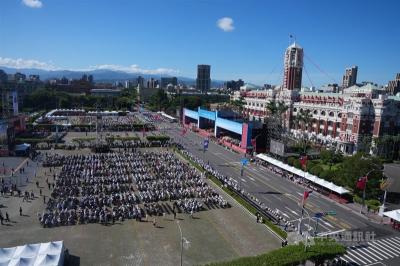
The Republic of China (ROC) is celebrating its 114th Double Ten National Day today, featuring military parades and a variety of performances and speeches in front of the Presidential Office in Taipei. The Taiwan Taiko Association opened the celebrations with a 100-drummer performance, including young percussionists. As per tradition, an air force Mirage 2000 fighter jet flew over the Presidential Office as a part of the performance. The Honor Guards of the ROC and its marching band also heralded in a military parade. Students from Taichung's Shin Min High School then followed with a colorful performance using floral imagery to represent Taiwan's alternate name

CHINESE INFILTRATION: Medical logistics is a lifeline during wartime and the reported CCP links of a major logistics company present a national security threat, an expert said The government would bolster its security check system to prevent China from infiltrating the nation’s medical cold chain, a national security official said yesterday. The official, who wished to stay anonymous, made the remarks after the Chinese-language magazine Mirror Media (鏡周刊) reported that Pharma Logistics (嘉里醫藥物流) is in charge of the medical logistics of about half of the nation’s major hospitals, including National Taiwan University Hospital and Taipei Veterans General Hospital. The company’s parent, Kerry TJ Logistics Co (嘉里大榮物流), is associated with the National Committee of the Chinese People’s Political Consultative Conference (CPPCC) and the Chinese People’s Liberation Army (PLA), the


 RSS
RSS