


Chinese vessels are transmitting fake signals in Taiwan’s waters as a form of cognitive warfare, testing Taipei’s responses to various types of incursions, a report by the Institute for the Study of War said on Friday.
Several Chinese fishing vessels transmitted fake automatic identification system (AIS) signals in Taiwan’s waters last month, with one mimicking a Russian warship and another impersonating a Chinese law enforcement vessel, the report said.
Citing data from Starboard Maritime Intelligence, the report said that throughout August and last month, the Chinese fishing boat Minshiyu 06718 (閩獅漁06718) sailed through the Taiwan Strait while intermittently transmitting its own AIS and the AIS of a ship called Haixun 15012 (海巡15012).
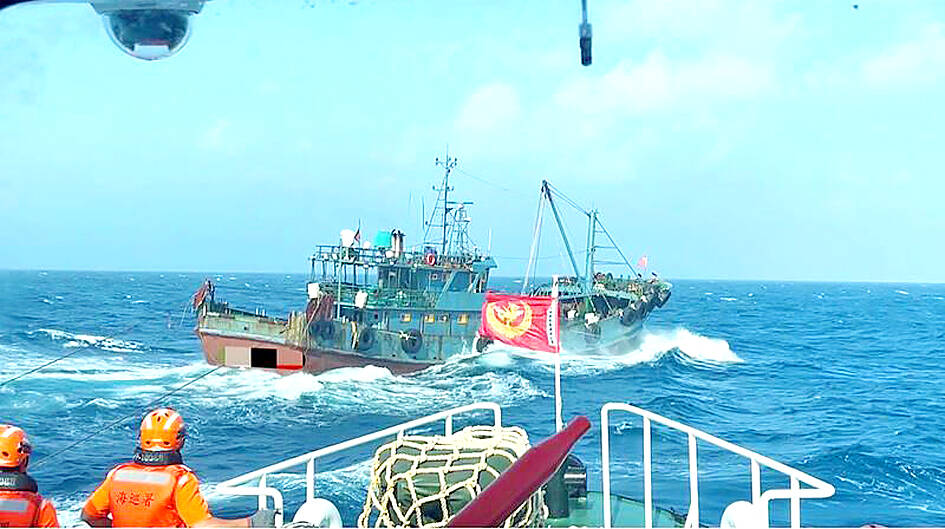
Photo courtesy of the Coast Guard Administration
Haixun ships are normally operated by the China Maritime Safety Administration (CMSA), a civilian law enforcement agency that has not been significantly involved in Chinese coercion against Taiwan, the report said.
This makes it likely that it was a fishing vessel posing as a CMSA vessel, rather than the other way around, it said.
On Sept. 17, another fishing boat, Minshiyu 07792 (閩獅漁07792), transmitted a fake signal of Russian Warship 532 in Taiwan’s northern exclusive economic zone, it said.
Several other Minshiyu vessels also transmitted fake AIS signals around the same time and area, with one posing as a tugboat and another as a different fishing boat, the report said.
China is experimenting with AIS spoofing to “pollute Taiwan’s information environment and test Taiwan’s responses to different kinds of perceived incursions,” it said.
That multiple fishing vessels with similar names transmitted different fake signals around the same time and place suggests a coordinated effort, it said.
These fishing boats likely belong to the Chinese maritime militia, which China often deploys to “carry out deniable ‘gray zone’ coercion, harassment and surveillance” in the Taiwan Strait and South China Sea, it said.
In addition, China Coast Guard vessels entered restricted waters around Kinmen County four times from Sept. 15 to 17.
While the overall frequency of three to four incursions per month has remained steady, the increasing concentration over short periods represents a new pattern, the report said.
In terms of airspace incursions, Chinese sorties into Taiwan’s air defense identification zone (ADIZ) have surpassed 300 per month for eight continuous months, more than double the monthly average before President William Lai (賴清德) took office in May last year.
China has “likely normalized a higher frequency of ADIZ incursions to degrade Taiwan’s threat awareness and response threshold, and to probe response protocols,” the report said.
Beijing’s increasingly routine incursions into Taiwan’s ADIZ have raised the bar for what constitutes a coercive act, “making it more difficult for Taiwan to detect and respond to a real threat effectively,” it said.
Maintaining readiness for these frequent incursions also places heavy demands on Taiwan’s resources and personnel, it added.
Additional reporting by CNA

‘NO SECURITY RISK’: The Railway Bureau reassured the public that the technicians’ activities were limited to technical guidance and did not involve sensitive systems The Railway Bureau yesterday said it had invited eight Chinese technicians to assist with an airport MRT construction project. The bureau issued the confirmation after an Internet user said Chinese nationals had entered the construction zone of Taiwan Taoyuan International Airport’s Terminal 3 project. They asked why “individuals from an enemy state” were allowed access to such a major national infrastructure project, which raised serious concerns over Taiwan’s industrial safety, sensitive systems and information security. The bureau’s Northern Region Engineering Branch Office said subcontractor Taiwan Handle Industrial Co (台灣手把工業) of the Taoyuan airport MRT’s “Contract No. CU05 Project A14 Station Civil, MEP &

A US uncrewed surface vessel (USV) encountered multiple Chinese warships during an autonomous transit of the Taiwan Strait, US defense company Seasats said in a statement on Wednesday. Seasats announced that a Lightfish USV had completed the first autonomous transit of the Taiwan Strait. Over five days, the USV traversed the entire length of the Strait while constantly monitoring surface vessel traffic, the company said. The Lightfish encountered multiple Chinese warships, one of which was a Chinese People’s Liberation Army Navy (PLAN) Type 056 corvette, it said. The Chinese vessels were operating “well within Taiwan’s exclusive economic zone without transmitting their identity via the

Taiwan is still in the process of assessing the possibility of recruiting workers from Eswatini, the Ministry of Foreign Affairs said yesterday, adding that its goal is to help Eswatini upgrade its vocational training centers. If there are plans to recruit workers from Eswatini, safeguarding national security, protecting public health and ensuring the employment rights of Taiwanese would be prerequisites, Department of West Asian and African Affairs Director-General Yen Chia-liang (顏嘉良) told a news conference. Key considerations would also include filling labor shortages in specific industries, and fostering bilateral professional and technical exchanges, he said. Yen was asked about the progress of labor

‘BOOMING’: ’ The number of partners we have here is incredible. You can see from their stock prices. They’re doing so well, they’re so happy,’ Jensen Huang said Nvidia Corp’s spending in Taiwan has ballooned to about US$150 billion a year, 10 times the US$10 billion to US$15 billion the company spent five years ago, Nvidia chief executive officer Jensen Huang (黃仁勳) said yesterday, suggesting Taiwan’s strategic importance in the global artificial intelligence (AI) supply chain. “Taiwan is the epicenter of the AI revolution. This is where the chips come, packaging comes. This is where the systems are made. This is where AI supercomputers were created,” Huang said at a meeting for the company’s employees in Beitou-Shilin Technology Park (北投士林科技園區) in Taipei, the planned site of Nvidia’s Taipei headquarters. “Taiwan


 RSS
RSS