


General Motors Corp (GM) heads into a critical week as the world's largest auto maker faces the bankruptcy filing of its top components supplier and tough negotiations with its workers' union.
The company, which lost more than US$1.2 billion in the first six months of this year, is seeking help from the United Auto Workers (UAW) union to help reduce its healthcare and pension costs, while working to limit the negative repercussions of Saturday's bankruptcy filing of its largest components supplier, Delphi Corp.
Delphi, which was spun-off from GM in 1999, and its decision to seek bankruptcy protection could pose enormous financial hardships for GM, since the company could be held liable for funding the supplier's pension equity, which is currently underfunded by US$4.3 billion.
Delphi had been seeking some type of bailout from its former parent company to avoid bankruptcy, but those negotiations failed to reach a mutually beneficial settlement.
GM has nearly US$16 billion in cash but can ill afford to pay Delphi's pension burdens at a time when it needs all its cash to fund future product programs. The automaker is trying to reverse a sharp decline in market share and compensate for shrinking sales in its most profitable models: full-sized trucks and SUVs.
The automaker says it does not expect Delphi's bankruptcy filing to trigger any obligation for it to pay for the supplier's pension obligations.
"In connection with the Delphi split-off, GM has provided limited guarantees with respect to certain benefits payable by Delphi to former GM US hourly employees who transferred to Delphi relating to pensions, post-retirement health care and life insurance. The Delphi Chapter 11 filing does not by itself trigger any of the benefit guarantees," the automaker said in a statement.
Union members could be some of the biggest losers in the fallout from the bankruptcy of Delphi.
"We may be witnessing the destruction of organized labor as we've known it in the auto industry," said David Cole, head of the Center for Automotive Research in Ann Arbor, Michigan.
Cole said that the bankruptcy would have profound impact on the US auto industry and its major unions, which over the past 60 years have built contract protections that guaranteed relatively high wages, medical benefits and pensions.
The top executive at Delphi, North America's largest automotive supplier, said on Saturday the company hopes to use court protection under Chapter 11 of the US bankruptcy code to force a re-write of labor contracts that have made it hard to compete in what is now a global business.
For now Delphi will continue to pay its 35,000 US employees under the current labor contract with the UAW and other unions.
"Our people will get their pay checks and will still have their health benefits. Retirees will continue to get their checks," Delphi chairman Robert "Steve" Miller said.
But Delphi expects to negotiate a new labor agreement by late winter with the UAW that will enable it to become more competitive. The bankruptcy laws require a good-faith effort to reach an equitable agreement with the UAW, but the company is also prepared to use the court to impose a new contract on the union, Miller said.
In negotiations prior to filing for bankruptcy protection, Delphi was looking for deep cuts in the pay and benefits of hourly workers, he confirmed. The company also expects to close or sell some of its plants, Miller said.
The UAW has said that the cuts Delphi sought would mean workers would no longer be able to buy cars made with the parts they built. It said on Saturday it was "deeply disappointed" by the decision to file for bankruptcy.
UAW president Ron Gettelfinger said the UAW was committed to doing everything it could to protect the interests of active and retired members and their families. And he ripped Delphi's decision to improve the severance package for the company's top management even as it was preparing to file for court protection.
"Once again, we see the disgusting spectacle of the people at the top taking care of themselves at the same time they are demanding extraordinary sacrifices from their hourly workers, engineers, administrative and support staff, mid-level managers and others. All of them deserved better from Delphi's senior executive leadership," Gettelfinger said.
Miller said the company was paying double the market rate to union members and defended the severance packages as necessary to help retain the executive talent needed to restructure the company.
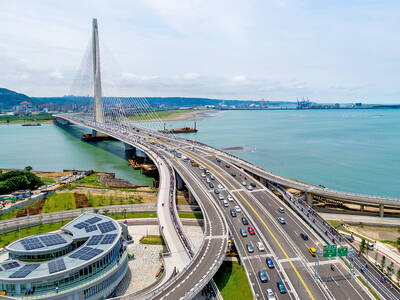
The Ministry of Transportation and Communications yesterday inaugurated the Danjiang Bridge across the Tamsui River in New Taipei City, saying that the structure would be an architectural icon and traffic artery for Taiwan. Feted as a major engineering achievement, the Danjiang Bridge is 920m long, 211m tall at the top of its pylon, and is the longest single-pylon asymmetric cable-stayed bridge in the world, the government’s Web site for the structure said. It was designed by late Iraqi-British architect Zaha Hadid. The structure, with a maximum deck of 70m, accommodates road and light rail traffic, and affords a 200m navigation channel for boats,
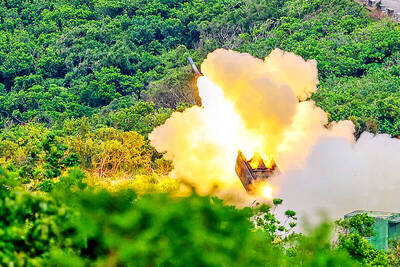
PRECISION STRIKES: The most significant reason to deploy HIMARS to outlying islands is to establish a ‘dead zone’ that the PLA would not dare enter, a source said A High Mobility Artillery Rocket System (HIMARS) would be deployed to Penghu County and Dongyin Island (東引) in Lienchiang County (Matsu) to force the Chinese military to retreat at least 100km from the coastline, a military source said yesterday. Taiwan has been procuring HIMARS and Army Tactical Missile Systems (ATACMS) from the US in batches. Once all batches have been delivered, Taiwan would possess 111 HIMARS units and 504 ATACMS, which have a range of 300km. Considering that “offense is the best defense,” the military plans to forward-deploy the systems to outlying islands such as Penghu and Dongyin so that

Taiwan Semiconductor Manufacturing Co (TSMC, 台積電), the world’s largest foundry service provider, yesterday said that global semiconductor revenue is projected to hit US$1.5 trillion in 2030, after the figure exceeds US$1 trillion this year, as artificial intelligence (AI) demand boosts consumption of token and compute power. “We are still at the beginning of the AI revolution, but we already see a significant impact across the whole semiconductor ecosystem,” TSMC deputy cochief operating officer Kevin Zhang (張曉強) said at the company’s annual technology symposium in Hsinchu City. “It is fair to say that in the past decade, smartphones and other mobile devices were
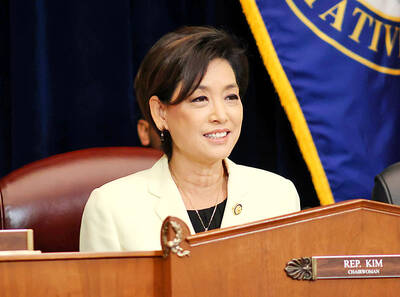
‘CLEAR MESSAGE’: The bill would set up an interagency ‘tiger team’ to review sanctions tools and other economic options to help deter any Chinese aggression toward Taiwan US Representative Young Kim has introduced a bill to deter Chinese aggression against Taiwan, calling for an interagency “tiger team” to preplan coordinated sanctions and economic measures in response to possible Chinese military or political action against Taiwan. “[Chinese President] Xi Jinping [習近平] has directed the People’s Liberation Army to be ready to invade Taiwan by 2027. China has a plan. America should have one too,” Kim said in a news release on Thursday last week. She introduced the “Deter PRC [People’s Republic of China] aggression against Taiwan act” to “ensure the US has a coordinated sanctions strategy ready should


 RSS
RSS