


In a sign of the growing economic importance of China, a chorus of warnings is coming from US experts about the impact of what is seen as an impending slowdown in the Asian economic powerhouse.
China's economic clout has not escaped US policymakers either. US officials said last month they hoped for Chinese participation in the G7 consultations of the top economic powers.
Private economists are warning that the likely cooling of China's red-hot economy will have important global implications.
"While China's GDP represented only a modest 4 percent of world GDP last year, it accounted for fully 13 percent of the world's growth," said Lehman Brothers economists Rob Subbaraman and John Llewellyn in a research note.
"And China's importance in world industrial output is even greater: increasingly the world's manufacturing sector, it consumes between 20 and 40 percent of many major raw materials," they said.
Added Morgan Stanley chief economist Stephen Roach, "The global impacts of the coming slowdown in China cannot be taken lightly. When today's Chinese economy sneezes, Asia and possibly even the rest of the world could well catch a cold."
The Chinese government late last month ordered that no approvals for new steel, aluminium and cement projects be made this year in a bid to halt "haphazard" and "redundant" investments.
In its latest attempt to cool the economy, the State Council issued a circular that also called for a nationwide examination of nearly all investment projects including commercial offices, golf courses and shopping malls.
Premier Wen Jiabao (
Still, the question of a slowdown on China's trading partners a concern in the US. US Treasury Under Secretary for International Affairs John Taylor will travel to China this month for consultations.
Morgan Stanley economist Richard Berner says however than fears for the US economy may be overblown.
"A slowdown in China's economy would have important implications for the US economy and financial markets, just as has the Chinese boom," he said.
"But contrary to fears that a significant slowdown in Chinese growth will trigger economic and financial turmoil, I see only limited US fallout. Unless it is truly a hard landing, a Chinese slowdown would only nick US economic growth," he said.
Nonetheless, some economists are saying the US should be prepared for the worst.
Subbaraman and Llewellyn cited "a significant risk -- say one in four -- of a hard landing" for China: "Whatever the outcome, it will impact most on Asia ... Beyond Asia, it would likely have mixed effects. Slower US and European exports would be unlikely to harm either region much; and global commodity prices could ease somewhat."
But the Lehman report said that if China were to suffer a hard economic landing, "we estimate that the rest of emerging Asia's GDP growth would drop by 3 percentage points, while Japan's growth would be half a percentage point lower enough to derail the fragile recovery in Japan's economy, and keep the deflation going."
"Should China's economy falter, the rest of the world would suffer," said Sung Won Sohn at Wells Fargo Bank.
Moreover, Sohn said China has little experience dealing with boom-and-bust cycles, "increasing the probability of an accident." Raising interest rates, he said, "could further attract speculative inflows of hot money into China."

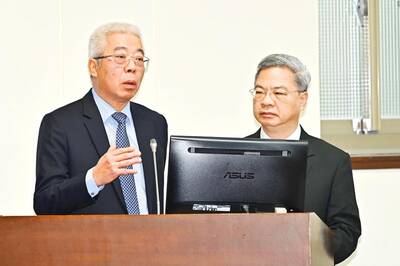
Taiwan has arranged for about 8 million barrels of crude oil, or about one-third of its monthly needs, to be shipped from the Red Sea this month to bypass the Strait of Hormuz and ease domestic supply pressures, CPC Corp, Taiwan (CPC, 台灣中油) said yesterday. The state-run oil company has worked with Middle Eastern suppliers to secure routes other than the Strait of Hormuz, through which about 20 percent of the world’s oil and liquefied natural gas typically passes, CPC chairman Fang Jeng-zen (方振仁) said at a meeting of the legislature’s Economics Committee in Taipei. Suppliers in Saudi Arabia have indicated they
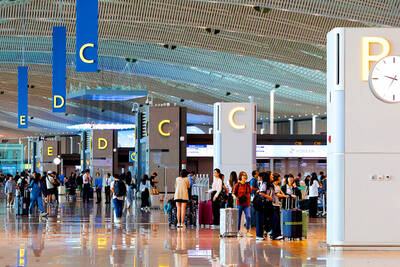
South Korea has adjusted its electronic arrival card system to no longer list Taiwan as a part of China, a move that the Ministry of Foreign Affairs said would help facilitate exchanges between the two sides. South Korea previously listed “Taiwan” as “Taiwan (China)” in the drop-down menus of its online arrival card system, where people had to fill out where they came from and their next destination. The ministry had requested South Korea make a revision and said it would change South Korea’s name on Taiwan’s online immigration system from “Republic of Korea” to “Korea (South),” should the issue not be

Tainan, Taipei and New Taipei City recorded the highest fines nationwide for illegal accommodations in the first quarter of this year, with fines issued in the three cities each exceeding NT$7 million (US$220,639), Tourism Administration data showed. Among them, Taipei had the highest number of illegal short-term rental units, with 410. There were 3,280 legally registered hotels nationwide in the first quarter, down by 14 properties, or 0.43 percent, from a year earlier, likely indicating operators exiting the market, the agency said. However, the number of unregistered properties rose to 1,174, including 314 illegal hotels and 860 illegal short-term rental
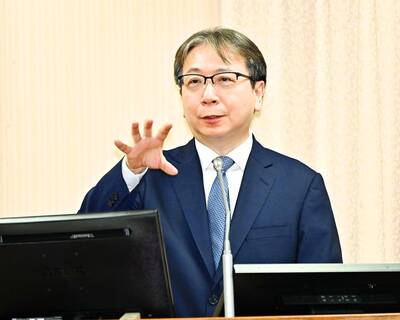
AIR ALERT: China’s reservation of airspace over the Yellow Sea and East China Sea could be an attempt to test the US’ response ahead of a Trump-Xi meeting, the NSB head said China’s attempts to infiltrate Taiwan are systematic, planned and targeted, with activity shifting from recruiting mid-level military officers to rank-and-file enlisted personnel, National Security Bureau (NSB) Director-General Tsai Ming-yen (蔡明彥) said yesterday. The Chinese Communist Party’s (CCP) integrates national security, intelligence operations and “united front” efforts into a dense network to conduct intelligence gathering and espionage in Taiwan, Tsai said at a meeting of the legislature’s Foreign Affairs and National Defense Committee. It uses specific networks to screen targets through exchange activities and recruiting local collaborators to establish intelligence-gathering organizations, he said. China is also shifting who it targets to lower-ranking military personnel,


 RSS
RSS