


Intel Corp, the world's largest semiconductor company, gained market share in the third quarter from Advanced Micro Devices Inc, its nearest rival in personal computer processors, researcher IDC said.
Intel's market share rose one percentage point to 82.6 percent, while Advanced Micro ended the quarter with 0.7 percent less at 16.5 percent, IDC analyst Shane Rau said in an e-mail.
"Overall, the PC microprocessor market earned significant unit and revenue growth in the third quarter of 2003," Rau said.
"The major suppliers, Intel and AMD, experienced notable unit growth and modest average selling-price growth over the second quarter of 2003," he said.
Processor unit shipments rose 22 percent in the third quarter from a year earlier, after gaining 14 percent in the second. Revenue increased 27 percent to about US$6.5 billion.
Compared with the second quarter, revenue grew 18 percent.
Rau said his research showed that demand for computer-related equipment has returned to "normal." Component manufacturers tend to get more orders in the third quarter as PC makers stock up ahead of the start of the academic year, when students need new equipment, and the year-end holiday season, when demand peaks.
By product, mobile processor shipments increased 13.6 percent and desktop processor shipments climbed 13 percent. Advanced Micro's mobile processor shipments jumped 72 percent in the third quarter from the preceding three months.
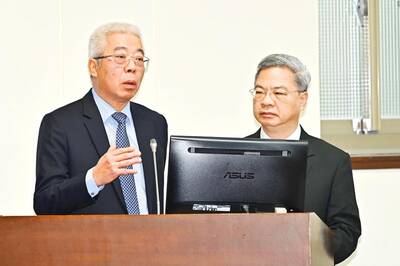
Taiwan has arranged for about 8 million barrels of crude oil, or about one-third of its monthly needs, to be shipped from the Red Sea this month to bypass the Strait of Hormuz and ease domestic supply pressures, CPC Corp, Taiwan (CPC, 台灣中油) said yesterday. The state-run oil company has worked with Middle Eastern suppliers to secure routes other than the Strait of Hormuz, through which about 20 percent of the world’s oil and liquefied natural gas typically passes, CPC chairman Fang Jeng-zen (方振仁) said at a meeting of the legislature’s Economics Committee in Taipei. Suppliers in Saudi Arabia have indicated they
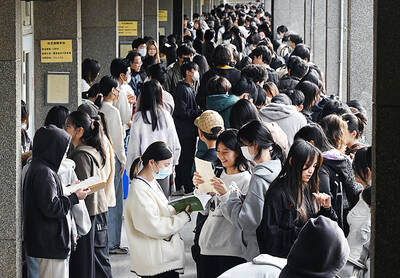
A global survey showed that 60 percent of Taiwanese had attained higher education, second only to Canada, the Ministry of the Interior said. Taiwan easily surpassed the global average of 43 percent and ranked ahead of major economies, including Japan, South Korea and the US, data from the Organisation for Economic Co-operation and Development (OECD) for 2024 showed. Taiwan has a high literacy rate, data released by the ministry showed. As of the end of last year, Taiwan had 20.617 million people aged 15 or older, accounting for 88.5 percent of the total population, with a literacy rate of 99.4 percent, the data

CCP ‘PAWN’? Beijing could use the KMT chairwoman’s visit to signal to the world that many people in Taiwan support the ‘one China’ principle, an academic said Chinese Nationalist Party (KMT) Chairwoman Cheng Li-wun (鄭麗文) yesterday arrived in China for a “peace” mission and potential meeting with Chinese President Xi Jinping (習近平), while a Taiwanese minister detailed the number of Chinese warships currently deployed around the nation. Cheng is visiting at a time of increased Chinese military pressure on Taiwan, as the opposition-dominated Legislative Yuan stalls a government plan for US$40 billion in extra defense spending. Speaking to reporters before going to the airport, Cheng said she was going on a “historic journey for peace,” but added that some people felt uneasy about her trip. “If you truly love Taiwan,

South Korea has adjusted its electronic arrival card system to no longer list Taiwan as a part of China, a move that the Ministry of Foreign Affairs said would help facilitate exchanges between the two sides. South Korea previously listed “Taiwan” as “Taiwan (China)” in the drop-down menus of its online arrival card system, where people had to fill out where they came from and their next destination. The ministry had requested South Korea make a revision and said it would change South Korea’s name on Taiwan’s online immigration system from “Republic of Korea” to “Korea (South),” should the issue not be


 RSS
RSS