


A shabbily dressed hawker squabbles with a teenager over the price of a latest Microsoft Windows program in Pakistan's biggest city Karachi.
The deal is closed at 40 rupees -- about US$0.70.
Saad Hasan has just bought a pirated copy of Windows XP, which is more readily available in Pakistan than the licensed product which retails at 5,800 rupees (US$100).
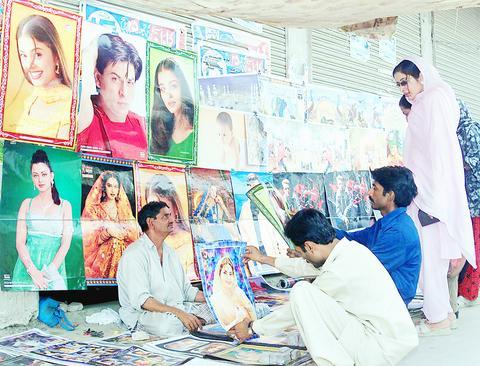
PHOTO: REUTERS
"Who can afford the original?" he said as he ran his fingers over row after row of CDs piled on the rickety push cart. "It would have cost me thousands of rupees. I can't afford that."
Another cart is stacked with Hollywood blockbusters and Indian "Bollywood" movies, all selling at less than a dollar.
The International Intellectual Property Alliance, based in Washington, ranked Pakistan one of the world's largest producers of pirated CDs and other optical discs for export in both 2001 and last year.
It said piracy of movies and music cost the industry around US$72 million in Pakistan last year and US$71 million the year before.
Now it wants Pakistan placed on the priority watchlist and has urged withdrawal of trade privileges on its exports to the US if the government fails to tackle the problem.
Pakistan says it has upgraded legislation to comply with international agreements. The Pakistani Commerce Ministry says it plans to set up an Intellectual Property Rights Organization to improve enforcement.
"Raids are conducted against violators and offenders are also being prosecuted," it said in a written response to queries.
"The illegal, offending material is being confiscated and in some cases being publicly destroyed."
Despite this claim, pirated products remain on open sale in virtually every market in the country.
Industry officials say a powerful mafia engaged in producing and selling pirated articles has effectively blocked half-hearted police efforts to crack down on the business.
According to Microsoft country manager Jawwad Rehman, more than 90 percent of the software and movies sold in Pakistan are pirated.
"We give heavy discounts to education institutions and students, but there are no buyers," he said. "They can get the pirated programs much cheaper."
Licensed Microsoft Office programs cost around 22,500 rupees (US$390), while the discounted rates are around 9,000 rupees (US$155). The pirated program on three CDs costs as little as 75 rupees (US$1.30).
The 12-story Rainbow Center in Saddar, the heart of Karachi, is Pakistan's biggest center for pirated movies and software with more than 200 shops.
Mohammed Omar, president of the Rainbow Video Cassette Dealers Association, said the market was providing a service for the poor.
"We are providing them with entertainment and knowledge. We cannot afford to sell copyright products as people cannot afford to buy," he said.
Tariq Rangoonwala, who runs Pulse Global, a company which markets English-language movies under licence for home entertainment, said piracy had all but killed his business.
"We started well in 1995, but now our sales are, I would say, non-existent," he said
Legitimate dealers are pushing the government to implement anti-piracy laws, but with little success.
"Laws are there to fight the problem," Rehman said. "The only issue is their implementation."

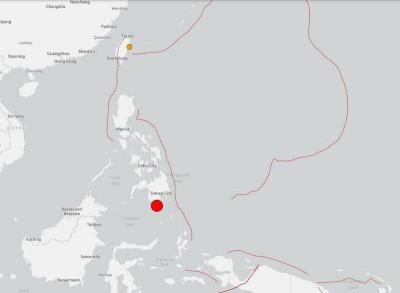
A magnitude 7.8 earthquake struck off the southern coast of Mindanao in the Philippines at 7:38am today, prompting the US Tsunami Warning System to issue an alert for neighboring countries, including Taiwan. The system issued a purple alert indicating a "tsunami threat." The potential threat zone includes Taiwan, the Philippines, Papua New Guinea, Yap and Palau. A spokesperson for Indonesia disaster mitigation agency said there were no reports of damage so far. Arlene Hollero, disaster chief of Maasim town in the Philippines' Sarangani Province, said their evacuation was underway in coastal villages and there were no reported casualties so far. DZBB radio, broadcasting from the

RESILIENCE: Taiwan plays a key role in semiconductors, energy, information infrastructure and advanced manufacturing, AIT Director Raymond Greene said Taiwan’s continued investment in deterrence and resilience remains vital, especially in uncrewed systems and other emerging technologies, American Institute in Taiwan (AIT) Director Raymond Greene said yesterday. Greene made the remarks at the annual National Strategic Summit on Supply Chain Resilience held by the Research Institute for Democracy, Society and Emerging Technology (DSET), a government-backed think tank. As Taiwan last year became the US’ fourth-largest trading partner and supply chain security is becoming more important, cooperation in emerging technologies continues to deepen between the two countries, he said. The US is committed to accelerating innovation, building key infrastructure, strengthening cooperation

The National Chungshan Institute of Science and Technology yesterday showcased its locally developed variants of the Vision 60 robotic patrol dog, which it plans to deploy on the nation’s outlying territories in the South China Sea. The variants were produced under the Joint Lab project — created by the institute and domestic companies — and assembled with domestically produced motors, lenses and artificial intelligence (AI) systems alongside licensed tech from the US, Missile and Rocket Systems Research Division deputy director Jen Kuo-kang (任國光) told the media event at a military base in Taipei’s Dazhi (大直) area. Taiwan has built up its strengths

RIGHT DIRECTION: Taiwan’s efforts to prevent forced labor include a proposal to ‘fully prohibit’ employers from withholding workers’ documents, an official said Taiwan is to establish a mechanism to restrict imports of goods linked to forced labor, the Executive Yuan said yesterday, after the US proposed imposing additional tariffs on Taiwanese goods over labor concerns. “The Ministry of Labor and the Ministry of Economic Affairs are to establish an interministerial review procedure,” Executive Yuan spokesperson Michelle Lee (李慧芝) said at a news briefing in Taipei. “The government is to use the Foreign Trade Act [貿易法] as the legal basis to restrict imports of goods produced with forced labor” and bring its supply chain governance more in line with international standards on human rights, resilience


 RSS
RSS