


Compaq Computer Corp chief executive Michael Capellas, who took over at the personal-computer maker in 1999, is hoping that his third reorganization will work.
Capellas, the former Oracle Corp executive whose two predecessors at Compaq were ousted by the board, last month sent a memo to employees outlining his latest effort to overhaul the company. His first two attempts failed to jump-start sales, and Compaq this year lost the title as the biggest PC seller to rival Dell Computer Corp.

PHOTO: BLOOMBERG
As PC sales slump, prices drop and profit margins narrow, Capellas is eyeing computer services, or setting up networks and managing systems and software for corporations. It's a strategy that helped International Business Machines Corp weather the slowdown in PC and computer demand -- and one that Compaq has tried and muffed before.
"They're doing a poor job of emulating" IBM, said Steven Salopek, a fund manager at Banc One Investment Advisors, which has reduced its Compaq shares to 4.4 million from 6.9 million, according to a March regulatory filing.
In Capellas's first reorganization, the Houston-based company last year reduced its distributors to four from more than 40, a move to mimic Dell, which sells PCs on the Internet and by phone.
In March, the company merged its corporate and consumer PC divisions and trimmed its workforce by 5,000.
"He took the helm of a company that needed open-heart surgery and his arsenal was a scalpel," said Ashok Kumar, an analyst at US Bancorp Piper Jaffray. "He should have brought in a hatchet." The changes didn't produce the expected increases in efficiency. With sales declining, Compaq has increased its job cuts this year to 8,500 workers, or 12 percent of its employees.
"These guys have a distribution problem and they've gone through a number of iterations mainly trying to compete against Dell," Salopek said. "They haven't executed." Capellas, 46, declined to be interviewed for this story, said Compaq spokesman Steve Sievert.
Compaq's past efforts to expand in services leave it far behind IBM, the biggest seller of computer hardware and related services. In 1998, Compaq bought Digital Equipment Corp for about US$9 billion, an acquisition meant to take on IBM with Digital's high-performance computers and services business. Instead, Compaq struggled to integrate Digital, and many consultants left the company after the sale.
In the first quarter, Compaq's Global Services revenue rose 4 percent to US$1.94 billion, or 21 percent of total sales. By comparison, IBM generated US$8.74 billion of its revenue from services in the second quarter, a 6.8 percent increase from a year earlier as a backlog of orders generated a steady stream of revenue. IBM's shares have climbed 23 percent this year, compared with Compaq's 7 percent drop.
In his June memo, Capellas wrote that low-end servers and storage devices, like PCs, are becoming commodities, and that's why Compaq must differentiate itself by selling services and software.
The company, already strong in telecommunications and financial services, is now targeting the entertainment and health care industries.
Capellas envisions 30 percent of Compaq's revenue coming each from PCs, services, and servers and storage devices plus 10 percent from software sales. The plan includes spending as much as US$500 million on computer-services companies and boosting services sales to reach 40 percent annual revenue growth.
Some of Capellas's efforts are paying off. Yesterday, the company said it won a three-year contract to supply PCs, servers and related services to Bank of America Corp, the third-largest US bank. The bank said it was switching to Compaq, which can supply the hardware and services, from a company that only provided services.
But Capellas knows what he's up against.
"We're in the midst of one of the most difficult periods in the history of our industry and our company," Capellas wrote in his memo.
Compaq lost its position this year as the top personal computer maker and saw its second-quarter profit fall 81 percent. The company blames the poor results on price cuts and slumping sales.
Capellas has twice tried to overhaul the company in an effort to jump-start sales, but both of those efforts failed.
The CEO's latest plan eyes growth in computer services -- a strategy used successfully by IBM. Compaq is also pushing software and services for the health care and entertainment industries.
"We're in the midst of one of the most difficult periods in the history of our industry and our company," Capellas says.

PROVOCATIVE: Chinese Deputy Ambassador to the UN Sun Lei accused Japan of sending military vessels to deliberately provoke tensions in the Taiwan Strait China denounced remarks by Japan and the EU about the South China Sea at a UN Security Council meeting on Monday, and accused Tokyo of provocative behavior in the Taiwan Strait and planning military expansion. Ayano Kunimitsu, a Japanese vice foreign minister, told the Council meeting on maritime security that Tokyo was seriously concerned about the situation in the East China and South China seas, and reiterated Japan’s opposition to any attempt to change the “status quo” by force, and obstruction of freedom of navigation and overflight. Stavros Lambrinidis, head of the EU delegation to the UN, also highlighted South China Sea

The final batch of 28 M1A2T Abrams tanks purchased from the US arrived at Taipei Port last night and were transported to the Armor Training Command in Hsinchu County’s Hukou Township (湖口), completing the military’s multi-year procurement of 108 of the tanks. Starting at 12:10am today, reporters observed more than a dozen civilian flatbed trailers departing from Taipei Port, each carrying an M1A2T tank covered with black waterproof tarps. Escorted by military vehicles, the convoy traveled via the West Coast Expressway to the Armor Training Command, with police implementing traffic control. The army operates about 1,000 tanks, including CM-11 Brave Tiger
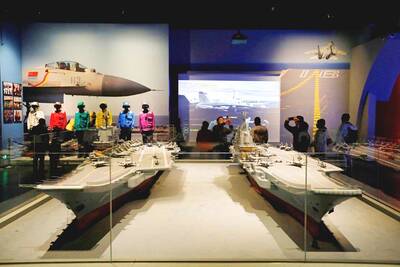
China on Wednesday teased in a video an aircraft carrier that could be its fourth, and the first using nuclear power, while making an allusion to Taiwan and vowing to further build up its islands, as it looks to boost maritime power, secure resources and bolster territorial claims. The video, issued on the eve of the 77th founding anniversary of the Chinese People’s Liberation Army Navy, featured fictional officers with names that are homophones of three commissioned aircraft carriers, the Liaoning (遼寧), Shandong (山東) and Fujian (福建). Titled Into the Deep, it showed a 19-year-old named “Hejian” (何劍) joining the group, sparking
Taiwan Semiconductor Manufacturing Co (TSMC, 台積電), the world’s largest contract chipmaker, said it expects its 2-nanometer (2nm) chip capacity to grow at a compound annual rate of 70 percent from this year to 2028. The projection comes as five fabs begin volume production of 2-nanometer chips this year — two in Hsinchu and three in Kaohsiung — TSMC senior vice president and deputy cochief operating officer Cliff Hou (侯永清) said at the company’s annual technology symposium in Silicon Valley, California, last week. Output in the first year of 2-nanometer production, which began in the fourth quarter of last year, is expected to


 RSS
RSS