


When Charlie Schandelmayer grills the 1360kg of habanero peppers it takes to make 2728 liters of Mountain Man Roasted Habanero Sauce, he wears goggles and a mask.
A shovel serves as a spatula to turn the blisteringly hot peppers, cooked outdoors on a 1.22m-by-2.44m charcoal grill.
"It's a brutal operation. You wear goggles and a paint respirator with two cylinders," said Schandelmayer, who runs a bottling business in Riviera Beach called Sauce Crafters Inc "It's real serious. It would be dangerous if you breathed in enough of it. You could suffocate.
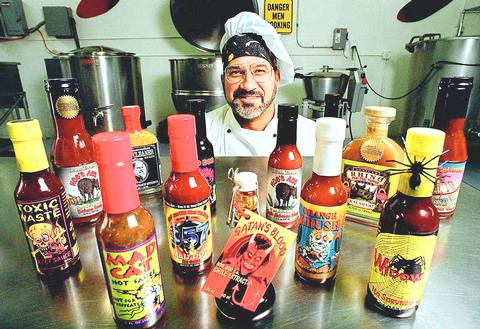
PHOTO: NY TIMES
Habanero peppers are the world's hottest, and are the main ingredient in many of the hottest hot sauces, said Dave DeWitt, an Albuquerque, New Mexico-based author of 31 books on peppers.
Hot sauce has grown to a US$200 million-a-year industry in the US over the past 10 years, industry experts estimate. Once viewed as just a fad, consumption of hot pepper sauce now is considered mainstream, DeWitt said.
In October, DeWitt's company, Sunbelt Shows, plans to hold its fourth Florida Fiery Foods & Barbecue Show in St. Petersburg, featuring 100 exhibitors in the spicy foods industry. He has more than 5,000 fiery foods companies in his database, including Sauce Crafters.
Sauce Crafters' growth mirrors the nation's increased craving for hot and spicy sauces and foods.
The privately held company produces 30,000 bottles a month of 50 different kinds of spicy sauces, including hot and barbecue sauces. The company is owned by Schandelmayer, who runs it with five employees.
Sales last year hit US$400,000, up from US$45,000 five years ago, Schandelmayer said.
Schandelmayer's company makes14 sauces from his own recipes, as well as sauces dreamed up by other people. For US$3,000 to US$5,000, Sauce Crafters will take a sauce you've created, provide label design and printing, take it through the required lab testing and bottle the first 60-gallon batch.
South Florida vegetable growers are part of the hot pepper boom.
Area growers raise the peppers from November through May. They've expanded beyond the still-popular jalapenos, long hots and finger hots to about 20 kinds of spicy peppers, including fiery habaneros and cherry hots.
"In the last two to three years, we've seen the demand increase," said Jim Alderman, president of Alderman Farms, west of Boynton Beach. "Everybody is producing different kinds of hot sauces. Five, six, seven, eight years ago, nobody here had heard of habaneros. Now we sell 2,000 crates of them a week during the season."
Glenn Whitworth, vice president of Whitworth Farms, says his farm's been growing peppers of all kinds for about 50 years. In the past few years, older hot varieties such as long hots have been surpassed by jalapenos, habaneros and cherry hots, and total hot pepper sales have tripled.
The hot pepper craze is fueled by Americans enjoying new cuisines and an influx of people from Mexico and the Caribbean, where spicy foods are the norm, said author DeWitt.
"When I first started writing about peppers, except for Louisiana and the southwestern US, people thought if they ate peppers it would kill them," DeWitt said. "We educated people that there are many varieties of peppers that are not too hot."
What makes the peppers hot is capsaicin (cap-SAY-iss-in), a chemical in the pepper's membrane. As the fancier downs the pepper, his mouth stings and sweat break outs on his forehead. His face flushes, his eyes tear up, and his nose runs. It might not sound like fun, but by irritating nerve endings in the mouth, the capsaicin stimulates the brain to release endorphins, the body's natural painkillers.
Eating hot peppers, therefore, will give you a sort of high.
A hot pepper's pungency level is measured on the Scoville scale, which was developed by Wilbur Scoville in 1912. The more Scoville units, the hotter the pepper. A bell pepper ranks zero; a jalapeno measures 2,500 to 10,000; and a habanero measures 80,000 to 300,000-plus.
The macho-like pursuit of ever-hotter sauces among hot pepper aficionados, known as chili heads, has led to the marketing of extracts that are almost 100 percent capsaicin, Schandelmayer said. His own hottest product, ranking at about 800,000 units on the Scoville scale, is an extract he calls Satan's Blood.
"What could be hotter than that?" Schandelmayer says as he holds the medicine-type bottle, labeled with warnings about how it can burn the skin and eyes. "It looks like blood when the light hits it. It's liquid heat to heat up other foods. You are not supposed to use it directly."
The quest for ever-hotter sauces is driving the market, but so are collectors who look for bizarre sauce labels, many with crude names.
Missy Hill, a cross-country truck driver based in Jensen Beach, created a habanero sauce called Erotic Fire, which is bottled by Sauce Crafters. The bottle sports a label depicting a fantasy female whose mermaid-style body is a hot pepper.
"The sensuality sells," Hill said. "I wanted her to be sexy, seductive and on fire."
Schandelmayer, 47, a father of three, also has indulged in some less-than-neutral names for his sauces.
A group of proctologists bought a case of his Rectal Rocket Fuel as gifts for patients. Colon Cleaner is another best-seller, as is the non-anatomically named Orange Krush, made from orange habaneros he buys locally.
Schandelmayer's "Widow . . . No Survivors" hot sauce features a black plastic spider on the bottle. It's so hot that customers at Koster's Prime Meats in Jupiter had to evacuate the store a few years ago when a customer dropped a bottle on the floor, says owner Susan Koster.
Some sauces falter and don't make it into the mass market, but others have attracted national attention.
John Vargo, executive chef at Gadeleto's, a New Paltz, New York, restaurant, invented the Mountain Man Roast Habanero Sauce that Sauce Masters prepares and bottles for him. He says he's sold "hundreds of thousands" of bottles in the past seven years.
Mountain Man sauce appears under the Smokey Bones label on the tables at the Orlando-based Darden Corp's new Smokey Bones barbecue chain, said a spokesman for Darden, which owns the Red Lobster and Olive Garden chains. The sauce is sold in 142g bottles for US$4.99.
"We're gearing toward corporate restaurants, which is what you see everywhere these days," Vargo said. "Our goal is to have a sauce on every table."
A sampling of wacky to scary hot sauces: Pure Poison, Toxic Waste, Mad Dog Liquid Fire, Goin' Bananas, Idiot Boyz, African Rhino Peri Peri Pepper Sauce, Rot N Ro's XXX Hot Sauce, Brenda's Bootie Burner, Ragin' Cajun, It's Sweet to Be Hot Sauce and Pete's Hydro Hot Hydroponic Hot Sauce.
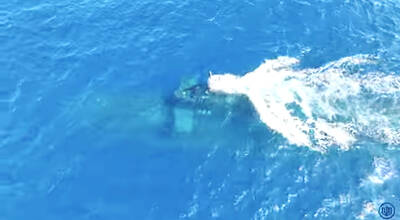
CSBC Corp, Taiwan (台灣國際造船) yesterday released the first video documenting the submerged sea trials of Taiwan’s indigenous defense submarine prototype, the Hai Kun (海鯤), or Narwhal, showing underwater navigation and the launch of countermeasures. The footage shows the vessel’s first dive, steering and control system tests, and the raising and lowering of the periscope and antenna masts. It offered a rare look at the progress in the submarine’s sea acceptance tests. The Hai Kun carried out its first shallow-water diving trial late last month and has since completed four submerged tests, CSBC said. The newly released video compiles images recorded from Jan. 29 to
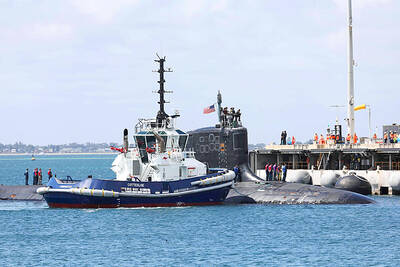
DETERRENCE EFFORTS: Washington and partners hope demonstrations of force would convince Beijing that military action against Taiwan would carry high costs The US is considering using HMAS Stirling in Western Australia as a forward base to strengthen its naval posture in a potential conflict with China, particularly over Taiwan, the Wall Street Journal reported on Saturday. As part of its Indo-Pacific strategy, Washington plans to deploy up to four nuclear-powered submarines at Stirling starting in 2027, providing a base near potential hot spots such as Taiwan and the South China Sea. The move also aims to enhance military integration with Pacific allies under the Australia-UK-US trilateral security partnership, the report said. Currently, US submarines operate from Guam, but the island could

RESTRAINTS: Should China’s actions pose any threat to Taiwan’s security, economic or social systems, China would be excluded from major financial institutions, the bill says The US House of Representatives on Monday passed the PROTECT Taiwan Act, which states that Washington would exclude China from participating in major global financial organizations if its actions directly threaten Taiwan’s security. The bill, proposed by Republican Representative Frank Lucas, passed with 395 votes in favor and two against. It stipulates that if China’s actions pose any threat to Taiwan’s security, economic or social systems, the US would, “to the maximum extent practicable,” exclude Beijing from international financial institutions, including the G20, the Bank for International Settlements and the Financial Stability Board. The bill makes it clear that China must be prepared

The partisan standoff over President William Lai’s (賴清德) proposed defense budget has raised questions about the nation’s ability to adequately fund its own defense, the US Congressional Research Service (CRS) said in a report released on Tuesday. The report, titled Taiwan: Defense and Military Issues, said the government has increased its defense budget at an average annual rate of 5 percent from 2019 to 2023, with about 2.5 percent of its GDP spent on defense in 2024. Lai in November last year proposed a special budget of about US$40 billion over eight years, and said he intends to increase defense spending to


 RSS
RSS