


The partisan standoff over President William Lai’s (賴清德) proposed defense budget has raised questions about the nation’s ability to adequately fund its own defense, the US Congressional Research Service (CRS) said in a report released on Tuesday.
The report, titled Taiwan: Defense and Military Issues, said the government has increased its defense budget at an average annual rate of 5 percent from 2019 to 2023, with about 2.5 percent of its GDP spent on defense in 2024.
Lai in November last year proposed a special budget of about US$40 billion over eight years, and said he intends to increase defense spending to about 3.3 percent of GDP this year, the report said.
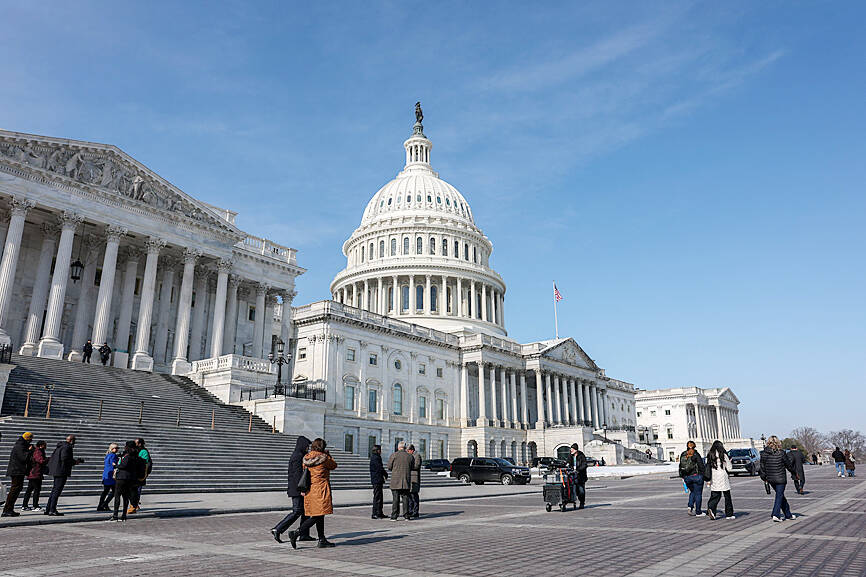
Photo: Reuters
However, Taiwan faces domestic challenges in realizing its defense goals, as policymakers disagree over how best to deter China, the report added.
While the two major political parties have expressed support for increasing defense investment, a partisan standoff between the executive and the opposition-controlled legislature has raised questions about the nation’s ability to adequately fund its defense, it said.
The military has also struggled to recruit, train and retain personnel, while the nation’s civil defense preparedness is considered insufficient, as energy, food, water, communications and other infrastructure are vulnerable to external disruption, the report said.
It is unclear what costs Taiwanese would be willing or are able to bear in a conflict, it added.
Meanwhile, the Chinese People’s Liberation Army (PLA) has undergone a decades-long modernization program focused on developing the capabilities needed to annex Taiwan, the report said.
The PLA is believed to soon be able to execute a range of military campaigns against Taiwan, including missile strikes, seizures of Taiwan’s small outlying islands, blockades, an amphibious landing and a takeover of Taiwan proper, the report added.
China engages in persistent noncombat operations that erode Taiwan’s military advantages and readiness, including large-scale military exercises and near-daily patrols in the vicinity of the nation; cyberoperations; uncrewed combat aerial vehicle flights circling Taiwan; and stepped-up law enforcement activities near Kinmen County, it said.
These “gray zone” activities provide training and intelligence-gathering opportunities for China, strain Taiwan’s forces and normalize PLA operations near Taiwan to undermine Taipei’s ability to discern the imminence of an attack, the report said, adding that Beijing likely uses such activities to sow doubt in the public about the military’s capabilities and to pressure Taiwan into acquiescing to “unification.”
Chinese leaders are believed to prefer gradually assuming control over Taiwan through “gray zone” coercion and political warfare rather than risk a large-scale conflict, it said.
Taiwan has certain advantages, such as US political and military support, and its geography, the report said.
The Taiwan Strait is about 70 nautical miles (130km) wide at its narrowest point, and weather conditions make it perilous to navigate at certain times of the year, while the nation’s mountainous terrain and densely populated west coast make it difficult for enemies to launch an amphibious landing and invasion operations, it said.

The National Chungshan Institute of Science and Technology yesterday showcased its locally developed variants of the Vision 60 robotic patrol dog, which it plans to deploy on the nation’s outlying territories in the South China Sea. The variants were produced under the Joint Lab project — created by the institute and domestic companies — and assembled with domestically produced motors, lenses and artificial intelligence (AI) systems alongside licensed tech from the US, Missile and Rocket Systems Research Division deputy director Jen Kuo-kang (任國光) told the media event at a military base in Taipei’s Dazhi (大直) area. Taiwan has built up its strengths

RIGHT DIRECTION: Taiwan’s efforts to prevent forced labor include a proposal to ‘fully prohibit’ employers from withholding workers’ documents, an official said Taiwan is to establish a mechanism to restrict imports of goods linked to forced labor, the Executive Yuan said yesterday, after the US proposed imposing additional tariffs on Taiwanese goods over labor concerns. “The Ministry of Labor and the Ministry of Economic Affairs are to establish an interministerial review procedure,” Executive Yuan spokesperson Michelle Lee (李慧芝) said at a news briefing in Taipei. “The government is to use the Foreign Trade Act [貿易法] as the legal basis to restrict imports of goods produced with forced labor” and bring its supply chain governance more in line with international standards on human rights, resilience
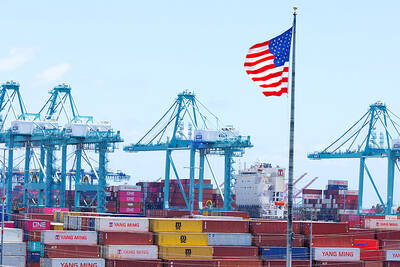
NOT IMMEDIATE: Taiwan has a chance to appeal the proposed 10 percent tariff before it starts, while other countries face a 12.5 percent tariff from the trade office Taiwan is among 60 economies determined by the US to have failed to impose or enforce a ban on the importation of goods produced with forced labor, according to a notice released on Tuesday by the Office of the US Trade Representative (USTR), which proposed imposing an additional 10 percent or more tariff on them. The USTR in a statement said that following an investigation, it had determined under Section 301 of the Trade Act of 1974 that the failure of the 60 economies to impose and effectively enforce a prohibition on the importation of goods produced with forced labor is
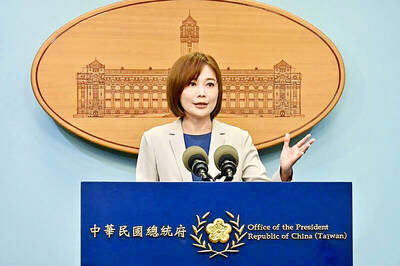
TIT-FOR-TAT: The US allegedly revoked the visa of a Chinese national working at Xinhua News Agency in the US in response to Beijing’s expulsion of Vivian Wang The Presidential Office yesterday condemned China for expelling a New York Times correspondent from Beijing following the newspaper’s interview with President William Lai (賴清德), saying the move highlighted Beijing’s suppression of press freedom and its threat to international news media. Taiwan has noted a series of recent incidents in which Beijing used similar tactics to “threaten and pressure international media outlets and journalists,” Presidential Office spokeswoman Karen Kuo (郭雅慧) said in a statement. “This concerns not only press freedom and freedom of expression, but also the safety of journalists, and Taiwan and relevant partners are paying close attention to the situation,” she


 RSS
RSS