


A surprising gut feeling may help pigeons find their way home.
Animals use various techniques to navigate, including following the stars and remembering key landmarks. Birds, fish and turtles orient themselves using Earth’s magnetic field as a compass, but it is not yet clear how exactly they do this.
Pigeons are a well-known group of frequent flyers that can traverse hundreds of kilometers in a single day. For thousands of years, humans have used them to carry news, notes and military messages.
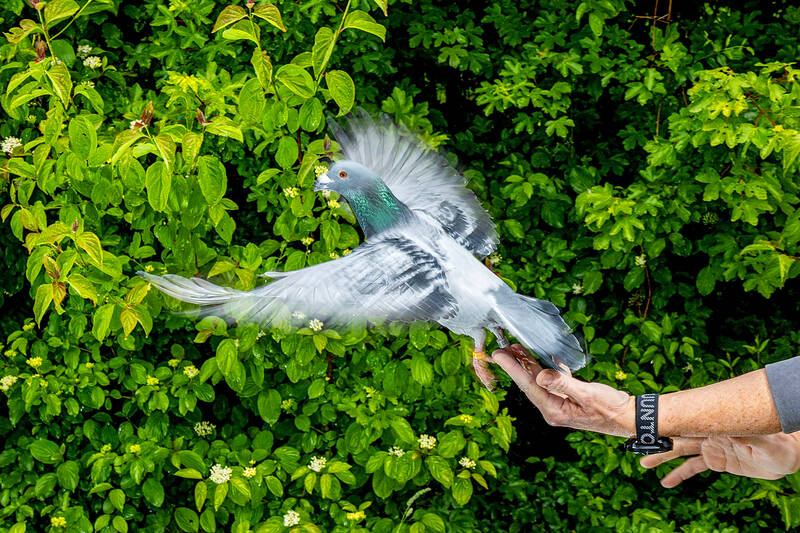
Photo: Christian Ziegler/Max Planck Institute of Animal Behavior via AP
Scientists have long tried to untangle how pigeons travel without getting lost. Some think the birds detect magnetic cues using light-sensitive molecules in their eyes, while others suggest it happens in the beak or inner ear.
“The magnetic sense has been this mystery for almost 100 years,” Max Planck Institute of Animal Behavior Department of Migration Director Martin Wikelski said.
In a new study, Wikelski and other researchers decided to draw back the curtain on pigeons’ navigational secrets. They searched for magnetic clues in the birds’ organs and found a strong signal in an unexpected place: the liver.
Specialized immune cells in the pigeon’s liver break down red blood cells and store iron. When scientists temporarily stripped pigeons of those immune cells and let them fly, the birds “just couldn’t find their way,” University of Bonn professor Christian Kurts said. That suggested the iron-rich liver cells might play a role in their sense of direction.
The birds’ magnetic compasses only got scrambled on overcast days. That is because they also use the sun as a navigational guide.
Scientists have previously wondered whether immune cells could be involved in magnetic sensing, but the new study published on Thursday in the journal Science is the first to present a full-fledged theory.
“I would never have guessed it, but once it was explained to me, it makes sense,” said University of Massachusetts Boston behavioral ecologist Albert Kao, who had no role in the study.
The immune cells are near nerve fibers in the liver.
That might be how they transmit their “magnetic sense” to the brain “and help the pigeons to navigate,” study coauthor Clivia Lisowski said.
The researchers think other birds and animals such as mice could operate using a similar magnetic GPS, but outside experts said more work is needed to verify that pigeons navigate this way and to firm up how these signals get to the brain.
While the researchers found the strongest magnetic signal in the pigeons’ livers, such immune cells have also been spotted in other areas, including the beak and spleen.
It is possible this magnetic puzzle does not have a single answer, veterinary pathologist Simon Spiro and biologist Hal Drakesmith wrote in an accompanying editorial.
The birds could use different techniques to sense magnetic fields depending on the task, be it traveling long distances or finding a specific destination, they said.

SPEAKING OUT: After Siranudh Scott’s allegations surfaced, celebrities and public figures took to social media to share their own experiences of sexual misconduct and abuse A high-profile alleged sexual abuse case within a wealthy Thai beer brewing family has prompted a wave of painful accounts from survivors of unconnected abuse in the conservative nation. Siranudh Scott, a member of the billionaire Thai family that founded the ubiquitous Singha beer brand, posted an emotional video this month accusing his elder brother Sunit of repeatedly abusing him when he was a teenager. Sunit, who is in his 30s, later denied the allegations in a video posted online, but Singha parent Boonrawd dismissed him from his executive role with the company on Tuesday last week. “I felt I needed to speak

A Hong Kong astronaut is to join a Chinese space mission for the first time as part of a three-person crew launching today, as Beijing edges closer to its goal of landing people on the moon. The Tiangong space station — crewed by teams of three astronauts that are typically rotated every six months — is the crown jewel of China’s space program, boosted by billions in state investment in a bid to catch up with the US and Russia. The Shenzhou-23 mission is to blast off at 11:08pm from the Jiuquan Satellite Launch Center in northwestern China, carrying three astronauts to

UPGRADED ALERT: The risk inside DR Congo is now considered ‘very high,’ while neighboring countries face a ‘high’ threat as the outbreak continues, the WHO said Ebola is spreading faster than responders can track it in eastern Congo, where health workers managed to follow up with barely one in five identified contacts in a single day. Authorities in the Democratic Republic of the Congo (DR Congo) reported 83 confirmed infections, 746 suspected cases and 1,603 identified contacts as of Thursday, but health workers were able to follow up on only 342 contacts that day — about 21 percent of the total under monitoring — data released by the DR Congo Ministry of Public Health on Friday showed. The figures suggest the response is falling behind the outbreak itself,

SEEKING ORDER: Rodrigo Paz said that ‘anyone who wants to destroy the nation will have to deal with this president and the full force of the constitution’ Bolivian President Rodrigo Paz on Wednesday said that the nation was at a “breaking point” after nearly a month of protests that have caused shortages of food, fuel and medicine. Paz, who took office six months ago amid the worst economic crisis there in four decades, is battling a groundswell of fury over his policies. The political capital, La Paz, has been besieged by low-income workers and members of the indigenous majority calling for his resignation. “The country needs order and is reaching breaking point,” the 58-year-old said at a public event in La Paz, renewing his appeal for dialogue. On Tuesday, the Bolivian


 RSS
RSS