


Penpa Tsering on Wednesday was sworn in for a second consecutive term as the president of Tibet’s government-in-exile following his re-election earlier this year.
Tsering, 58, has led the exile government based in Dharamshala, India, since 2021. He secured another five-year term in elections in February among Tibetans living in India and overseas.
Tsering was first elected to the Tibetan parliament-in-exile in 1996 and served as speaker from 2008 until he rose to the top executive post.
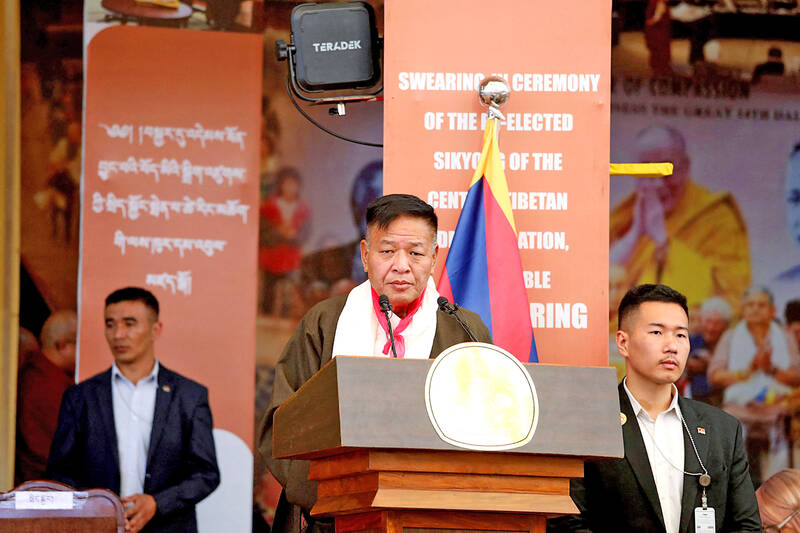
Photo: AFP
Formed in 1959, the Tibetan government-in-exile, now called the Central Tibetan Administration, has executive, judicial and legislative branches.
Tsering said that the Central Tibetan Administration “remains firmly committed to the Middle Way Policy envisioned by His Holiness the Dalai Lama,” adding that the policy seeks resolution through nonviolence, dialogue and lasting mutual benefit.
“Until a resolution is achieved, we will continue the back-channel communications with caution and steadiness with the Chinese government,” he said.
Tsering’s swearing-in ceremony took place in the presence of the Dalai Lama, who was escorted to the venue by red-robed monks among the sounds of beating drums and chanted prayers. The audience included hundreds of monks and Tibetans who looked on as Tibetan Supreme Justice Commission Chief Justice Yeshi Wangmo administered the oath of office.
The February vote marked the fourth direct election of the Tibetan exile leadership since the Dalai Lama, the Tibetan spiritual leader, formally ended his role in the administration’s governance in 2011.
China says Tibet has been part of its territory since the mid-13th century and that the Chinese Communist Party has governed the Himalayan region since 1951.
Many Tibetans say they were effectively independent for most of their history and the Chinese government wants to exploit the resource-rich region while crushing its cultural identity.
China does not recognize the Central Tibetan Administration and has not held dialogue with the Dalai Lama’s representatives since 2010.
India considers Tibet as part of China, but hosts the Tibetan exile government.
Beijing accuses the Dalai Lama of seeking to separate Tibet from China.
He denies the accusation.
Yu Jing (宇?), a spokeswoman for the Chinese embassy in India, on Sunday dismissed the legitimacy of the exile administration, saying it was “not recognized by any sovereign country” and had no authority to represent Tibetans or oversee the reincarnation process of the Dalai Lama.

It began as a satirical online project. Now millions of young people in India are flocking to it as an outlet for their frustration. A parody political party called the Cockroach Janta Party, with the insect as its symbol, has exploded across India’s social media by turning absurdist humor into protest. Memes and short videos mocking corruption, joblessness and political dysfunction have flooded social media sites, where millions of users are embracing the cockroach — known for its ability to survive harsh conditions — as a tongue-in-cheek symbol of endurance. The online movement’s rise has been unusually rapid. The Cockroach Janta Party (CJP)

SPEAKING OUT: After Siranudh Scott’s allegations surfaced, celebrities and public figures took to social media to share their own experiences of sexual misconduct and abuse A high-profile alleged sexual abuse case within a wealthy Thai beer brewing family has prompted a wave of painful accounts from survivors of unconnected abuse in the conservative nation. Siranudh Scott, a member of the billionaire Thai family that founded the ubiquitous Singha beer brand, posted an emotional video this month accusing his elder brother Sunit of repeatedly abusing him when he was a teenager. Sunit, who is in his 30s, later denied the allegations in a video posted online, but Singha parent Boonrawd dismissed him from his executive role with the company on Tuesday last week. “I felt I needed to speak

A Hong Kong astronaut is to join a Chinese space mission for the first time as part of a three-person crew launching today, as Beijing edges closer to its goal of landing people on the moon. The Tiangong space station — crewed by teams of three astronauts that are typically rotated every six months — is the crown jewel of China’s space program, boosted by billions in state investment in a bid to catch up with the US and Russia. The Shenzhou-23 mission is to blast off at 11:08pm from the Jiuquan Satellite Launch Center in northwestern China, carrying three astronauts to

UPGRADED ALERT: The risk inside DR Congo is now considered ‘very high,’ while neighboring countries face a ‘high’ threat as the outbreak continues, the WHO said Ebola is spreading faster than responders can track it in eastern Congo, where health workers managed to follow up with barely one in five identified contacts in a single day. Authorities in the Democratic Republic of the Congo (DR Congo) reported 83 confirmed infections, 746 suspected cases and 1,603 identified contacts as of Thursday, but health workers were able to follow up on only 342 contacts that day — about 21 percent of the total under monitoring — data released by the DR Congo Ministry of Public Health on Friday showed. The figures suggest the response is falling behind the outbreak itself,


 RSS
RSS