


War in Iran, strained US commitments in Asia and rising tensions over Taiwan are likely to dominate the agenda at this week’s annual Shangri-La Dialogue, the region’s premier defense forum.
The free-wheeling informal gathering, running from Friday to Sunday, draws an eclectic mix of ministers, generals, intelligence chiefs, diplomats, analysts and weapons makers for carefully worded speeches and frank exchanges behind polished hotel doors.
While Vietnamese President To Lam is set to deliver Friday night’s keynote speech, the spotlight will fall squarely on US Secretary of Defense Pete Hegseth when the Pentagon chief takes the floor against the backdrop of halting efforts to end the war in Iran.
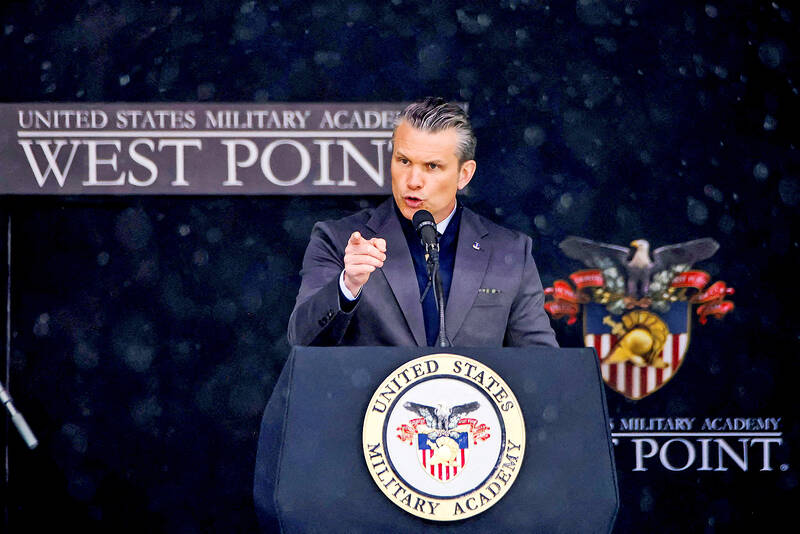
Photo: Reuters
US President Donald Trump on Sunday said that he had told his representatives not to rush into any deal with Iran, as his administration played down hopes of an imminent breakthrough in the three-month-old conflict.
The US blockade on Iranian ships in the Strait of Hormuz would “remain in full force and effect until an agreement is reached, certified, and signed,” Trump wrote on social media.
Iran has effectively shut the strait since the war erupted on Feb. 28, throttling a vital artery that typically carries about one-fifth of global oil and gas shipments.
Asian allies are expected to scrutinize Hegseth for any sign that Trump’s administration is overstretched, pulled into the Middle East conflict, embroiled in disputes with Europe, including withdrawing troops from Germany, and consequently distracted from the region.
“There will likely be some continued anxiety over the unpredictability and volatility of US policy, and the consequences for stability,” said Chong Ja Ian (莊嘉穎), a political scientist at the National University of Singapore. “The most pressing issue for Asia would be the US-Israel-Iran conflict and its effects on energy supply.”
The Iran war has thrown the global economy into disarray with sharply higher oil prices stoking inflation and straining supply chains from fertilizer to food, pressures that are acutely felt across Asia’s import-dependent economies.
A key unknown is whether China would send its defense minister after skipping last year’s dialogue, a decision that ceded the stage to Washington, with Beijing later accusing Hegseth of “vilifying” China.
The Chinese Ministry of National Defense has not confirmed whether Chinese Minister of National Defense Dong Jun (董軍) would attend and which other officials it might also send. The ministry did not respond to a request for comment.
Hegseth arrives after the summit between Chinese President Xi Jinping (習近平) and Trump earlier this month in Beijing and amid simmering tensions over Taiwan.
China has ramped up pressure on Taiwan by increasing its military presence around the nation, keeping Taipei on high alert for further Chinese moves following the summit.
“In the aftermath of the summit, I suspect he will tread carefully on China,” said Bonnie Glaser, head of the Indo-Pacific Program of the German Marshall Fund think tank, adding that Hegseth might further push allies and partners to spend more on defense.
Foreign military attaches say the Chinese delegation is likely to face pointed questions at the forum about how sweeping corruption purges of senior officers are affecting the Chinese military’s combat readiness.
Analysts expect exchanges on how smaller states navigate the US-China rivalry, as well as a focus on maritime flashpoints in the South China Sea and the Strait of Malacca, and defense spending.
Lam is expected to underscore Hanoi’s neutrality as it deepens ties with both Washington and Beijing, while defending its maritime claims against China.
Newly installed as both Communist Party of Vietnam general secretary and president, Lam is the most powerful Vietnamese leader in decades and is poised to play a more prominent diplomatic role.
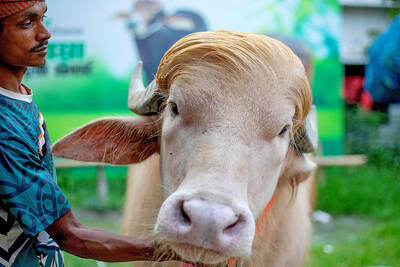
Crowds in Bangladesh are flocking to snap photographs with an unlikely social media star — an albino buffalo with flowing blond hair nicknamed “Donald Trump” that is due to be sacrificed within days. Owner Zia Uddin Mridha, 38, said his brother named the 700kg bull over its flowing helmet of hair resembling the signature look of the US president. “My younger brother picked this name because of the buffalo’s extraordinary hair,” he said at his farm in Narayanganj, just outside the capital, Dhaka. Mridha said that a constant stream of curious visitors — social media fans, onlookers and children — have come throughout

It began as a satirical online project. Now millions of young people in India are flocking to it as an outlet for their frustration. A parody political party called the Cockroach Janta Party, with the insect as its symbol, has exploded across India’s social media by turning absurdist humor into protest. Memes and short videos mocking corruption, joblessness and political dysfunction have flooded social media sites, where millions of users are embracing the cockroach — known for its ability to survive harsh conditions — as a tongue-in-cheek symbol of endurance. The online movement’s rise has been unusually rapid. The Cockroach Janta Party (CJP)
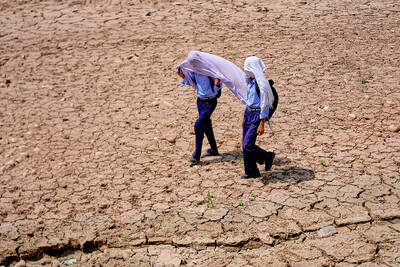
HOTTER: While Indians are accustomed to summer heat, climate change has caused northwestern India to warm faster than other parts of the country, an academic said Roads and markets have emptied during afternoons and some farmers have switched to nighttime work to avoid scorching temperatures as a heat wave grips large parts of India. The India Meteorological Department forecast maximum temperatures for yesterday of about 45°C in the capital, New Delhi, where authorities have opened temporary “cooling zones” to help people cope. The weather department warned that conditions would likely persist across several northern regions in the coming days, with temperatures staying well above seasonal averages. Authorities urged people to stay indoors during the hottest hours and take precautions against heat-related illnesses. India declares a heat wave whenever maximum temperatures
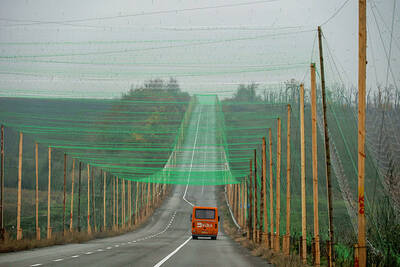
BIGGER ROLE: Beijing has said it maintains an impartial stance on the war in Ukraine, but by training Russian troops, China is far more involved than previously known China’s armed forces secretly trained about 200 Russian military personnel in China late last year, and some have since returned to fight in Ukraine, according to three European intelligence agencies and documents seen by Reuters. While China and Russia have held a number of joint military exercises since Moscow’s full-scale invasion of Ukraine in 2022, Beijing has repeatedly said that it is neutral in the conflict and presents itself as a peace mediator. The covert training sessions, which predominantly focused on the use of drones, were outlined in a dual-language Russian-Chinese agreement signed by senior Russian and Chinese officers in Beijing on


 RSS
RSS