


Russia pounded Kyiv with a massive bombardment that killed four people, authorities said on Sunday, with Moscow unleashing its nuclear-capable hypersonic Oreshnik missile in one of the largest barrages in the more-than-four-year war.
Multiple rounds of loud explosions were heard in the Ukrainian capital throughout the early hours of the morning, journalists reported, as residents took shelter in underground stations. Daylight revealed rescue workers extinguishing fires and sifting through debris of heavily damaged buildings — houses, shopping centers, museums, theaters, schools and universities.
Russian President Vladimir Putin had earlier threatened retaliation for Ukrainian strikes in Russian-occupied eastern Ukraine that killed 21 people in a vocational school.
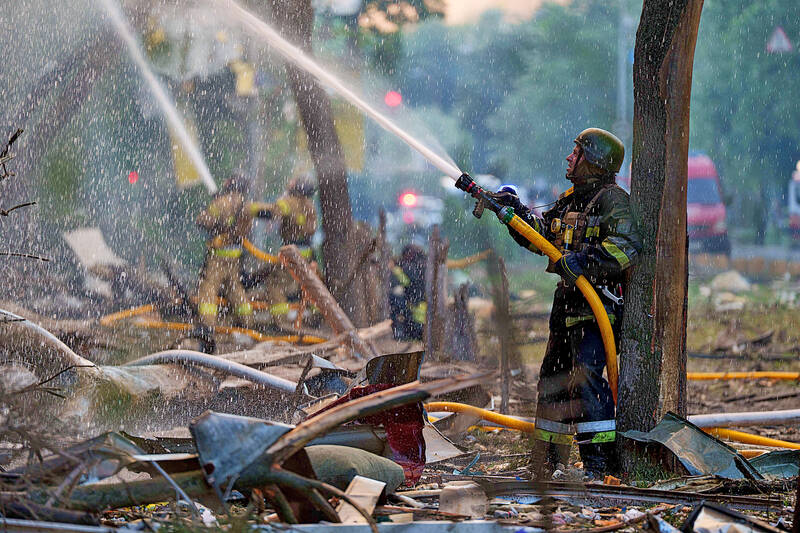
Photo: AP
In Kyiv, Sofia Melnychenko, 21, thought she was safe in the subway, “but then there were three loud explosions, and after the fourth one the ceiling in the metro started crumbling,” she said. “There was complete chaos. Children started screaming, people were panicking. It was a very frightening night.”
The Ukrainian air force said the raid involved 600 drones and 90 missiles, of which 549 drones and 55 missiles were intercepted.
Kyiv has been grappling with an acute air defense missile deficit since the US-Israeli air campaign against Iran drove up demand for US-made Patriot rounds.
European leaders reacted by saying the salvo showed Russia’s desperation.
“Terror against civilians is not strength. It’s despair,” European Commission President Ursula von der Leyen said on social media.
French President Emmanuel Macron said the strikes signaled “the dead end of Russia’s war of aggression,” while German Chancellor Friedrich Merz called the use of Oreshnik a “reckless escalation.”
Ukrainian President Volodymyr Zelenskiy urged more action from allies.
“I am grateful to everyone now expressing words of support. But concrete steps to bolster air defence are also needed — missile deliveries must not stop for a single day,” he said on social media.
He earlier said that Russia hit dozens of residential buildings, schools, a water supply facility and a market in a “genuinely deranged” attack.
Russia’s army confirmed it had launched the Oreshnik at Ukraine for the third time in the war, saying it was “in response to Ukraine’s terrorist attacks on civilian infrastructure on Russian territory.” The missile was used without a nuclear warhead.
Moscow denied it had targeted civilians, saying it had struck command posts of the Ukrainian army and intelligence.
Four people were killed and more than 100 were wounded in Kyiv and the surrounding region, local officials said.
Kyiv Mayor Vitali Klitschko said damage had been recorded in every district of the capital.
The residence of the Albanian ambassador was also hit and the Balkan nation summoned the Russian envoy in protest. Buildings housing a studio of German broadcaster ARD and an office for German outlet DW were damaged as well, the companies said in statements. Both premises were empty of people at the time.
Projectiles also hit other Ukrainian regions, with dozens of wounded reported in the Kharkiv, Cherkasy and Dnipropetrovsk regions.
Attacks continued during the day, with a shelling killing two and wounding 17 in the frontline city of Kherson.
Ukraine had been expecting a major strike after its own forces launched a drone barrage on Starobilsk, in the Russian-occupied east of the country, which Moscow said hit a college dormitory and killed 21 people, most of them young female students.
Launched overnight on Thursday to Friday, the drone salvo — one of Ukraine’s deadliest such strikes in months — also wounded dozens in the city in the occupied Lugansk region.
Ukraine denied targeting civilians, saying it had hit a Russian drone unit stationed in the area.

Crowds in Bangladesh are flocking to snap photographs with an unlikely social media star — an albino buffalo with flowing blond hair nicknamed “Donald Trump” that is due to be sacrificed within days. Owner Zia Uddin Mridha, 38, said his brother named the 700kg bull over its flowing helmet of hair resembling the signature look of the US president. “My younger brother picked this name because of the buffalo’s extraordinary hair,” he said at his farm in Narayanganj, just outside the capital, Dhaka. Mridha said that a constant stream of curious visitors — social media fans, onlookers and children — have come throughout

It began as a satirical online project. Now millions of young people in India are flocking to it as an outlet for their frustration. A parody political party called the Cockroach Janta Party, with the insect as its symbol, has exploded across India’s social media by turning absurdist humor into protest. Memes and short videos mocking corruption, joblessness and political dysfunction have flooded social media sites, where millions of users are embracing the cockroach — known for its ability to survive harsh conditions — as a tongue-in-cheek symbol of endurance. The online movement’s rise has been unusually rapid. The Cockroach Janta Party (CJP)
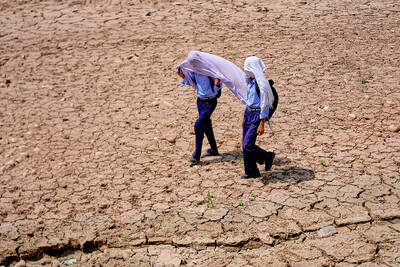
HOTTER: While Indians are accustomed to summer heat, climate change has caused northwestern India to warm faster than other parts of the country, an academic said Roads and markets have emptied during afternoons and some farmers have switched to nighttime work to avoid scorching temperatures as a heat wave grips large parts of India. The India Meteorological Department forecast maximum temperatures for yesterday of about 45°C in the capital, New Delhi, where authorities have opened temporary “cooling zones” to help people cope. The weather department warned that conditions would likely persist across several northern regions in the coming days, with temperatures staying well above seasonal averages. Authorities urged people to stay indoors during the hottest hours and take precautions against heat-related illnesses. India declares a heat wave whenever maximum temperatures
BIGGER ROLE: Beijing has said it maintains an impartial stance on the war in Ukraine, but by training Russian troops, China is far more involved than previously known China’s armed forces secretly trained about 200 Russian military personnel in China late last year, and some have since returned to fight in Ukraine, according to three European intelligence agencies and documents seen by Reuters. While China and Russia have held a number of joint military exercises since Moscow’s full-scale invasion of Ukraine in 2022, Beijing has repeatedly said that it is neutral in the conflict and presents itself as a peace mediator. The covert training sessions, which predominantly focused on the use of drones, were outlined in a dual-language Russian-Chinese agreement signed by senior Russian and Chinese officers in Beijing on


 RSS
RSS