


JAPAN
Man incinerates wife at zoo
Japanese police arrested a man for allegedly incinerating his dead wife at the zoo where he worked, officials and local media said yesterday, following the discovery of human remains. The man, Tatsuya Suzuki, is suspected of transporting “the victim’s body to a tourist facility” in Hokkaido and destroying it through incineration there, police said. Police have not said how the victim, 33-year-old Yui Suzuki, died. The man said he used his zoo’s incinerator to burn the woman’s body “for a few hours,” local media reported. While alive, the wife once told her relatives that her husband was threatening to “burn you until no trace of you will be left,” public broadcaster NHK said, citing investigative sources. The gruesome case forced Asahiyama Zoo to delay its reopening scheduled for Wednesday to yesterday. Officials bowed to visitors and apologized for the trouble caused. “The zoo is in an extremely difficult situation at the moment,” Asahikawa City Mayor Hirosuke Imazu said. “But we would like to turn your support into our energy, and convey the beautiful lives of our animals.”
AUSTRALIA
Clashes erupt over killing
An angry crowd yesterday clashed with Australian police outside a hospital treating the suspected killer of a five-year-old indigenous girl in the town of Alice Springs. The violence followed the discovery on Thursday of a body believed to be that of the little girl, referred to at her family’s request as Kumanjayi Little Baby. She had disappeared from an indigenous community camp called Old Timers last week, sparking a vast, days-long search that gripped much of the country. Hours after her body was found, police announced they had arrested the suspect, Jefferson Lewis. He was beaten until he was unconscious after turning himself in to indigenous community members on Thursday evening at a camp by Alice Springs. When police and emergency services intervened, they too came under attack, Northern Territory Police Force Commissioner Martin Dole said. Lewis was then taken to hospital, where a large crowd gathered and tried to gain access to the building, he said. Many people outside the hospital shouted that Lewis must face “payback,” public broadcaster ABC reported, referring to a traditional punishment in central Australian indigenous communities. Police said they removed Lewis for his safety from hospital to the Northern Territory capital of Darwin, where he was being held in custody. He is expected to face charges in the coming days.
NEW ZEALAND
Wellington awaits ceasefire
New Zealand yesterday said it would only support a US-led coalition to secure the Strait of Hormuz if a sustainable ceasefire in the Middle East was in place first. The government confirmed that it has received a proposal from Washington and said it is seeking further details before making any decisions, a New Zealand Ministry of Foreign Affairs spokesperson said in a statement. “We are not close to a point where the New Zealand Government would be making any decisions about it,” the statement said. “New Zealand’s consideration of participation in any mission related to the Strait of Hormuz would be contingent on there being a sustainable ceasefire agreement in place.” The statement comes as the US seeks to build an international coalition to safeguard shipping through the strategic waterway. New Zealand said it has also been attending discussions on UK and France-led military planning for a potential multinational mission to reopen the strait.

SPEAKING OUT: After Siranudh Scott’s allegations surfaced, celebrities and public figures took to social media to share their own experiences of sexual misconduct and abuse A high-profile alleged sexual abuse case within a wealthy Thai beer brewing family has prompted a wave of painful accounts from survivors of unconnected abuse in the conservative nation. Siranudh Scott, a member of the billionaire Thai family that founded the ubiquitous Singha beer brand, posted an emotional video this month accusing his elder brother Sunit of repeatedly abusing him when he was a teenager. Sunit, who is in his 30s, later denied the allegations in a video posted online, but Singha parent Boonrawd dismissed him from his executive role with the company on Tuesday last week. “I felt I needed to speak

SEEKING ORDER: Rodrigo Paz said that ‘anyone who wants to destroy the nation will have to deal with this president and the full force of the constitution’ Bolivian President Rodrigo Paz on Wednesday said that the nation was at a “breaking point” after nearly a month of protests that have caused shortages of food, fuel and medicine. Paz, who took office six months ago amid the worst economic crisis there in four decades, is battling a groundswell of fury over his policies. The political capital, La Paz, has been besieged by low-income workers and members of the indigenous majority calling for his resignation. “The country needs order and is reaching breaking point,” the 58-year-old said at a public event in La Paz, renewing his appeal for dialogue. On Tuesday, the Bolivian
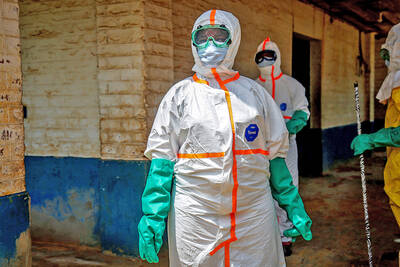
COMMUNITY CONFLICT: Concerns about disease spread from corpses has run up against friends and families’ desire to bury their dead as infection spreads in the area Angry residents of a town at the epicenter of the Ebola outbreak in the Democratic Republic of the Congo (DR Congo) attacked and burned a tent that was part of a health center where people are being treated for the virus, the staff there said Saturday. It was the second such attack in the region in a week. No one was hurt in the attack, according to reports but as patients ran out to escape the fire, 18 people with suspected Ebola infections fled the facility and are unaccounted for, a hospital director said. Angry residents arrived at the clinic in the

Forecasters in Europe yesterday warned of exceptional heat as record temperatures driven by a “heat dome” push temperatures well above seasonal norms across the continent. The surge follows a record-breaking Monday, with France logging its hottest day in the month of May on record, its weather agency said, and the UK also posting unprecedented highs. A so-called “heat dome” of warm air from northern Africa trapped under a high-pressure system over western Europe is behind the high temperatures not usually seen until high summer. Restrictions on outdoor work were imposed in parts of Italy, beaches in southwest France filled earlier than usual and


 RSS
RSS