


North Korea faces an “unusual” and “severe” drought this year, and the government is working to protect crops, state media reported yesterday.
Natural disasters tend to have an outsized impact on the diplomatically isolated country due to its weak infrastructure and economy.
Elizabeth Salmon, the UN special rapporteur on human rights in North Korea, in February said that food shortages are already a key concern.
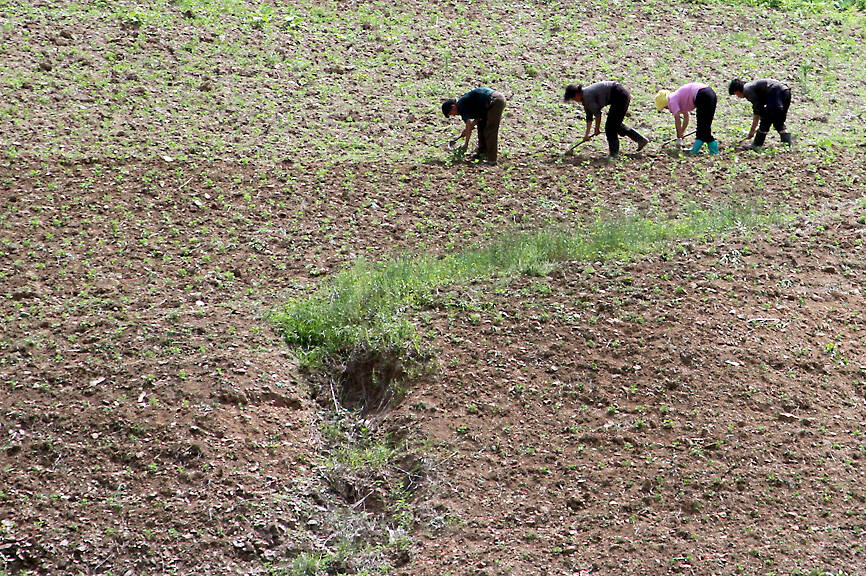
Photo: Reuters
“An unusual drought has recently persisted across much of the country, a phenomenon rarely seen in previous years,” Pyongyang’s official Korean Central News Agency (KCNA) reported.
“Workers across various regions are concentrating all efforts on protecting early-season crops from the drought,” KCNA reported.
In a separate report, it said that North Korean Premier Pak Thae-song carried out on-site inspections at farms in South Pyongan and North Hwanghae provinces to discuss “countermeasures to minimize drought damage.”
He called for fully identifying and efficiently using all available water sources, adding that a successful harvest hinged on overcoming this year’s “severe drought,” KCNA said.
South Korea — Asia’s fourth-largest economy — also endured a prolonged drought last year that hit the eastern coastal city of Gangneung.
That dry spell forced authorities to implement water restrictions, including shutting off 75 percent of household meters across the city.
KCNA said that North Korean cities and counties were carrying out “repairs to the gates of reservoirs and waterways.”
Workers are also implementing “technical measures,” boosting the drought resistance of wheat and barley, and striving to ensure the stable growth of early-season crops, it added.

SPEAKING OUT: After Siranudh Scott’s allegations surfaced, celebrities and public figures took to social media to share their own experiences of sexual misconduct and abuse A high-profile alleged sexual abuse case within a wealthy Thai beer brewing family has prompted a wave of painful accounts from survivors of unconnected abuse in the conservative nation. Siranudh Scott, a member of the billionaire Thai family that founded the ubiquitous Singha beer brand, posted an emotional video this month accusing his elder brother Sunit of repeatedly abusing him when he was a teenager. Sunit, who is in his 30s, later denied the allegations in a video posted online, but Singha parent Boonrawd dismissed him from his executive role with the company on Tuesday last week. “I felt I needed to speak

SEEKING ORDER: Rodrigo Paz said that ‘anyone who wants to destroy the nation will have to deal with this president and the full force of the constitution’ Bolivian President Rodrigo Paz on Wednesday said that the nation was at a “breaking point” after nearly a month of protests that have caused shortages of food, fuel and medicine. Paz, who took office six months ago amid the worst economic crisis there in four decades, is battling a groundswell of fury over his policies. The political capital, La Paz, has been besieged by low-income workers and members of the indigenous majority calling for his resignation. “The country needs order and is reaching breaking point,” the 58-year-old said at a public event in La Paz, renewing his appeal for dialogue. On Tuesday, the Bolivian
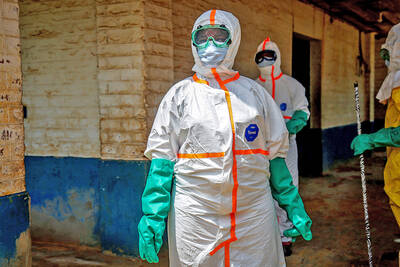
COMMUNITY CONFLICT: Concerns about disease spread from corpses has run up against friends and families’ desire to bury their dead as infection spreads in the area Angry residents of a town at the epicenter of the Ebola outbreak in the Democratic Republic of the Congo (DR Congo) attacked and burned a tent that was part of a health center where people are being treated for the virus, the staff there said Saturday. It was the second such attack in the region in a week. No one was hurt in the attack, according to reports but as patients ran out to escape the fire, 18 people with suspected Ebola infections fled the facility and are unaccounted for, a hospital director said. Angry residents arrived at the clinic in the

Forecasters in Europe yesterday warned of exceptional heat as record temperatures driven by a “heat dome” push temperatures well above seasonal norms across the continent. The surge follows a record-breaking Monday, with France logging its hottest day in the month of May on record, its weather agency said, and the UK also posting unprecedented highs. A so-called “heat dome” of warm air from northern Africa trapped under a high-pressure system over western Europe is behind the high temperatures not usually seen until high summer. Restrictions on outdoor work were imposed in parts of Italy, beaches in southwest France filled earlier than usual and


 RSS
RSS