


JAPAN
Shorts-wearing encouraged
Tokyo’s metropolitan government is encouraging staff to wear shorts to work to cut reliance on air-conditioning, an official said yesterday, as concerns grow over high energy costs. The loosened dress code is part of an upgraded version of “Cool Biz” — an energy-saving initiative started by the Ministry of the Environment in 2005 that encouraged bureaucrats to ditch ties and jackets in summer, and saw some turn up to work in Okinawan-style collared T-shirts. An energy crunch threatened by the Middle East war is “one of the factors” that prompted the capital to take it up a notch and start allowing its workers to don shorts this month, said the official, who declined to be named. Tokyo Governor Yuriko Koike, who herself started the Cool Biz campaign as minister of the environment two decades ago, is all in. This summer, “we encourage ‘cool’ attire that prioritizes comfort, including polo shirts, T-shirts and sneakers and — depending on job responsibilities — shorts,” she told reporters earlier this month, citing “a severe outlook for the supply and demand of electricity.”
THAILAND
PM meets with Wang Yi
Prime Minister Anutin Charnvirakul and Chinese Minister of Foreign Affairs Wang Yi (王毅) agreed to boost collaboration in fighting transnational crime and cyberscams, government spokesperson Rachada Dhnadirek said yesterday amid a visit by the Chinese envoy aimed at improving the countries’ strategic partnership and expanding cooperation. Anutin thanked China for its continued support for Thailand, while Wang congratulated Anutin on retaining his office after an election, and expressed confidence that bilateral ties would continue to improve, Dhnadirek said.
INDIA
‘Hellhole’ remark slammed
The government said that comments shared by US President Donald Trump that described the country as a “hellhole” were “uninformed,” adding that they were inappropriate and inconsistent with the strong relationship between the two countries. The comments were made by political commentator Michael Savage in an episode of The Savage Nation talk radio show. Trump posted a transcript of the show on Truth Social on Thursday without any comments. “A baby here becomes an instant citizen, and then they bring the entire family in from China or India or some other hellhole on the planet,” Savage said, according to the transcript. “That there’s almost no loyalty to this country amongst the immigrant class coming in today, which was not always the case. No, they’re not like the European Americans of today and their ancestors.” Ministry of Foreign Affairs spokesman Randhir Jaiswal said that “the remarks are obviously uninformed, inappropriate and in poor taste.”
UNITED STATES
Putin invited to G20
Washington would invite Russian President Vladimir Putin to a G20 summit in Miami, an official said on Thursday, but President Donald Trump said he doubted his counterpart would attend. “All G20 members will be invited to attend ministerial meetings and the leaders’ summit,” a senior Trump administration official said in a statement. Trump, questioned later by a reporter, seemed unaware of any invitation. “I don’t know that he’s coming. I doubt he’d come, to be honest with you,” Trump said, but added: “If he came, it would be probably very helpful.”

SPEAKING OUT: After Siranudh Scott’s allegations surfaced, celebrities and public figures took to social media to share their own experiences of sexual misconduct and abuse A high-profile alleged sexual abuse case within a wealthy Thai beer brewing family has prompted a wave of painful accounts from survivors of unconnected abuse in the conservative nation. Siranudh Scott, a member of the billionaire Thai family that founded the ubiquitous Singha beer brand, posted an emotional video this month accusing his elder brother Sunit of repeatedly abusing him when he was a teenager. Sunit, who is in his 30s, later denied the allegations in a video posted online, but Singha parent Boonrawd dismissed him from his executive role with the company on Tuesday last week. “I felt I needed to speak

SEEKING ORDER: Rodrigo Paz said that ‘anyone who wants to destroy the nation will have to deal with this president and the full force of the constitution’ Bolivian President Rodrigo Paz on Wednesday said that the nation was at a “breaking point” after nearly a month of protests that have caused shortages of food, fuel and medicine. Paz, who took office six months ago amid the worst economic crisis there in four decades, is battling a groundswell of fury over his policies. The political capital, La Paz, has been besieged by low-income workers and members of the indigenous majority calling for his resignation. “The country needs order and is reaching breaking point,” the 58-year-old said at a public event in La Paz, renewing his appeal for dialogue. On Tuesday, the Bolivian
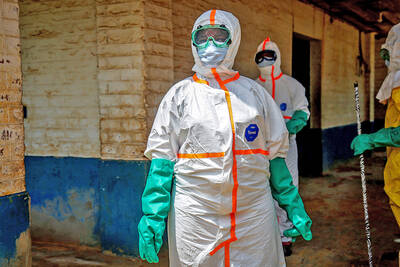
COMMUNITY CONFLICT: Concerns about disease spread from corpses has run up against friends and families’ desire to bury their dead as infection spreads in the area Angry residents of a town at the epicenter of the Ebola outbreak in the Democratic Republic of the Congo (DR Congo) attacked and burned a tent that was part of a health center where people are being treated for the virus, the staff there said Saturday. It was the second such attack in the region in a week. No one was hurt in the attack, according to reports but as patients ran out to escape the fire, 18 people with suspected Ebola infections fled the facility and are unaccounted for, a hospital director said. Angry residents arrived at the clinic in the

Forecasters in Europe yesterday warned of exceptional heat as record temperatures driven by a “heat dome” push temperatures well above seasonal norms across the continent. The surge follows a record-breaking Monday, with France logging its hottest day in the month of May on record, its weather agency said, and the UK also posting unprecedented highs. A so-called “heat dome” of warm air from northern Africa trapped under a high-pressure system over western Europe is behind the high temperatures not usually seen until high summer. Restrictions on outdoor work were imposed in parts of Italy, beaches in southwest France filled earlier than usual and


 RSS
RSS