


Englishman Ollie Jenks remembers when his friend first pitched the idea to him.
“It was so ridiculous I couldn’t say no,” Jenks said.
The proposal by his Canadian buddy Seth Scott, a fellow lover of cars and crazy adventures, was for them to drive a decades-old British-made Reliant Robin from London to the southern tip of Africa — a 22,500km journey through 22 countries — to set a record for the longest trip in a three-wheeled vehicle.
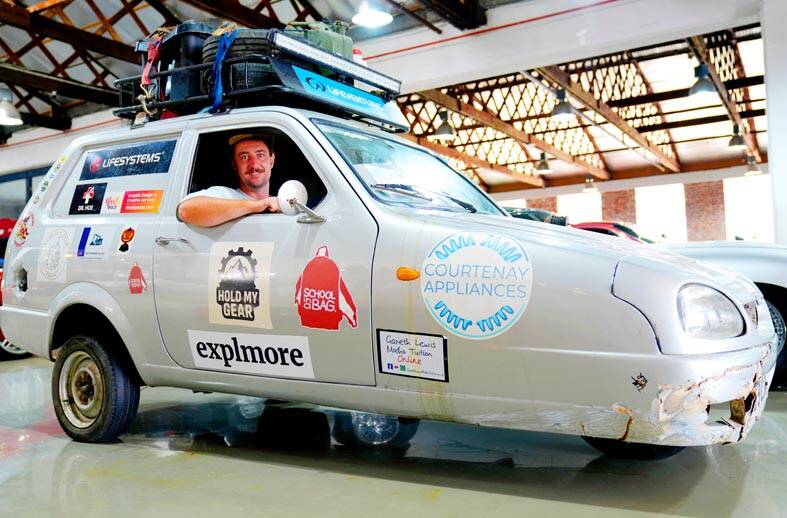
Photo: AP
Reliant Robins have cultlike status in the UK as humble three-wheelers that, in Jenks’ words, were designed to go to the shops and back in 1970s UK. They went out of production in the early 2000s, but remain loved in British culture, especially after a Reliant appeared as the Trotter brothers’ trusty, but battered yellow van in the hugely popular sitcom Only Fools and Horses.
Yet you could not find a less suitable vehicle to take thousands of kilometers through tropical jungles, mountain ranges and deserts down the west side of Africa. That is precisely why Jenks went for the absurd plan.
Sheila, the silver three-wheeler — one of the last Reliant Robins to be built — was acquired specifically for the adventure. Jenks and Scott set off in October last year with a can of fuel and a few essential supplies strapped to Sheila’s small roof, and a large amount of blind hope that they would somehow make it to Cape Town, near the bottom of the world.
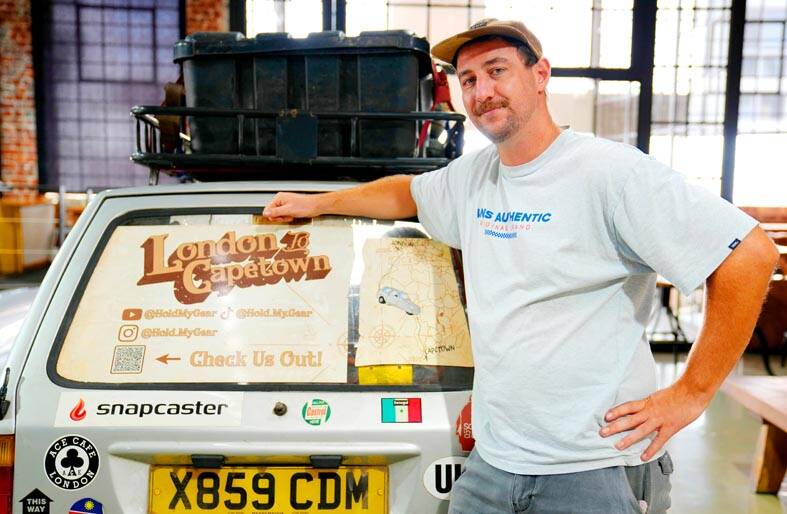
Photo: AP
“No power steering, no air-con, and it doesn’t do well up hills or down them. It is the most unsuitable car for probably any journey,” Jenks said in an unkind assessment of Sheila’s abilities. “We made friends with the designer of this car, and he’s scared to take it any more than 20 miles [32km].”
Jenks and Scott ignored all the advice and took Sheila on the epic journey over four-and-a-half months that cost in the region of US$40,000 to US$50,000, Jenks said.
They had help from sponsors and crowd funding, and documented the journey on Instagram, pulling in nearly 100,000 followers under the title: “14,000 miles, 3 wheels, 0 common sense.”
They arrived in Benin during an attempted coup. They skirted through northern Nigeria as the US launched airstrikes on Islamic State targets. They were given a military escort for about 480km through a region of separatist violence in Cameroon.
“Imagine this car in a military convoy,” Jenks said.
There were also many brushes with traffic-related danger, including when an overtaking bus almost flattened Sheila against a cliff face in the Democratic Republic of the Congo.
True to form that Reliants are sometimes not so reliable, there were also countless breakdowns on the punishing roads.
Sheila needed her wheel springs replaced in the first two weeks. The gearbox broke in Ghana, leaving them with only fourth gear. In Cameroon, there were clutch and distributor problems and then the big one: The engine blew up.
Through all the technical problems, the kindness of strangers and the intrepidness of Jenks and Scott kept them going. One man got a new gearbox shipped to Ghana. Reliant enthusiasts in the UK helped find a new engine to send to Cameroon.
After one breakdown, people helped load Sheila onto a cattle truck so she could be taken to a garage. Mechanics across the continent screwed, hammered and welded Sheila to keep her together, sometimes shaking their heads at the madness of it all.
There were also majestic moments, the kind that Jenks and Scott had envisioned to make it all worth it.
Sheila cruised through stunning mountain ranges and vast deserts — where surely no Reliant Robin has gone before. She went on safari, driving alongside galloping giraffes, spotting endangered rhinos and posing for a picture next to a giant elephant.
More than 120 days after setting off, she last month rattled into Cape Town on an engine that began badly overheating in the Namibian desert and had been touch and go for about 1,600km.
“This is a great underdog story,” said Graeme Hurst, a South African car lover who followed them on Instagram and came to see Sheila. “I see the farcical kind of comical nature of it ... but also the sheer admiration. I mean, they have utter tenacity.”
In South Africa, Sheila was put on temporary display in a showroom for high-end cars and was the center of attention ahead of the glittering Porsches and Mercedes, showing off her broken side window, her gasoline-stained windshield, her bent tire rims and her countless dents and scratches.
She will rest now and be given the thorough service she deserves, Jenks said.
Eventually, she would be driven to Kenya, put on a ship to Turkey, then make one last trip back to the UK to find a home at the London Transport Museum.
Jenks said he felt triumphant after reaching Cape Town, but relieved to have survived and finally be out of the tiny two-seater.
“It was like driving a motorized coffin,” he said.

Through the noise of rushing papers and whirring belts at a print factory in Kyoto, two creators watch their photo essay come to life in broadsheet form — part of an effort to win new audiences in the age of artificial intelligence (AI). Despite the decline of the publishing industry, self-publication and handmade “zine” magazines are growing in popularity in Japan, reflecting the nation’s enduring love of paper in the digital era. While speaking to Agence France-Presse at the plant, his hands black with ink, one of the creators, Kazuma Obara, said: “I think [paper] is a medium that engages all five

‘ABSURD MISTAKE’: The election commission said that there had been a failure to anticipate turnout after 14 polling stations ran short of ballot papers South Korean riot police yesterday cleared protesters from a Seoul polling station after a 35-hour blockade sparked by a shortage of ballot papers during local elections earlier this week. Wednesday’s election was the first nationwide vote since South Korean President Lee Jae-myung took office following the ouster of Yoon Suk-yeol over his short-lived martial law declaration. Lee’s ruling Democratic Party swept most races, but failed to flip the crucial Seoul mayoral seat. The South Korean National Election Commission apologized, blaming a failure to anticipate turnout after 14 polling stations in Seoul ran short of ballot papers. Some polling stations stayed open until 10pm to

Australian researchers have trained lab-grown brain cells on a silicon computer chip to play the 1990s shooter game Doom and said they are just scratching the surface of what the neurons could be capable of doing. It is the science-fiction work of biotech boffins at Cortical Labs, who researched and developed the technology that harnesses the workings of the brain’s networking system. Each so-called “biological computer” contains about 200,000 living human brain cells, grown from stem cells that were harvested from blood donations. Having mastered the simple computer game Pong, where a paddle is moved up and down to send a ball

France experienced its hottest spring on record, the French weather service said on Tuesday, after an exceptional early heat wave that also broke highs for the season in England and Wales. Meteo-France said the average nationwide temperature over March to May was 13.8°C — about 1.7°C above the norm, and surpassing records set in 2011 and 2020. “The warmest spring since records began in 1900,” it said in a bulletin. All three months were warmer than average, but the onset of an “unprecedented heatwave” late last month pushed the mercury to highs typically seen at the height of the summer. “Our country had never


 RSS
RSS