


Police in London said they had arrested more than 500 pro-Palestinian protesters at a demonstration in support of the banned group Palestine Action on Saturday.
Officers carried away activists to cheers and clapping from other demonstrators who gathered for the sit-down demonstration in the capital’s Trafalgar Square.
The protesters held placards in support of the banned group Palestine Action, making them liable for arrest.
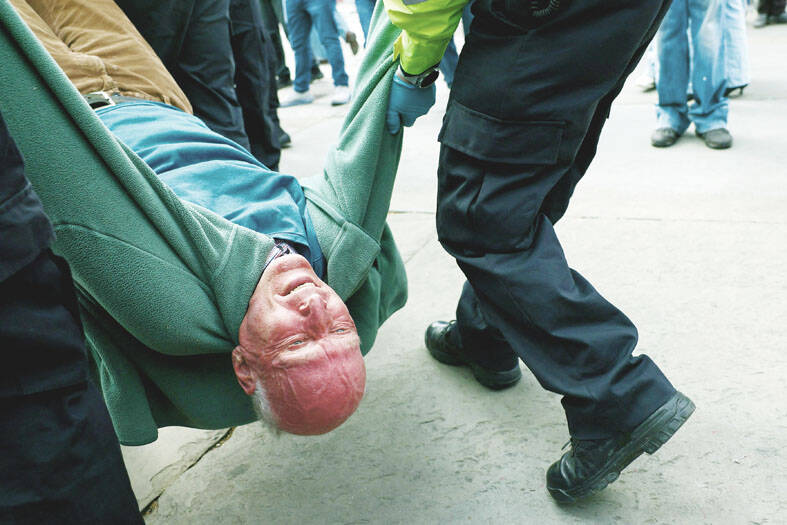
Photo: Reuters
London’s Metropolitan Police (MET) said on social media platform X just before midnight that they had arrested 523 people aged between 18 and 87.
Palestine Action was proscribed as a terrorist organization in July last year, making it a criminal offense to belong to or support the group, punishable by up to 14 years in prison. The British High Court in London upheld a challenge to the ban in February, saying it had interfered with the right to freedom of speech.
The British government has been granted leave to appeal against the decision.
London’s Metropolitan Police paused arrests in the wake of the High Court ruling before announcing late last month that they would resume.
“It’s really important to continue to show up,” said Freya, 28, manager of a London environmental organization, one of those sitting toward the front of the crowd of protesters.
“It’s important that we all continue to oppose genocide... The government might flip-flop in their legal argument, but the morals of these people [here] do not change,” she said.
There have been about 3,000 arrests since the ban on Palestine Action was imposed, mainly for carrying placards defending it. Hundreds of people are facing charges.
Protester Denis MacDermot, 73, from Edinburgh, said he had been arrested before and had no hesitation about turning out again.
“I’m a supporter of these great people,” he said, waving toward other protesters, adding that if the court process was definitive “there would be no need for all this.”
Protest organizers Defend Our Juries said hundreds of people had taken part in Saturday’s demonstration, protesting against “the UK Government’s complicity in Israel’s genocide in Gaza and the misguided crackdown on peaceful protest at home.”
Police were “choosing to make arrests despite the government’s ban on the group being ruled unlawful by the High Court, and leading lawyers warning that any arrests would be unlawful,” it said in a statement.
Amnesty UK condemned the arrests as “yet another blow to civil liberties in this country.”
“The MET rightly said it would stop making arrests. It has now gone back to its old, failed policy — mass arrests of people holding pieces of card, including today an elderly woman with walking sticks,” it said in a statement on X.
The ban, which put Palestine Action on a blacklist that also includes Palestinian militants Hamas and the Iran-backed Lebanese group Hezbollah, has sparked severe backlash.
A judge has put on hold all trials of people charged with supporting Palestine Action, scheduling a blanket review of cases for July 30.
Set up in 2020, Palestine Action’s stated goal on its now-blocked Web site is to end “global participation in Israel’s genocidal and apartheid regime.”
It has mainly targeted weapons factories, especially those belonging to the Israeli defense group Elbit Systems.

It began as a satirical online project. Now millions of young people in India are flocking to it as an outlet for their frustration. A parody political party called the Cockroach Janta Party, with the insect as its symbol, has exploded across India’s social media by turning absurdist humor into protest. Memes and short videos mocking corruption, joblessness and political dysfunction have flooded social media sites, where millions of users are embracing the cockroach — known for its ability to survive harsh conditions — as a tongue-in-cheek symbol of endurance. The online movement’s rise has been unusually rapid. The Cockroach Janta Party (CJP)

SPEAKING OUT: After Siranudh Scott’s allegations surfaced, celebrities and public figures took to social media to share their own experiences of sexual misconduct and abuse A high-profile alleged sexual abuse case within a wealthy Thai beer brewing family has prompted a wave of painful accounts from survivors of unconnected abuse in the conservative nation. Siranudh Scott, a member of the billionaire Thai family that founded the ubiquitous Singha beer brand, posted an emotional video this month accusing his elder brother Sunit of repeatedly abusing him when he was a teenager. Sunit, who is in his 30s, later denied the allegations in a video posted online, but Singha parent Boonrawd dismissed him from his executive role with the company on Tuesday last week. “I felt I needed to speak

A Hong Kong astronaut is to join a Chinese space mission for the first time as part of a three-person crew launching today, as Beijing edges closer to its goal of landing people on the moon. The Tiangong space station — crewed by teams of three astronauts that are typically rotated every six months — is the crown jewel of China’s space program, boosted by billions in state investment in a bid to catch up with the US and Russia. The Shenzhou-23 mission is to blast off at 11:08pm from the Jiuquan Satellite Launch Center in northwestern China, carrying three astronauts to
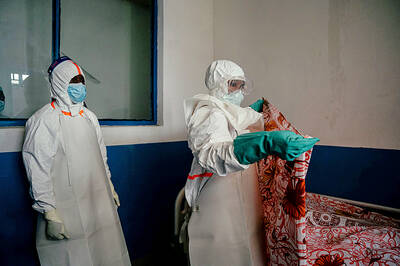
UPGRADED ALERT: The risk inside DR Congo is now considered ‘very high,’ while neighboring countries face a ‘high’ threat as the outbreak continues, the WHO said Ebola is spreading faster than responders can track it in eastern Congo, where health workers managed to follow up with barely one in five identified contacts in a single day. Authorities in the Democratic Republic of the Congo (DR Congo) reported 83 confirmed infections, 746 suspected cases and 1,603 identified contacts as of Thursday, but health workers were able to follow up on only 342 contacts that day — about 21 percent of the total under monitoring — data released by the DR Congo Ministry of Public Health on Friday showed. The figures suggest the response is falling behind the outbreak itself,


 RSS
RSS