


Facing daily barrages of Russian drones and missiles, Ukraine has invited private companies to get their own air-defense systems in a bid to ease the burden on its military.
A senior Ukrainian military official said the plan — involving state authorization and integration into the air force coordination system — has already attracted more than a dozen companies.
The goal is to give businesses “the possibility, at their own expense and with their own employees, to protect themselves against aerial threats,” said Yuriy Myronenko, 48, inspector general at the Ukrainian Ministry of Defense and the main architect of the project.
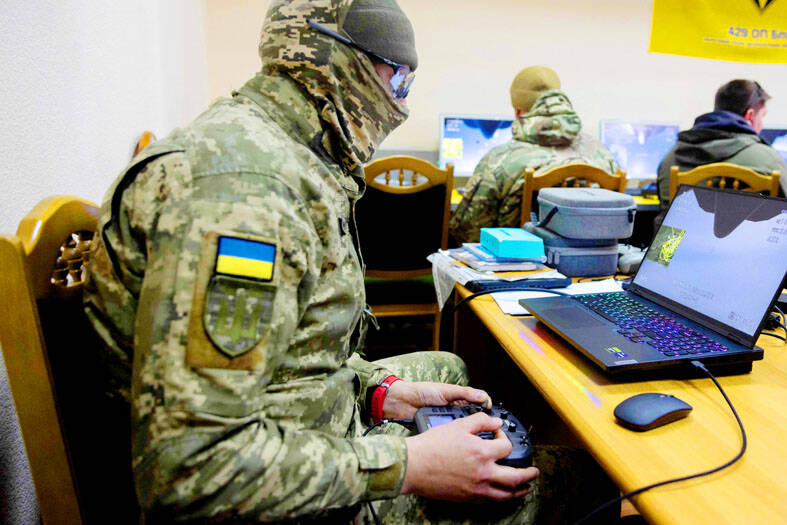
Photo: AFP
Since it invaded in 2022, Russia has regularly launched at Ukraine hundreds of long-range Shahed drones, originally Iranian-designed, but now mass-produced in Russia.
Cheap, but lethal, the drones target residential areas and critical infrastructure, sometimes hundreds of kilometers from the front line.
The largest attack since the start of the invasion came at the end of last month, when Russia fired nearly 1,000 drones in 24 hours, along with missiles.
Ukraine’s air-defense system — which includes thousands of mobile anti-drone teams — is fairly effective, but cannot cover the entire country.
That is why the defense ministry has opted to partly outsource the task to private actors, including energy companies, frequently targeted by Russian strikes, logistics firms and security groups to protect their sites.
For now, the Ukrainian authorities have released few details of the plan.
Sixteen firms have received the necessary authorization, and “some companies are already shooting down Shaheds,” Myronenko said.
“I think we are the first in the world to create such a system,” he said, referring to the plan he said was already yielding results.
“The first shoot-downs were two weeks ago,” added the lieutenant-colonel who used to command a drone unit.
In the northeastern Kharkiv region, near the front line, one company — unnamed for security reasons — used heavy machine guns mounted on remote-controlled turrets to intercept several Russian drones.
After the defense ministry published a statement on the matter, “dozens” of other groups contacted the authorities to enquire about the scheme, Myronenko said.
“We don’t expect private air defense to solve all our problems,” he said. “We are forced to take this step because every opportunity to shoot down one, two, three, four, five Shaheds helps.”
Companies wanting to take part must undergo a special authorization process, including to rule out any Russian ties, before they can purchase weapons and train their staff.
They must also integrate into the air force’s real-time coordination system, a key element of the sophisticated network that manages thousands of air-defense teams.
The special software allows commanders to see “who is shooting down what, with which systems, which teams,” and to locate incoming targets, Myronenko said.
For him, the future of private air defense lies in drone interceptors — small uncrewed aircraft designed to destroy incoming drones midair.
Under the pressure of relentless attacks, Ukraine has already developed about 50 different interceptor models, an industry that barely existed a year ago.
Intense competition is pushing manufacturers to improve effectiveness while slashing costs, sometimes to less than US$1,000 per unit, making them “affordable,” Myronenko said.
In the longer term, private companies could even be allowed to acquire weapons capable of downing cruise missiles that Russia frequently uses against Ukraine, such as man-portable air-defense systems, he added.
“We don’t limit what protective means they can buy,” he said, adding: “Because we understand that the war will change in three months, six months.”
The main goal set by Ukrainian Minister of Defense Mykhailo Fedorov — appointed in January — for this year is to “detect 100 percent of all air targets,” both drones and missiles, and “shoot down 95 percent of them,” up from about 80 percent currently.
Myronenko called the target “absolutely realistic,” citing the surge in interceptor production, with tens of thousands being delivered to the army each month.
“We must clearly demonstrate [to Russia] that terrorizing our population and civilian infrastructure will not work,” he said.
South Korea’s air force yesterday apologized for a 2021 midair collision involving two fighter jets, a day after auditors said the pilots were taking selfies and filming during the flight and held them responsible for the accident. “We sincerely apologize to the public for the concern caused by the accident that occurred in 2021,” an air force spokesman told a news conference, adding that one of the pilots involved had been suspended from flying duties, received severe disciplinary action and has since left the military. The apology followed a report released on Wednesday by the South Korean Board of Audit and Inspection,

About 240 Indians claiming descent from a Biblical tribe landed at Tel Aviv airport on Thursday as part of a government operation to relocate them to Israel. The newcomers passed under a balloon arch in blue and white, the colors of the Israeli flag, as dozens of well-wishers welcomed them with a traditional Jewish song. They were the first “bnei Menashe” (“sons of Manasseh”) to arrive in Israel since the government in November last year announced funding for the immigration of about 6,000 members of the community from the states of Manipur and Mizoram in northeast India. The community claims to descend from

Indonesian police have arrested 13 people after shocking images of alleged abuse against small children at a daycare center went viral, sparking outrage across the nation, officials said on Monday. Police on Friday last week raided Little Aresha, a daycare center in Yogyakarta on Java island, following a report from a former employee. CCTV footage circulating on social media showed children, most younger than two, lying on the floor wearing only diapers, their hands and feet bound with rags. The police have confirmed that the footage is authentic. Police said they also found 20 children crammed into a room just 3m by 3m. “So

‘TROUBLING’: The firing of Phelan, who was an adviser to a nonprofit that supported the defense of Taiwan, was another example of ‘dysfunction’ under Trump, a US senator said US Secretary of the Navy John Phelan has been fired, a US official and a person familiar with the matter said on Wednesday, in another wartime shakeup at the Pentagon coming just weeks after US Secretary of Defense Pete Hegseth ousted the Army’s top general. The Pentagon announced his departure in a brief statement, saying he was leaving the administration “effective immediately,” but it did not provide a reason or say whether it was his decision to go. The sources, who spoke on condition of anonymity, said Phelan was dismissed in part because he was moving too slowly to implement reforms to


 RSS
RSS