


US President Donald Trump on Wednesday vented his frustration with NATO during a private meeting with NATO Secretary-General Mark Rutte as relations in the military alliance reached a crisis point over the Iran war.
“He is clearly disappointed with many NATO allies, and I can see his point,” Rutte said on CNN’s The Lead with Jake Tapper, after spending more than two hours at the White House. “This was a very frank, very open discussion, but also a discussion between two good friends.”
Rutte spoke hours after White House spokeswoman Karoline Leavitt quoted Trump as saying of NATO: “They were tested, and they failed” during the Iran war.
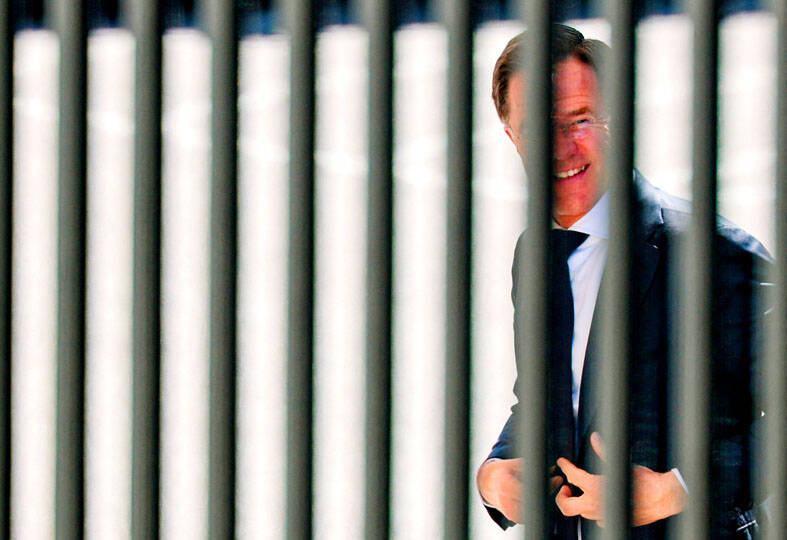
Photo: Reuters
Several NATO countries resisted supporting the US military campaign against Iran by denying US military planes use of their airspace or declining to send naval forces to help reopen the Strait of Hormuz for energy tankers.
Without specifying the countries, Rutte said his own view was that “some” NATO countries had failed to live up to their commitments in the Iran operation, but that “the large majority of Europeans” had been helpful.
The White House did not disclose details of the talks, but Trump wrote his thoughts on Truth Social after the meeting.
“NATO WASN’T THERE WHEN WE NEEDED THEM, AND THEY WON’T BE THERE IF WE NEED THEM AGAIN. REMEMBER GREENLAND, THAT BIG, POORLY RUN, PIECE OF ICE!!!” he said.
Trump has repeatedly called NATO a “paper tiger” and threatened to withdraw from the 32-member transatlantic alliance in the past few weeks, saying that Washington’s European allies have relied on US security guarantees while providing inadequate support for the US-Israeli bombing campaign in Iran.
Although Trump on Tuesday said the attacks on Iran would be paused under a two-week ceasefire, the fallout from the conflict has continued to strain ties between Washington and its allies, suggesting the diplomatic consequences might linger longer.
Leavitt on Wednesday said that NATO countries had “turned their backs on the American people,” who fund their nations’ defense, and that Trump would have a “very frank and candid conversation” with the NATO chief.
Conflict over Iran has worsened transatlantic anxieties over Ukraine, Greenland and military spending, although senior US officials have privately reassured European governments that the administration remains committed to NATO, according to one of the two European officials, who was involved in such conversations.
“This is a dangerous point for the transatlantic alliance,” said Oana Lungescu, an analyst at the London-based think tank Royal United Services Institute and a former NATO spokeswoman.

Crowds in Bangladesh are flocking to snap photographs with an unlikely social media star — an albino buffalo with flowing blond hair nicknamed “Donald Trump” that is due to be sacrificed within days. Owner Zia Uddin Mridha, 38, said his brother named the 700kg bull over its flowing helmet of hair resembling the signature look of the US president. “My younger brother picked this name because of the buffalo’s extraordinary hair,” he said at his farm in Narayanganj, just outside the capital, Dhaka. Mridha said that a constant stream of curious visitors — social media fans, onlookers and children — have come throughout

It began as a satirical online project. Now millions of young people in India are flocking to it as an outlet for their frustration. A parody political party called the Cockroach Janta Party, with the insect as its symbol, has exploded across India’s social media by turning absurdist humor into protest. Memes and short videos mocking corruption, joblessness and political dysfunction have flooded social media sites, where millions of users are embracing the cockroach — known for its ability to survive harsh conditions — as a tongue-in-cheek symbol of endurance. The online movement’s rise has been unusually rapid. The Cockroach Janta Party (CJP)
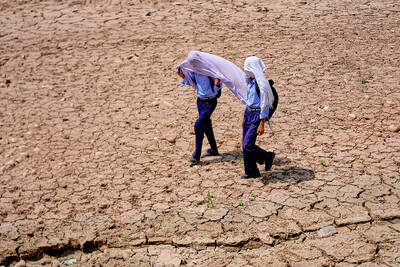
HOTTER: While Indians are accustomed to summer heat, climate change has caused northwestern India to warm faster than other parts of the country, an academic said Roads and markets have emptied during afternoons and some farmers have switched to nighttime work to avoid scorching temperatures as a heat wave grips large parts of India. The India Meteorological Department forecast maximum temperatures for yesterday of about 45°C in the capital, New Delhi, where authorities have opened temporary “cooling zones” to help people cope. The weather department warned that conditions would likely persist across several northern regions in the coming days, with temperatures staying well above seasonal averages. Authorities urged people to stay indoors during the hottest hours and take precautions against heat-related illnesses. India declares a heat wave whenever maximum temperatures

BIGGER ROLE: Beijing has said it maintains an impartial stance on the war in Ukraine, but by training Russian troops, China is far more involved than previously known China’s armed forces secretly trained about 200 Russian military personnel in China late last year, and some have since returned to fight in Ukraine, according to three European intelligence agencies and documents seen by Reuters. While China and Russia have held a number of joint military exercises since Moscow’s full-scale invasion of Ukraine in 2022, Beijing has repeatedly said that it is neutral in the conflict and presents itself as a peace mediator. The covert training sessions, which predominantly focused on the use of drones, were outlined in a dual-language Russian-Chinese agreement signed by senior Russian and Chinese officers in Beijing on


 RSS
RSS