


More than 1,000 humanitarian workers have been killed across the globe in the past three years, nearly triple the death count in the previous three years, the UN said on Wednesday.
“This is not an accidental escalation — it is the collapse of protection,” UN Undersecretary-General for Humanitarian Affairs Tom Fletcher told the UN Security Council.
Of the more than 1,010 humanitarian workers killed from 2023 to last year, more than 560 were in Gaza and the West Bank, 130 in Sudan, 60 in South Sudan, 25 in Ukraine and 25 in the Democratic Republic of the Congo, compared with 377 killed from 2020 to 2022, he said.
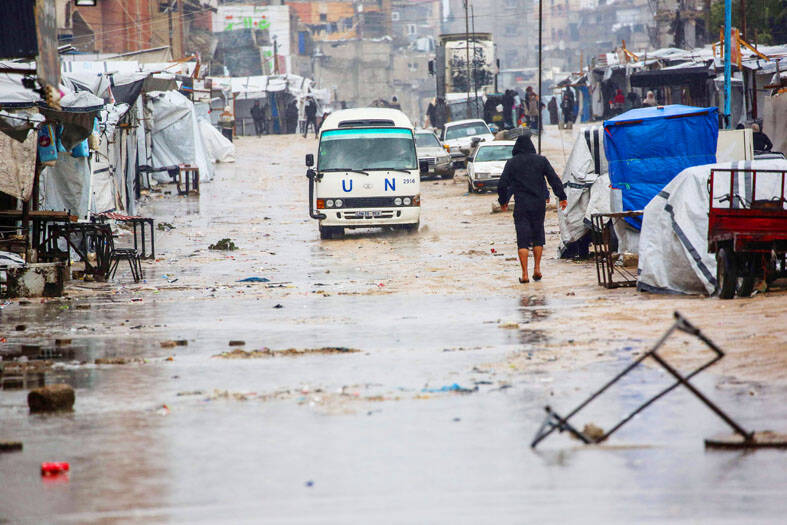
Photo: AFP
The surge in deaths occurred during the war between Israel and Hamas, which began in October 2023. A ceasefire has been in effect since October last year, although shootings and airstrikes have persisted.
Last year alone, at least 326 aid workers were recorded as killed in 21 countries, while in 2024, a record 383 were killed in global hot spots while distributing food, water, shelter and medicine, Fletcher said.
“They died in clearly marked convoys and on missions coordinated directly with authorities,” he said.
The Security Council was meeting on a resolution it adopted in May 2024 that condemned attacks on humanitarian workers and UN personnel and demanded that all combatants protect them in accordance with international law.
Fletcher asked the 15 members of the UN’s most powerful body if the killings were because international law “is no longer convenient” or because “it is more important to protect those designing, selling, supplying and firing lethal weapons?”
“Or is it because member states see these numbers as collateral damage, part of the fog of war? Or worse, are we now seen as legitimate targets?” he asked. “Perhaps the most chilling question: If these deaths were ‘preventable,’ why then were they not prevented?”
Humanitarian staff are not only being killed, but “restricted, penalized and delegitimized” — and told where they cannot go and whom they cannot help, Fletcher said.
In Yemen, 73 UN staff and dozens of others working for non-governmental organizations are being arbitrarily detained by Houthi rebels, he said.
In Afghanistan, female humanitarian staff are banned from doing their jobs, he said.
In Gaza, Israel restricts the UN and other international organizations, and in Ukraine drone attacks have forced aid workers back from the front line, he added.
“These trends, alongside the collapse in funding for our lifesaving work, are a symptom of a lawless, bellicose, selfish and violent world,” Fletcher said.
He challenged the UN’s 193 member nations to uphold the 2024 resolution’s demands to protect humanitarian workers and ensure accountability for crimes against them.

South Korea’s air force yesterday apologized for a 2021 midair collision involving two fighter jets, a day after auditors said the pilots were taking selfies and filming during the flight and held them responsible for the accident. “We sincerely apologize to the public for the concern caused by the accident that occurred in 2021,” an air force spokesman told a news conference, adding that one of the pilots involved had been suspended from flying duties, received severe disciplinary action and has since left the military. The apology followed a report released on Wednesday by the South Korean Board of Audit and Inspection,

About 240 Indians claiming descent from a Biblical tribe landed at Tel Aviv airport on Thursday as part of a government operation to relocate them to Israel. The newcomers passed under a balloon arch in blue and white, the colors of the Israeli flag, as dozens of well-wishers welcomed them with a traditional Jewish song. They were the first “bnei Menashe” (“sons of Manasseh”) to arrive in Israel since the government in November last year announced funding for the immigration of about 6,000 members of the community from the states of Manipur and Mizoram in northeast India. The community claims to descend from

Indonesian police have arrested 13 people after shocking images of alleged abuse against small children at a daycare center went viral, sparking outrage across the nation, officials said on Monday. Police on Friday last week raided Little Aresha, a daycare center in Yogyakarta on Java island, following a report from a former employee. CCTV footage circulating on social media showed children, most younger than two, lying on the floor wearing only diapers, their hands and feet bound with rags. The police have confirmed that the footage is authentic. Police said they also found 20 children crammed into a room just 3m by 3m. “So

‘TROUBLING’: The firing of Phelan, who was an adviser to a nonprofit that supported the defense of Taiwan, was another example of ‘dysfunction’ under Trump, a US senator said US Secretary of the Navy John Phelan has been fired, a US official and a person familiar with the matter said on Wednesday, in another wartime shakeup at the Pentagon coming just weeks after US Secretary of Defense Pete Hegseth ousted the Army’s top general. The Pentagon announced his departure in a brief statement, saying he was leaving the administration “effective immediately,” but it did not provide a reason or say whether it was his decision to go. The sources, who spoke on condition of anonymity, said Phelan was dismissed in part because he was moving too slowly to implement reforms to


 RSS
RSS