

Davorin Cetin was cleaning a yard in a Croatian village when a landmine exploded meters away, leaving him badly injured and killing a close friend instantly. It took him two decades and more than a dozen operations before he felt safe stepping on grass again, haunted by what might lie beneath.
Croatia finally declared it was mine-free earlier this year, lifting a threat that had lingered for its people since its four-year war of independence began in 1991.
“That danger is gone. We can walk freely in our country,” said Cetin, who was left severely disabled by the explosion.
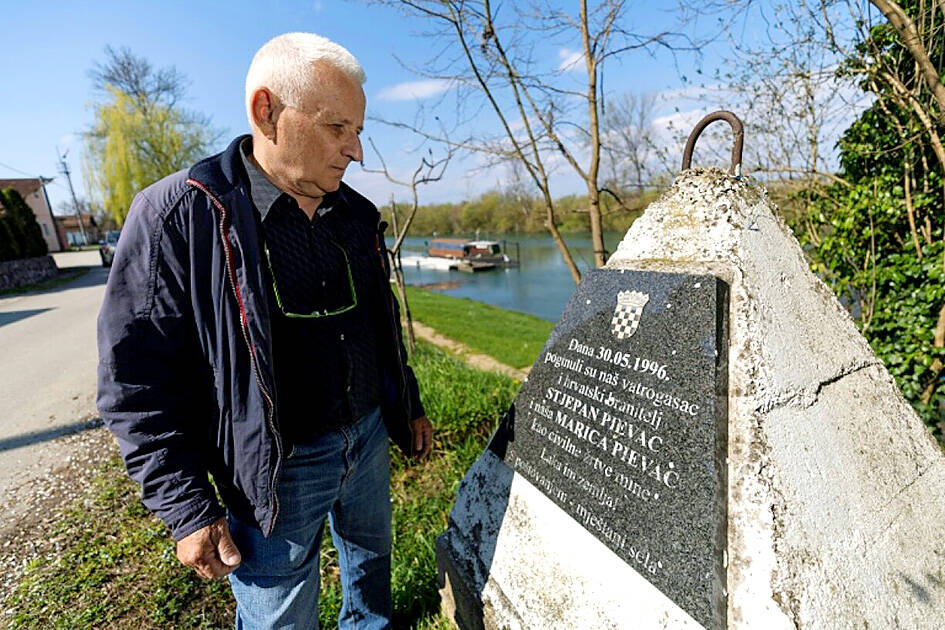
Photo: AFP
However, the toll was terrible. More than 200 people were killed by landmines and about 400 more injured.
It took Croatia 30 years to remove more than 107,000 landmines and 470,000 unexploded ordnance at a cost of 1.2 billion euros (US$1.4 billion) left after the conflict as the former Yugoslavia collapsed. Yet for hundreds of landmine survivors and the families of victims, the legacy remains.
The landmine that forever changed the Pievac family was laid just a short walk from their home in the village of Brodjani, near the central town of Karlovac.
Months after fighting had ended, the young family was walking along a path when a falling branch triggered a blast that killed Juraj Pievac’s brother, fatally wounded his wife and disabled him for life. His daughter miraculously escaped unharmed.
“It hit three of us, standing just a few meters apart,” Pievac said.
His family was among the Croats who fled the farming village when Belgrade-backed Serb rebels seized the area in 1991. When fighting ended, the community slowly returned to rebuild the war-ravaged village — waiting for them were deadly explosives hidden in homes and littering the surrounding land.
“It was a struggle. Somehow we made it through, but a deep pain remains,” the 70-year-old grandfather said, after spending two years on crutches and undergoing lengthy rehabilitation for his arm and leg injuries.
“However, the memories return, especially when I wake up at night,” he said through tears while looking at a wedding photo of his wife, who was 36 when she died.
He has since returned to his farm and now shares the renovated home with his son’s family.
“What we had is gone and can never be brought back. I did what I could to keep our farm going,” he said.
The UN first feared as much as one-fifth of Croatia had been affected by mines after Yugoslavia disintegrated in a bloody series of wars. Although later efforts shrank that estimate substantially, more than 870km2 had to be cleared.
In neighboring Bosnia, about 1.6 per cent of its territory is still suspected of having mines. More than 600 have died there since the end of the war. Among the victims in both countries are dozens of demining experts, killed while attempting to remove the deadly devices.
Mirsad Tokic, who worked disarming landmines for years, had several close calls before a blast took his leg in 2007. The 57-year-old was drawn to the job despite the risks, enjoying the adrenaline-fueled work that required absolute focus. However, when he stepped on a mine while working in a remote village near Croatia’s Adriatic coast, his thoughts had drifted instead to his upcoming birthday party waiting for him back home.
“I just wanted to finish the task and rushed to clear a narrow path of vegetation ... and walked straight into it,” he said.
The father of three said he would be glad to have a completely mine-free country.
“It would be wonderful if no one ever had to experience such a tragedy again,” he said.
Cetin, who is a campaigner for landmine victims, said the chance to live without the everyday fear of mines was an important moment for Croatia.
“A huge, great job was done,” he said.
However, victims require long-term support, including mental health care, he said.
Cetin himself battled post-traumatic stress disorder for years, but found solace in nature, fishing and his motorcycles.
“I don’t live in the past. I’ve welcomed a grandchild, my daughter has graduated,” the 62-year-old said, smiling gently.
“Life is a miracle,” he said.

A Chinese artificial intelligence (AI) cybersecurity tool called ARTEX was used in a spate of recent hacks of Japanese companies, the subsidiary of a major Tokyo-based Internet company yesterday. Dozens of Japanese companies, from restaurant chains to a car hire operator, have disclosed unauthorized access or data breaches in the past weeks — potentially impacting millions of customers. The information security arm of GMO Internet Group said it had “confirmed ARTEX was used” having investigated the attacks in collaboration with external organizations. “It also became clear ... the attacks were almost exclusively targeting Japan,” GMO cybersecurity center director Daiki Fukumori

On his terrace overlooking the forest in eastern Pennsylvania, Ed Negra lays out four letters. All are from a developer promising a US$10,000 check to each household once its data center is running. “I call it a bribe,” the US retiree said. The scene is picture-perfect. Autumn leaves are turning russet, and there is a stunning mountain view in this corner of Pennsylvania, a key state in the US’ upcoming midterm elections. “We thought it was a beautiful place to retire,” said the septuagenarian, who used to manage a large building-supply store in neighboring New Jersey. He and his wife settled in a sprawling

A 16-year-old on Thursday shot his way through locked doors to get into an elementary school in Bend, Oregon, killing three children and a teacher. He was then shot by a person at the scene who followed him inside, authorities said. The suspect was found dead inside the school minutes after the shooting was first reported, Bend Police Chief Mike Krantz said. The three children killed were aged 5, 8 and 11. Another child, 7, and a teacher, 54, were injured and taken to the hospital in critical condition, he said. The first 911 call came just before 1pm from a person in
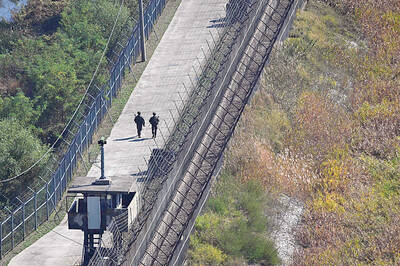
A STEP UP: The moving of small military positions forward should be taken seriously amid the North’s recent demonstrations of its firepower, an analyst said North Korea has moved new units into “firing positions,” the sister of leader Kim Jong-un said yesterday, days after Pyongyang warned it was considering deploying additional strike means to its border with South Korea. Tensions between Seoul and Pyongyang have soared since the South last month blamed an explosion inside the heavily fortified demilitarized zone (DMZ) separating the two countries on landmines laid by North Korea, an accusation it has rejected. “Our military leadership underlined the need to make those rogues aware that our new firepower units have taken their firing positions,” state media cited Kim Yo-jong as saying. Her statement came a


 RSS
RSS