


Satellite imaging firm Planet Labs on Saturday said it would indefinitely withhold visuals of Iran and the region of conflict in the Middle East to comply with a request from the US government.
California-based Planet Labs announced the decision in an e-mail to customers and said the US government had asked all satellite imagery providers to indefinitely withhold images of the conflict region.
The restriction expands upon a 14-day delay on imagery of the Middle East that Planet Labs imposed last month, a move the firm said was meant to prevent adversaries from using it to attack the US and its allies.
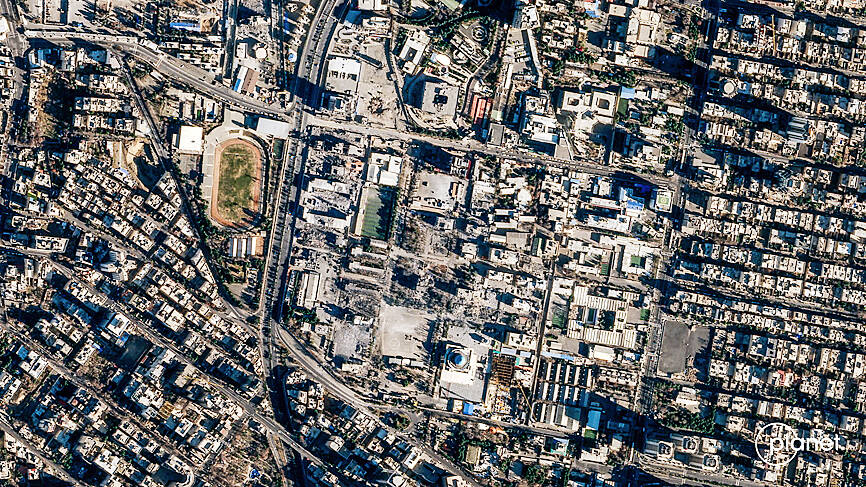
Photo: Planet Labs PBC / handout via Reuters
Planet Labs said it would withhold imagery dating back to March 9 and that it expects the policy to remain in effect until the conflict ends.
The war began when the US and Israel attacked Iran on Feb. 28, and the conflict spread in the region when Tehran responded by launching its own attacks on Israel and US bases in Gulf states, including Saudi Arabia, Kuwait and Bahrain.
Military uses of satellite technology include target identification, weapons guidance, missile tracking and communications.
Some space specialists say Iran could be accessing commercial imagery, including pictures obtained via US adversaries.
Satellite images also help journalists and academicians studying hard-to-reach places.
Planet Labs, which operates a large fleet of Earth-imaging satellites and sells frequently updated images to governments, companies and media, did not respond to a request for further comment.
The Pentagon said it does not comment on intelligence-related matters.
Planet Labs said in its e-mail to customers that it would switch to a “managed distribution of images” deemed not to pose a risk to safety.
Under a new system, Planet Labs would release imagery on a case-by-case basis for urgent, mission-critical requirements or in the public interest.
“These are extraordinary circumstances, and we are doing all we can to balance the needs of all our stakeholders,” the firm said.
One commercial provider, Vantor, formerly Maxar Technologies, said that it was not contacted by the US government.
Vantor for years has reserved the right to “implement enhanced access controls during times of geopolitical conflict” and has applied them for parts of the Middle East, a company spokesperson said in a statement.
Those controls can include limits on who can request new images or buy pictures of regions where the US military and its allies are “actively operating,” and areas “actively targeted by adversaries,” the spokesperson said.

An American scientist convicted of lying to US authorities about payments from China while he was at Harvard University has rebuilt his research lab in Shenzhen, China, to pursue technology the Chinese government has identified as a national priority: embedding electronics into the human brain. Charles Lieber, 67, is among the world’s leading researchers in brain-computer interfaces. The technology has shown promise in treating conditions such as amyotrophic lateral sclerosis and restoring movement in paralyzed people. It also has potential military applications: Scientists at the Chinese People’s Liberation Army have investigated brain interfaces as a way to engineer super soldiers by boosting

Indonesian police have arrested 13 people after shocking images of alleged abuse against small children at a daycare center went viral, sparking outrage across the nation, officials said on Monday. Police on Friday last week raided Little Aresha, a daycare center in Yogyakarta on Java island, following a report from a former employee. CCTV footage circulating on social media showed children, most younger than two, lying on the floor wearing only diapers, their hands and feet bound with rags. The police have confirmed that the footage is authentic. Police said they also found 20 children crammed into a room just 3m by 3m. “So

Jailed media entrepreneur Jimmy Lai (黎智英) has been awarded Deutsche Welle’s (DW) freedom of speech award for his contribution to Hong Kong’s pro-democracy movement. The German public broadcaster on Thursday said Lai would be presented in absentia with the 12th iteration of the award on June 23 at the DW Global Media Forum in Bonn. Deutsche Welle director-general Barbara Massing praised the 78-year-old founder of the now-shuttered news outlet Apple Daily for standing “unwaveringly for press freedom in Hong Kong at great personal risk.” “With Apple Daily, he gave journalists a platform for free reporting and a voice to the democracy movement in

PHILIPPINE COMMITTEE: The head of the committee that made the decision said: ‘If there is nothing to hide, there is no reason to hide, there is no reason to obstruct’ A Philippine congressional committee on Wednesday ruled that there was “probable cause” to impeach Philippine Vice President Sara Duterte after hearing allegations of unexplained wealth, misuse of state funds and threats to have the president assassinated. The unanimous decision of the 53-member committee in the Philippine House of Representatives sends the two impeachment complaints to deliberations and voting by the entire lower chamber, which has more than 300 lawmakers. The complaints centered on Duterte’s alleged illegal use and mishandling of intelligence funds from the vice president’s office, and from her time as education secretary under Philippine President Ferdinand Marcos Jr. Duterte and the


 RSS
RSS