


The UN Security Council postponed a vote scheduled for yesterday on a draft resolution brought by Bahrain authorizing the use of “defensive” force to protect shipping in the Strait of Hormuz from Iranian attacks.
The reason given was that the UN observes Good Friday as a public holiday, diplomatic sources said.
No new date has been given for voting on the draft.
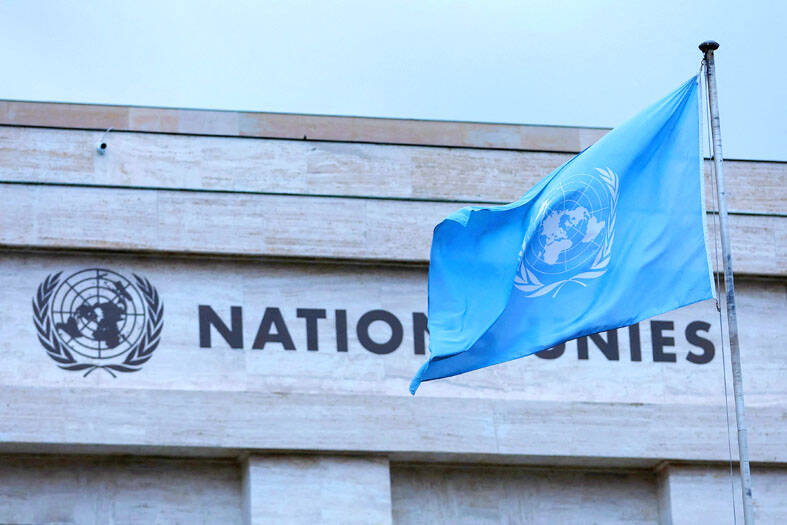
Photo: Reuters
Iran has placed a stranglehold on the key shipping lane in retaliation for US-Israeli strikes that triggered the month-old Middle East war.
“We cannot accept economic terrorism affecting our region and the world, the whole world is being affected by the developments,” Bahrain Ambassador to the UN Jamal Alrowaiei said.
The text of the draft, which has gone through several amendments and is supported by the US, “comes at a critical juncture,” he added.
US President Donald Trump had called for countries struggling with fuel shortages to “go get your own oil” in the Strait of Hormuz, adding that US forces would not help them.
A sixth and final draft greenlights member states — either unilaterally or as “voluntary multinational naval partnerships” — to use “all defensive means necessary and commensurate with the circumstances.”
It applies to the strait and adjacent waters to “secure transit passage and to deter attempts to close, obstruct or otherwise interfere with international navigation through the Strait of Hormuz.”
The measure would last for a period of at least six months. The draft resolution has been molded in a bid to rally several countries that have appeared skeptical, including Russia, China and France.
Revised wording no longer explicitly invokes Chapter 7 of the UN Charter, which allows the Security Council to authorize armed force to restore peace.
It also emphasizes the defensive nature of any intervention — a stipulation that seems to have alleviated French concerns.
French Ambassador to the UN Jerome Bonnafont said “it is up to the Council to quickly devise the necessary defensive response” after members last month voted to condemn Iran’s blocking of the Strait of Hormuz.
It is not certain that Russia and China — who wield veto powers — would back the draft resolution.
“Authorizing member states to use force would amount to legitimizing the unlawful and indiscriminate use of force, which would inevitably lead to further escalation of the situation and lead to serious consequences,” Chinese Permanent Representative to the UN Fu Cong (傅?).
Russia, a long-time ally of Tehran, has denounced what it calls one-sided measures.
Considering the possible Russian and Chinese vetoes, the text “faces tall odds to make it through the Security Council,” International Crisis Group analyst Daniel Forti said. “It is hard to see them supporting a resolution that treats stability in the strait exclusively as a security issue, instead of one that also grapples with the need for a durable political end to the hostilities.”

It began as a satirical online project. Now millions of young people in India are flocking to it as an outlet for their frustration. A parody political party called the Cockroach Janta Party, with the insect as its symbol, has exploded across India’s social media by turning absurdist humor into protest. Memes and short videos mocking corruption, joblessness and political dysfunction have flooded social media sites, where millions of users are embracing the cockroach — known for its ability to survive harsh conditions — as a tongue-in-cheek symbol of endurance. The online movement’s rise has been unusually rapid. The Cockroach Janta Party (CJP)

SPEAKING OUT: After Siranudh Scott’s allegations surfaced, celebrities and public figures took to social media to share their own experiences of sexual misconduct and abuse A high-profile alleged sexual abuse case within a wealthy Thai beer brewing family has prompted a wave of painful accounts from survivors of unconnected abuse in the conservative nation. Siranudh Scott, a member of the billionaire Thai family that founded the ubiquitous Singha beer brand, posted an emotional video this month accusing his elder brother Sunit of repeatedly abusing him when he was a teenager. Sunit, who is in his 30s, later denied the allegations in a video posted online, but Singha parent Boonrawd dismissed him from his executive role with the company on Tuesday last week. “I felt I needed to speak

A Hong Kong astronaut is to join a Chinese space mission for the first time as part of a three-person crew launching today, as Beijing edges closer to its goal of landing people on the moon. The Tiangong space station — crewed by teams of three astronauts that are typically rotated every six months — is the crown jewel of China’s space program, boosted by billions in state investment in a bid to catch up with the US and Russia. The Shenzhou-23 mission is to blast off at 11:08pm from the Jiuquan Satellite Launch Center in northwestern China, carrying three astronauts to

UPGRADED ALERT: The risk inside DR Congo is now considered ‘very high,’ while neighboring countries face a ‘high’ threat as the outbreak continues, the WHO said Ebola is spreading faster than responders can track it in eastern Congo, where health workers managed to follow up with barely one in five identified contacts in a single day. Authorities in the Democratic Republic of the Congo (DR Congo) reported 83 confirmed infections, 746 suspected cases and 1,603 identified contacts as of Thursday, but health workers were able to follow up on only 342 contacts that day — about 21 percent of the total under monitoring — data released by the DR Congo Ministry of Public Health on Friday showed. The figures suggest the response is falling behind the outbreak itself,


 RSS
RSS