


Australia said it would ban gambling advertisements featuring celebrities and limit online gambling advertisements to Internet users aged 18 or older from next year, an attempt to appease public health concerns, but falling short of measures recommended by its own inquiry.
Nearly three years since the Australian government’s review recommended a total ban of online gambling advertisements, citing a blowout in public health costs, Australian Prime Minister Anthony Albanese yesterday said that his administration would only allow the advertisements online for users who were logged in to accounts and 18 or older.
Gambling advertisers, a major contributor to free-to-air television and sports revenue, already face restrictions in frequency and the time of day that they can go on air. The wide-ranging new rules include a cap of three advertisements per hour between 6am and 8:30pm, with a complete ban during live sports broadcasts within those hours.
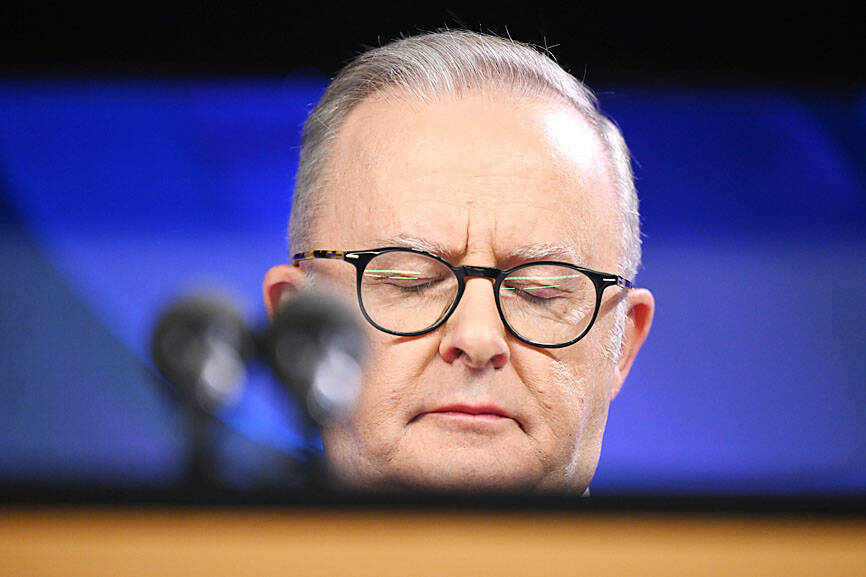
Photo: EPA
The package, which takes effect from next year, addresses an issue that has gnawed at Albanese’s government, although it commands a record majority in parliament.
Cross-benchers say Albanese has been too slow to address gambling, a problem that was forecast to cost Australians A$34 billion (US$23 billion) last year, the most per capita in the world.
Public health experts say the true cost is even higher, as the losses often lead to treatment for depression and gambling and alcohol addiction.
“Not a single parent in this country would opt in to their kids seeing gambling ads,” Alliance for Gambling Reform chief advocate Tim Costello said, referring to a feature of the new law that requires an Internet user to opt out if they do not want to see ads.
“The government should not claim they are protecting kids from gambling advertising by asking parents to opt out. The onus should be squarely on the gambling companies and the platforms,” Costello said.
Albanese stood by the new rules, which he called “the most significant reform on gambling that has ever been implemented.”
“The government is taking decisive action to tackle the community and public health concerns associated with gambling,” he said in a statement.

Through the noise of rushing papers and whirring belts at a print factory in Kyoto, two creators watch their photo essay come to life in broadsheet form — part of an effort to win new audiences in the age of artificial intelligence (AI). Despite the decline of the publishing industry, self-publication and handmade “zine” magazines are growing in popularity in Japan, reflecting the nation’s enduring love of paper in the digital era. While speaking to Agence France-Presse at the plant, his hands black with ink, one of the creators, Kazuma Obara, said: “I think [paper] is a medium that engages all five
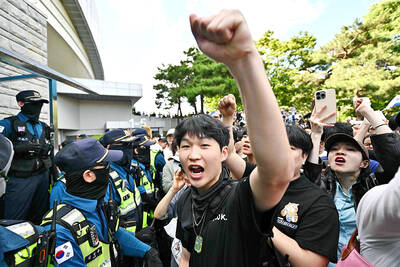
‘ABSURD MISTAKE’: The election commission said that there had been a failure to anticipate turnout after 14 polling stations ran short of ballot papers South Korean riot police yesterday cleared protesters from a Seoul polling station after a 35-hour blockade sparked by a shortage of ballot papers during local elections earlier this week. Wednesday’s election was the first nationwide vote since South Korean President Lee Jae-myung took office following the ouster of Yoon Suk-yeol over his short-lived martial law declaration. Lee’s ruling Democratic Party swept most races, but failed to flip the crucial Seoul mayoral seat. The South Korean National Election Commission apologized, blaming a failure to anticipate turnout after 14 polling stations in Seoul ran short of ballot papers. Some polling stations stayed open until 10pm to

Australian researchers have trained lab-grown brain cells on a silicon computer chip to play the 1990s shooter game Doom and said they are just scratching the surface of what the neurons could be capable of doing. It is the science-fiction work of biotech boffins at Cortical Labs, who researched and developed the technology that harnesses the workings of the brain’s networking system. Each so-called “biological computer” contains about 200,000 living human brain cells, grown from stem cells that were harvested from blood donations. Having mastered the simple computer game Pong, where a paddle is moved up and down to send a ball

France experienced its hottest spring on record, the French weather service said on Tuesday, after an exceptional early heat wave that also broke highs for the season in England and Wales. Meteo-France said the average nationwide temperature over March to May was 13.8°C — about 1.7°C above the norm, and surpassing records set in 2011 and 2020. “The warmest spring since records began in 1900,” it said in a bulletin. All three months were warmer than average, but the onset of an “unprecedented heatwave” late last month pushed the mercury to highs typically seen at the height of the summer. “Our country had never


 RSS
RSS