


A magnitude 7.4 earthquake struck yesterday off eastern Indonesia, killing one person, damaging buildings and sending people running into the streets in panic.
The early-morning tremor in the Molucca Sea between the Sulawesi and Maluku island groups triggered waves up to 75cm high and prompted a tsunami warning that was subsequently lifted.
“I didn’t know what to do. I was just trying to save my family,” street food vendor Siti Rohayati, 58, told reporters of the moment the quake hit during the breakfast rush in Manado in North Sulawesi Province. “All that mattered was getting my children away safely. I pushed all three of them and told them: ‘Run.’”
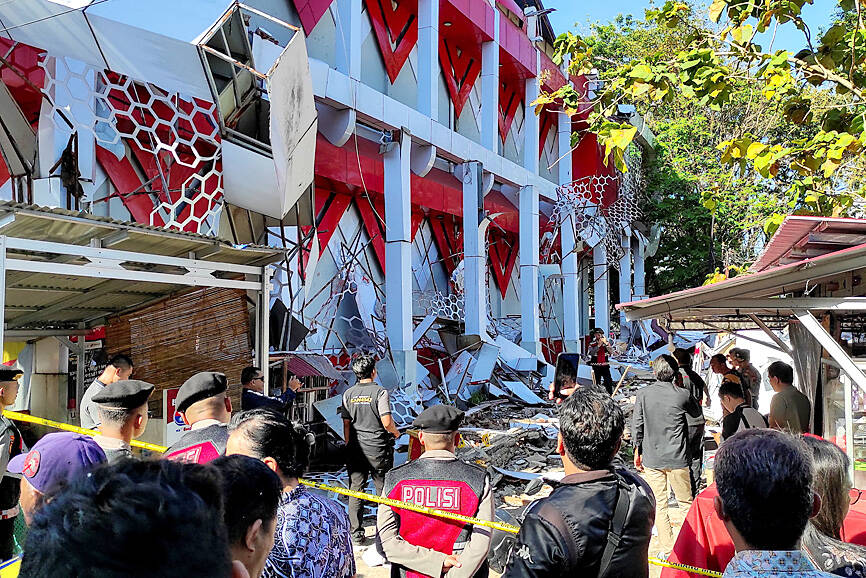
Photo: Reuters
One person was killed when a building collapsed in Manado, said George Leo Mercy Randang, the region’s search and rescue chief.
The person was “buried under the rubble,” he said.
Agency spokesman Nuriadin Gumeleng later said that three people in Manado sustained light injuries.
The US Geological Survey (USGS) said the tremor hit at a shallow depth of 35km.
The Hawaii-based Pacific Tsunami Warning Center initially said that hazardous tsunami were possible within 1,000km of the epicenter along the coasts of Indonesia, the Philippines and Malaysia.
Elevated waves were observed in nine locations in North Maluku, North Sulawesi and Gorontalo provinces, with the highest hitting 75cm in North Minahasa, Indonesia’s BMKG geological agency said.
The Pacific center lifted its warning just over two hours after the tremor, saying the tsunami threat “has now passed.”
Budi Nurgianto, a 42-year-old resident of Ternate in North Maluku province, said he was inside his house when the tremor struck, sending people outside in terror.
“The quake was felt strongly. I heard it first from the walls of the house that shook,” he said. “When I went outside, there were many people outside. They were panicked. The quake was felt [for] quite long, more than a minute. I even saw some people leaving their house without having finished their shower.”
Dozens of aftershocks rippled through the area after the main quake, Teuku Faisal Fathani, the head of the Indonesian geological agency, told reporters in the capital, Jakarta.
One of them was magnitude 5.9, USGS data showed.
A reporter in Manado, about 300km west of Ternate by sea, said the shaking woke him and others in the city of about 450,000 people.
“I immediately woke up and left my house. People [were] immediately scrambling outside. There is a school and the pupils rushed outside,” he said.
The shaking persisted for “quite long,” but he did not see “significant damage,” he added.
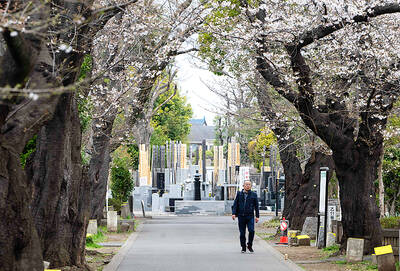
ROCKY RELATIONS: The figures on residents come as Chinese tourist numbers drop following Beijing’s warnings to avoid traveling to Japan The number of Chinese residents in Japan has continued to rise, even as ties between the two countries have become increasingly fractious, data released on Friday showed. As of the end of December last year, the number of Chinese residents had increased by 6.5 percent from the previous year to 930,428. Chinese people accounted for 22.6 percent of all foreign residents in Japan, making them by far the largest group, Japanese Ministry of Justice data showed. Beijing has criticized Tokyo in increasingly strident terms since Japanese Prime Minister Sanae Takaichi last year suggested that a military conflict around Taiwan could

Germany is considering Australia’s Ghost Bat robot fighter as it looks to select a combat drone to modernize its air force, German Minister of Defense Boris Pistorius said yesterday. Germany has said it wants to field hundreds of uncrewed fighter jets by 2029, and would make a decision soon as it considers a range of German, European and US projects developing so-called “collaborative combat aircraft.” Australia has said it will integrate the Ghost Bat, jointly developed by Boeing Australia and the Royal Australian Air Force, into its military after a successful weapons test last year. After inspecting the Ghost Bat in Queensland yesterday,
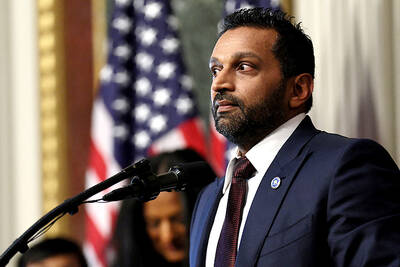
A pro-Iran hacking group claimed to breach FBI Director Kash Patel’s personal e-mail inbox and posted some of the contents online. The e-mails provided by the hacking group include travel details, correspondence with leasing agents in Washington and global entry, and loyalty account numbers. The e-mail address the hackers claim to have compromised has been previously tied to Patel’s personal details, and the leaked e-mails contain photos of Patel and others, in addition to correspondence with family members and colleagues. “The FBI is aware of malicious actors targeting Director Patel’s personal email information,” the agency said in a statement on
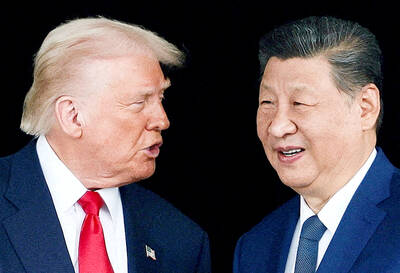
RIVALRY: ‘We know that these are merely symbolic investigations initiated by China, which is in fact the world’s most profligate disrupter of supply chains,’ a US official said China has started a pair of investigations into US trade practices, retaliating against similar probes by US President Donald Trump’s administration as the superpowers stake out positions before an expected presidential summit in May. The move, announced by the Chinese Ministry of Commerce on Friday, is a direct mirror of steps Trump took to revive his tariff agenda after the US Supreme Court last month struck down some of his duties. “China expresses its strong dissatisfaction and firm opposition to these actions,” a ministry spokesperson said in a statement, referring to the so-called Section 301 investigations initiated on March 11.


 RSS
RSS