


A New Mexico jury on Tuesday determined that Meta knowingly harmed children’s mental health and concealed what it knew about child sexual exploitation on its social media platforms, a verdict that signals a changing tide against tech companies and the government’s willingness to crack down.
The landmark decision comes after a nearly seven-week trial, and as jurors in a federal court in California have been sequestered in deliberations for more than a week about whether Meta and YouTube should be liable in a similar case.
New Mexico jurors sided with state prosecutors who said that Meta — which owns Instagram, Facebook and WhatsApp — prioritized profits over safety, and violated parts of the state’s Unfair Practices Act.
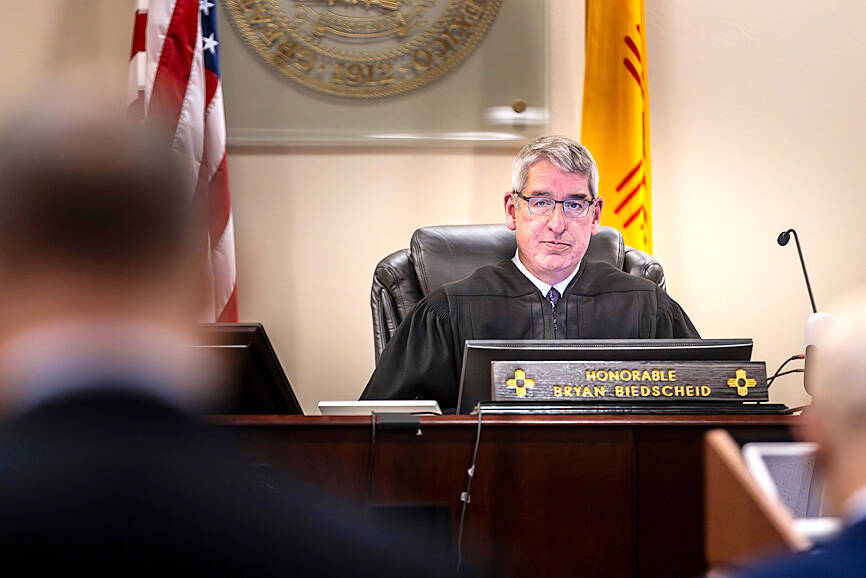
Photo: Nathan Burton, Santa Fe New Mexican via AP
The jury agreed with allegations that Meta made false or misleading statements and also agreed that Meta engaged in “unconscionable” trade practices that unfairly took advantage of the vulnerabilities of and inexperience of children.
Jurors found there were thousands of violations, each counting separately toward a penalty of US$375 million. That is less than one-fifth of what prosecutors were seeking.
Meta is valued at about US$1.5 trillion and the company’s stock was up 5 percent in early afterhours trading following the verdict, a signal that shareholders were shrugging off the news.
Juror Linda Payton, 38, said the jury reached a compromise on the estimated number of teenagers affected by Meta’s platforms, while opting for the maximum penalty per violation.
She said she thought each child was worth the maximum amount, US$5,000 for each violation.
The social media conglomerate would not be forced to change its practices right away. It would be up to a judge — not a jury — to determine whether Meta’s social media platforms created a public nuisance and whether the company should pay for public programs to address the harms. That second phase of the trial is to start in May.
A Meta spokesperson said the company disagrees with the verdict and would appeal.
New Mexico’s case was among the first to reach trial in a wave of litigation involving social media platforms and their effects on children.
More than 40 state attorneys general have filed lawsuits against Meta, claiming it is contributing to a mental health crisis among young people by deliberately designing Instagram and Facebook features that are addictive.
“Meta’s house of cards is beginning to fall,” said Sacha Haworth, executive director of watchdog group The Tech Oversight Project. “For years, it’s been glaringly obvious that Meta has failed to stop sexual predators from turning online interactions into real world harm.”
Haworth pointed to whistle-blowers such as Arturo Bejar, as well as unsealed documents and other evidence, saying it painted a damning picture.
New Mexico’s case relied on an undercover investigation where agents created social media accounts posing as children to document sexual solicitations and Meta’s response.
Tech companies have been protected from liability for content posted on their social media platforms under Section 230, a 30-year-old provision of the US Communications Decency Act, as well as a First Amendment shield.
New Mexico prosecutors said Meta should be responsible for its role in pushing out that content through complex algorithms that proliferate material that is harmful for children.
“We know the output is meant to be engagement and time spent for kids,” prosecuting attorney Linda Singer said. “That choice that Meta made has profound negative impacts on kids.”
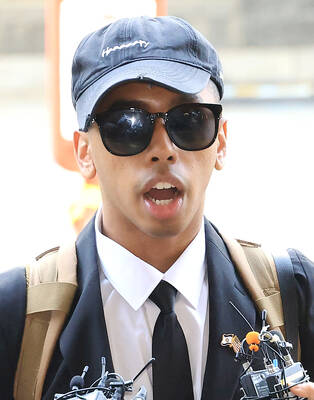
A US YouTuber who caused outrage for filming himself kissing a statue commemorating Korean wartime sex slaves has been sentenced to six months in prison, a court in Seoul said yesterday. Johnny Somali, 25, gained notoriety several years ago for recording himself doing a series of provocative stunts in South Korea and Japan, and streaming them on platforms such as YouTube and Twitch. South Korean authorities indicted Somali — whose real name is Ramsey Khalid Ismael — in 2024 on public order violations and obstruction of business, and banned him from leaving the country. “The court has sentenced him to six months in

Former Lima mayor Rafael Lopez Aliaga, a Peruvian presidential hopeful, gathered hundreds of supporters in Lima on Tuesday and gave authorities 24 hours to annul the first round of the country’s election over allegations of fraud. Lopez Aliaga is locked in a tight three-way race with two other candidates for second place in Sunday’s vote. The election runner-up wins a ticket to June’s presidential run-off against front-runner Keiko Fujimori. “I am giving them 24 hours to declare this electoral fraud null and void,” said Lopez Aliaga, surrounded by a crowd of several hundred supporters. “If it is not declared null and void tomorrow,
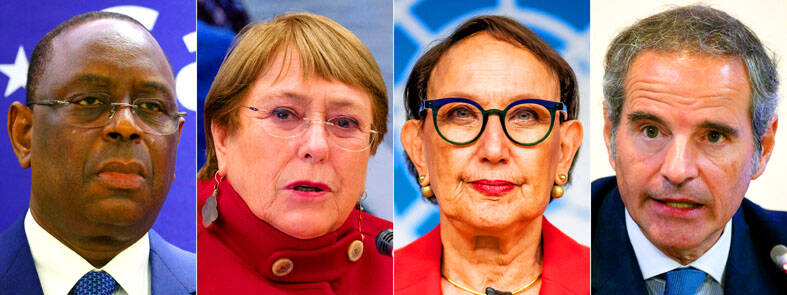
Four contenders are squaring up to succeed Antonio Guterres as secretary-general of the UN, which faces unprecedented global instability, wars and its own crushing budget crisis. Chile’s Michelle Bachelet, Argentina’s Rafael Grossi, Costa Rica’s Rebeca Grynspan and Senegal’s Macky Sall are each to face grillings by 193 member states and non-governmental organizations for three hours today and tomorrow. It is only the second time the UN has held a public question-and-answer, a format created in 2016 to boost transparency. Ultimately the five permanent members of the UN’s top body, the Security Council, hold the power, wielding vetoes over who leads the

A humanoid robot that won a half-marathon race for robots in Beijing on Sunday ran faster than the human world record in a show of China’s technological leaps. The winner from Honor, a Chinese smartphone maker, completed the 21km race in 50 minutes and 26 seconds, said a WeChat post by the Beijing Economic-Technological Development Area, also known as Beijing E-Town, where the race began. That was faster than the human world record holder, Ugandan Jacob Kiplimo, who finished the same distance in about 57 minutes in March at the Lisbon road race. The performance by the robot marked a significant step forward


 RSS
RSS