


The leaders of Colombia and Ecuador on Tuesday sparred over allegations that the Ecuadoran bombing of suspected criminal hideouts near their shared border had spilled into Colombian territory.
Months of tension between Colombian President Gustavo Petro and Ecuadoran President Daniel Noboa spiked on Monday when Petro alleged that an explosive was dropped from a plane near the border.
On Tuesday, Petro posted on X a photograph of an unexploded “bomb” that he said had fallen on the border between Colombia and Ecuador.
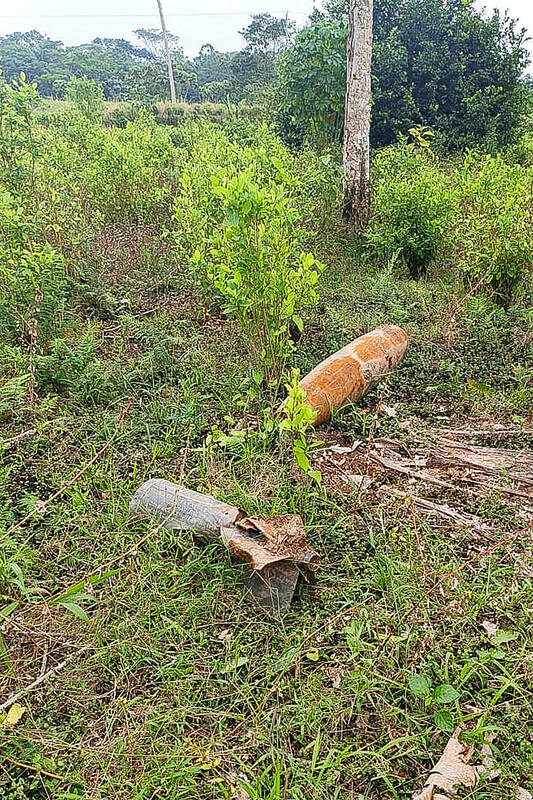
Photo: AFP
He called for a thorough investigation, saying: “It fell 100 meters from the home of a poor family.”
“It’s a bomb that can only be — I don’t want to say fired, but maybe dropped without intending to fire it — from a plane,” Petro said during a speech on Tuesday, adding that it “was not from a small plane, much less a drone.”
Experts said the munition is believed to be a “freefall bomb” that is not guided, falling by the force of gravity.
A Colombian armed forces spokesperson told reporters that bomb disposal teams successfully deactivated the device on Tuesday night.
Local farmers speaking with reporters corroborated Petro’s account.
“We were all terrified — you know, scared — and worried that those devices might suddenly explode and take our lives,” farmer Julian Imbacuan told reporters by phone.
Colombian Minister of National Defense Pedro Sanchez implored residents to avoid the area, announcing later on Tuesday that troops had been deployed there.
Noboa on Tuesday wrote on X that Ecuador is “currently bombing locations that served as hideouts” for criminal groups that are “largely Colombian, and which your government allowed to infiltrate our country due to negligence regarding your border.”
“President Petro, your statements are false,” Noboa said. “We are operating within our own territory, not yours.”
Petro said that “there are 27 charred bodies and Noboa’s explanation is not credible,” without specifying if he was referring to recent casualties.
Reporters contacted the army, which was unable to clarify Petro’s comment.
Colombia and Ecuador share a 586km border, along which Colombian guerrilla groups and criminal organizations from both countries operate.
They engage in the trafficking of drugs, weapons and people, as well as illegal mining.
The countries faced a similar rise in tensions in 2008 when then-Colombian president Alvaro Uribe ordered a strike on Ecuadoran soil to take out a guerilla commander.
Ecuador recently began anti-drug operations with US support and also joined the “Shield of the Americas,” a 17-nation coalition set up by US President Donald Trump this month to combat drug trafficking in the region.
Colombia is not in the group.
About 70 percent of the cocaine produced in Colombia and Peru — the world’s largest producers of the drug — transits through Ecuador to be exported via its Pacific ports.

SPEAKING OUT: After Siranudh Scott’s allegations surfaced, celebrities and public figures took to social media to share their own experiences of sexual misconduct and abuse A high-profile alleged sexual abuse case within a wealthy Thai beer brewing family has prompted a wave of painful accounts from survivors of unconnected abuse in the conservative nation. Siranudh Scott, a member of the billionaire Thai family that founded the ubiquitous Singha beer brand, posted an emotional video this month accusing his elder brother Sunit of repeatedly abusing him when he was a teenager. Sunit, who is in his 30s, later denied the allegations in a video posted online, but Singha parent Boonrawd dismissed him from his executive role with the company on Tuesday last week. “I felt I needed to speak

SEEKING ORDER: Rodrigo Paz said that ‘anyone who wants to destroy the nation will have to deal with this president and the full force of the constitution’ Bolivian President Rodrigo Paz on Wednesday said that the nation was at a “breaking point” after nearly a month of protests that have caused shortages of food, fuel and medicine. Paz, who took office six months ago amid the worst economic crisis there in four decades, is battling a groundswell of fury over his policies. The political capital, La Paz, has been besieged by low-income workers and members of the indigenous majority calling for his resignation. “The country needs order and is reaching breaking point,” the 58-year-old said at a public event in La Paz, renewing his appeal for dialogue. On Tuesday, the Bolivian

A Hong Kong astronaut is to join a Chinese space mission for the first time as part of a three-person crew launching today, as Beijing edges closer to its goal of landing people on the moon. The Tiangong space station — crewed by teams of three astronauts that are typically rotated every six months — is the crown jewel of China’s space program, boosted by billions in state investment in a bid to catch up with the US and Russia. The Shenzhou-23 mission is to blast off at 11:08pm from the Jiuquan Satellite Launch Center in northwestern China, carrying three astronauts to
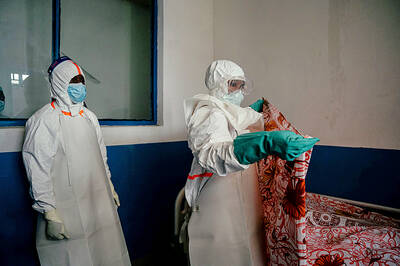
UPGRADED ALERT: The risk inside DR Congo is now considered ‘very high,’ while neighboring countries face a ‘high’ threat as the outbreak continues, the WHO said Ebola is spreading faster than responders can track it in eastern Congo, where health workers managed to follow up with barely one in five identified contacts in a single day. Authorities in the Democratic Republic of the Congo (DR Congo) reported 83 confirmed infections, 746 suspected cases and 1,603 identified contacts as of Thursday, but health workers were able to follow up on only 342 contacts that day — about 21 percent of the total under monitoring — data released by the DR Congo Ministry of Public Health on Friday showed. The figures suggest the response is falling behind the outbreak itself,


 RSS
RSS