


Salvadorans who were deported from the US have been arbitrarily detained in El Salvador and have disappeared into the Central American nation’s prison system, a Human Rights Watch report released on Monday said.
The detainees featured in the report are among more than 9,000 Salvadorans deported from the US since the beginning of US President Donald Trump’s second administration in January last year. Some of them were deported alongside Venezuelans and sent to the Center for Terrorism Confinement, a prison in El Salvador also known as CECOT, according to the New York-based human rights group.
The report did not say exactly how many people are subject to arbitrary detention. The group interviewed 20 relatives and lawyers of 11 Salvadorans who were deported from the US between March and October last year and were immediately detained in El Salvador.
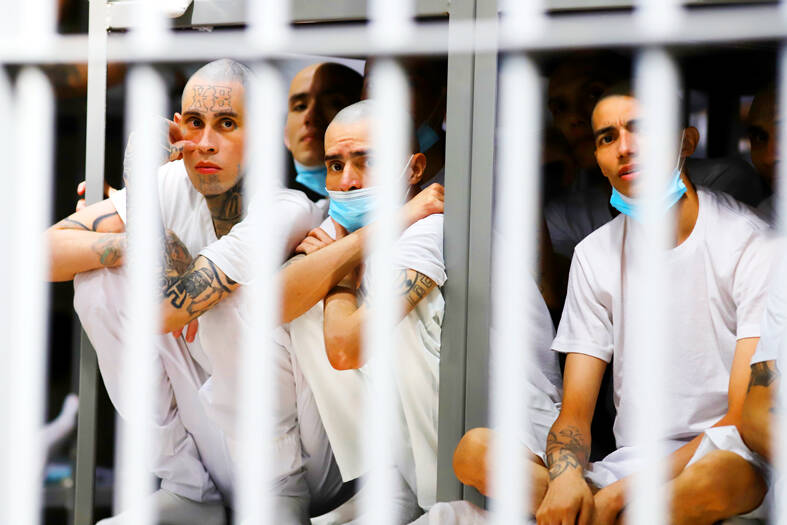
Photo: AP
The detainees cannot communicate with their families or talk to lawyers, the group said.
“They have a right to due process, to be taken before a judge, and their relatives are entitled to know where they are being held and why,” said Juanita Goebertus, the Americas director at Human Rights Watch. “Deportation cannot mean enforced disappearance.”
The Salvadoran Presidential Office did not respond to a request for comment on the report.
Detainees disappearing into El Salvador’s prison system has become a regular phenomenon since Salvaoran President Nayib Bukele declared a “state of emergency” in March 2022 to suppress the nation’s gangs.
The once temporary measure, which has been extended for nearly four years, suspends key constitutional rights and has led to about 91,300 people being detained in El Salvador.
Bukele says 8,000 innocent people have been released.
Most have been detained based on scant evidence and vague accusations. Detainees have very little access to due process — prisoners are often judged in mass trials and lawyers regularly lose track of their clients.
Prisons have been accused of human rights abuses for years. Rights groups have documented cases of beatings by prison guards, sexual abuse and deteriorating prison conditions. Detainees’ families often agonize, unsure if they will ever see their loved ones again.
Human Rights Watch said Salvadoran authorities have provided no information suggesting any of the detainees have been brought before a judge.
The relatives and lawyers of some of the detainees say they do not know where they are being held or why, the report said.
In five cases, relatives knew the deportees’ whereabouts through litigation at the Inter-American Commission on Human Rights.
Many of the Salvadoran deportees have family in the U.S.
“I still know nothing about my son, nothing,” said a 47-year-old mother of a Salvadoran who was deported on March 15 last year. “I want information. I want someone to tell me that my son is OK, that he’s alive.”
The woman, who lives in Maryland without legal status, said she last talked to her 29-year-old son when he called her about three days before he was deported. She said she discovered her son was in El Salvador six months after the deportation, when she saw a photograph that Bukele posted online showing detainees at CECOT.
The woman asked not to be identified for fear of being arrested in the US. She also asked that her son’s identity be kept anonymous.
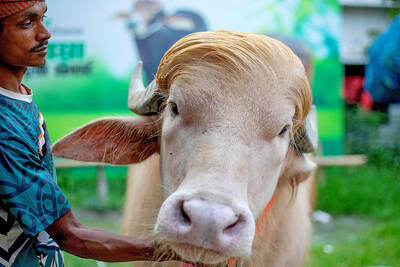
Crowds in Bangladesh are flocking to snap photographs with an unlikely social media star — an albino buffalo with flowing blond hair nicknamed “Donald Trump” that is due to be sacrificed within days. Owner Zia Uddin Mridha, 38, said his brother named the 700kg bull over its flowing helmet of hair resembling the signature look of the US president. “My younger brother picked this name because of the buffalo’s extraordinary hair,” he said at his farm in Narayanganj, just outside the capital, Dhaka. Mridha said that a constant stream of curious visitors — social media fans, onlookers and children — have come throughout

It began as a satirical online project. Now millions of young people in India are flocking to it as an outlet for their frustration. A parody political party called the Cockroach Janta Party, with the insect as its symbol, has exploded across India’s social media by turning absurdist humor into protest. Memes and short videos mocking corruption, joblessness and political dysfunction have flooded social media sites, where millions of users are embracing the cockroach — known for its ability to survive harsh conditions — as a tongue-in-cheek symbol of endurance. The online movement’s rise has been unusually rapid. The Cockroach Janta Party (CJP)
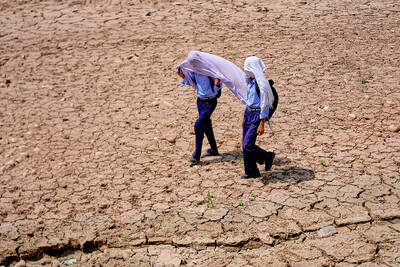
HOTTER: While Indians are accustomed to summer heat, climate change has caused northwestern India to warm faster than other parts of the country, an academic said Roads and markets have emptied during afternoons and some farmers have switched to nighttime work to avoid scorching temperatures as a heat wave grips large parts of India. The India Meteorological Department forecast maximum temperatures for yesterday of about 45°C in the capital, New Delhi, where authorities have opened temporary “cooling zones” to help people cope. The weather department warned that conditions would likely persist across several northern regions in the coming days, with temperatures staying well above seasonal averages. Authorities urged people to stay indoors during the hottest hours and take precautions against heat-related illnesses. India declares a heat wave whenever maximum temperatures

SPEAKING OUT: After Siranudh Scott’s allegations surfaced, celebrities and public figures took to social media to share their own experiences of sexual misconduct and abuse A high-profile alleged sexual abuse case within a wealthy Thai beer brewing family has prompted a wave of painful accounts from survivors of unconnected abuse in the conservative nation. Siranudh Scott, a member of the billionaire Thai family that founded the ubiquitous Singha beer brand, posted an emotional video this month accusing his elder brother Sunit of repeatedly abusing him when he was a teenager. Sunit, who is in his 30s, later denied the allegations in a video posted online, but Singha parent Boonrawd dismissed him from his executive role with the company on Tuesday last week. “I felt I needed to speak


 RSS
RSS